Vanilla Swiss roll
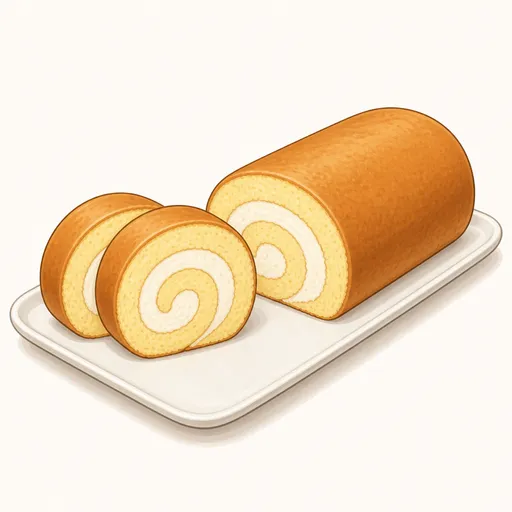
A vanilla Swiss roll has a thin, soft and wonderfully flexible sponge that rolls up without cracking, wrapped around a cool layer of vanilla whipped cream. Each slice shows a pretty spiral of white and gold, making it lovely for afternoon tea or as a gift.
- Difficulty
- Medium
- Prep
- 40 min
- Cook
- 15 min
- Rising or chilling
- 1 hr 30 min
- Total time
- 2 hr 25 min
- Method
- Oven-baked
Ingredients
Yolk batter
Whipped egg whites (meringue)
Vanilla whipped cream filling
Instructions
Step 1
Heat the oven to 170°C and cut parchment paper to line a 25 by 35 cm rectangular tray completely, letting the paper rise a little above the sides. Lining the whole tray lets the thin sponge release easily without tearing. The tray is ready when the paper lies flat, the corners are neatly folded and there are no bumps.
Step 2
Whisk 80 g egg yolks with 20 g granulated sugar, then add 45 g whole milk, 35 g vegetable oil and 3 g vanilla extract. The oil keeps the sponge soft and pliable so you can roll it while it is still warm. The mixture is ready when it is bright yellow, smooth and the oil is fully blended in.
Step 3
Sift 65 g cake flour and a pinch salt into the yolk bowl and stir in a figure-eight motion until the dry flour just disappears. Mixing only as much as needed keeps the sponge from turning tough and hard to roll. The batter is ready when it is smooth and saucy, with no lumps.
Step 4
Whip 140 g egg whites with 1 g cream of tartar on medium speed, and once the foam is fine, gradually add 50 g superfine sugar and keep whipping for about five minutes. A rolled cake needs a softer meringue than a tall cake so the sponge stays supple rather than brittle. The meringue is ready when it is glossy and smooth and the peak folds over like a hook.
Step 5
Stir one third of the meringue into the yolk batter until combined, then fold in the rest gently in two additions. Adding it in stages brings the two mixtures to a similar consistency so they blend quickly. The batter is ready when it is light, evenly colored and flows slowly off the lifted whisk.
Step 6
Pour the batter onto the tray, spread it into the corners with an offset spatula, tap the tray twice and bake at 170°C for about 12 to 15 minutes. A thin layer bakes very quickly, and baking it longer would dry the sponge so it cracks when rolled. It is done when the top is pale golden, does not stick to your finger and the edges pull slightly away from the paper.
Step 7
Immediately flip the sponge onto a fresh sheet of parchment, peel off the old paper, roll the cake up with the paper while it is still warm and let it cool for about 30 minutes. Rolling it warm helps the cake remember its shape, so it will not crack when you roll it again with the cream. It is ready when the roll is completely cool and keeps its round shape.
Step 8
Whip 200 g cold whipping cream with 20 g powdered sugar and 2 g vanilla extract on medium speed. The colder the cream and bowl, the faster the cream whips and the longer it holds its shape. The cream is ready when it is soft and fluffy and forms standing peaks while the surface stays silky.
Step 9
Unroll the cake, spread the cream evenly over the surface, leaving about two centimeters bare at the far edge, then roll it up snugly and keep the parchment wrapped around the outside. Leaving that border keeps the cream from squeezing out as you reach the end. The roll is ready when it is evenly round and tight, with the seam underneath.
Step 10
Twist both ends of the parchment like a candy wrapper and chill the roll in the fridge for about an hour. Chilling sets the cream so the roll holds its shape when sliced. It is ready when it feels firm to the touch and the cream does not give.
Step 11
Trim both ends of the roll neatly with a serrated knife dipped in hot water, then cut it into slices about two centimeters thick. A hot knife glides through the sweet cream without dragging the roll out of shape. The slices are just right when each cut face shows a clear spiral and the cream is not pushed out.
Equipment
- Oven
- Rectangular pan
- Parchment paper
- Hand mixer
- Whisk
- Spatula
- Sieve
- Mixing bowl
- Kitchen scale
- Wire cooling rack
- Refrigerator
Tips
- To keep the sponge from cracking, roll it along the short side and score a few shallow lines along the starting edge before rolling.
- You can scatter diced fruit such as strawberries or mango over the cream before rolling.
- If your oven heats unevenly, rotate the tray after about seven minutes of baking.
Storage
Because of the whipped cream filling, keep the roll in the fridge, wrapped tightly in plastic wrap, and enjoy it within three days. It tastes best taken out of the fridge about ten minutes before serving.
Common problems and how to fix them
- The sponge cracks as you roll it.
- The cake was baked too long or left to cool before rolling. Cut the baking time by one to two minutes and roll it as soon as it comes out of the oven.
- The cream runs and the roll slumps.
- The cream was not whipped enough or the sponge had not cooled completely. Wait until the sponge is fully cool and whip the cold cream until it holds standing peaks.
This recipe is based on the common ratios for this bake and is written entirely in our own words.