Vanilla chiffon cake
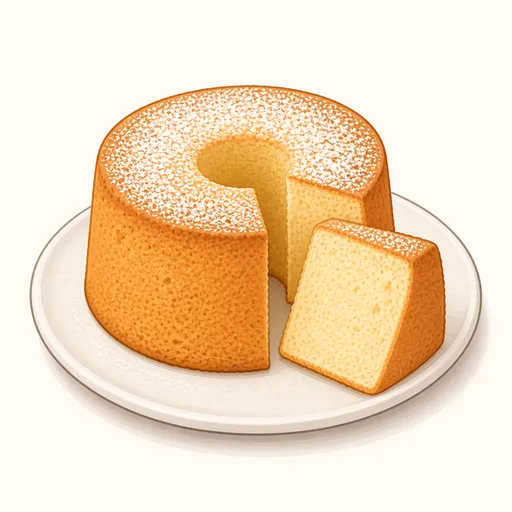
Chiffon is a sponge cake made with oil instead of butter, which gives it a soft, moist, cloud-light crumb that stays tender even in the fridge. It's baked in a tube pan and cooled upside down so it doesn't collapse, and it's lovely with tea or as a base for layer cakes.
- Difficulty
- Medium
- Prep
- 30 min
- Cook
- 45 min
- Rising or chilling
- 1 hr 30 min
- Total time
- 2 hr 45 min
- Method
- Oven-baked
Ingredients
For the yolk batter
For the meringue
Instructions
Step 1
Preheat the oven to 160°C for at least fifteen minutes, with a rack in the middle or one notch lower. Don't grease the tube pan, because chiffon batter needs to cling to the sides of the pan to climb as it rises. The oven is hot enough when the heating light turns off for the first time.
Step 2
Separate the eggs while they're still cold, putting 90 g egg yolks in one bowl and 160 g egg whites in another bowl that's perfectly clean, dry and free of grease. Even a trace of yolk makes the whites hard to whip. The whites are ready when they're completely clear with no streaks of yellow.
Step 3
Add 15 g granulated sugar and a pinch salt to the yolks, whisk them together, then add 70 g whole milk, 45 g vegetable oil and 4 g vanilla extract one at a time. Mix well so the oil and milk blend together, giving the cake a moist, fine crumb. The mixture is ready when it's uniform, slightly thick and has no oil floating on top.
Step 4
Sift 90 g cake flour and 2 g baking powder directly into the yolk mixture, then whisk in a zigzag motion until all the flour has dissolved. Whisk gently and not for too long, so the batter doesn't turn tough. The batter is ready when it's smooth, as thick as thin condensed milk and free of dry lumps.
Step 5
Whip the egg whites on medium speed until large bubbles form, then add 1 g cream of tartar and add 60 g superfine sugar in three additions about a minute apart. Adding the sugar gradually makes the bubbles small, glossy and more stable when folded. The meringue is ready when lifting the whisk leaves a peak that stands upright with a slightly bent tip, like a bird's beak.
Step 6
Spoon about a third of the meringue into the yolk batter and mix well to lighten it, then pour it all back into the remaining meringue and fold from the bottom up with a spatula. Folding preserves the air bubbles, which are what make the cake rise tall. The batter is ready when it's an even color with no white streaks and still airy, falling from the spatula in a thick ribbon.
Step 7
Pour the batter into the tube pan from a height of about ten centimeters, run a chopstick around through the batter once to pop large air bubbles, then tap the pan lightly on the counter twice. Bake at 160°C for about 40 to 45 minutes, until the cake has risen high and the top is golden brown. It's done when the top springs back when pressed lightly and a skewer inserted in the center comes out dry.
Step 8
Take the cake out of the oven, drop the pan onto the counter once from about ten centimeters up to release the hot air, then turn the pan upside down over a bottle or rack and let it cool completely for about an hour and a half. Hanging upside down lets the cake's own weight stretch the crumb instead of crushing it. The cake is ready when the sides of the pan feel completely cool to the touch.
Step 9
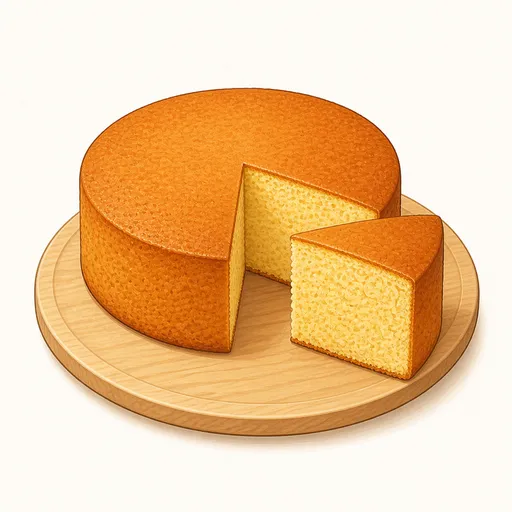
Turn the pan right side up, run a thin knife closely around the sides and around the center tube, then push up the base and slide the knife underneath to release the cake. Keeping the knife close to the pan prevents the outer crust from tearing. The cake is ready when it stands straight and evenly tall, with a fine crumb of tiny air holes; you can dust a little powdered sugar on top before slicing.
Equipment
- Oven
- Tube pan (chiffon pan)
- Hand mixer
- Whisk
- Spatula
- Sieve
- Kitchen scale
- Mixing bowl
Tips
- Cold eggs are easier to separate, but room-temperature whites whip up faster, so separate the eggs straight from the fridge and let the whites rest for about fifteen minutes before whipping.
- If you don't have cream of tartar, a few drops of lemon juice will help stabilize the meringue instead.
- An uncoated aluminum tube pan gives the best results, since the batter needs to cling to the sides of the pan to climb as it rises.
Storage
Wrapped tightly in plastic wrap, the cake stays soft at room temperature for a day. You can keep it in the fridge for up to four days; let it sit at room temperature for about twenty minutes before serving so the crumb softens again.
Common problems and how to fix them
- The cake sinks or shrinks after coming out of the oven.
- This usually means the cake wasn't fully baked or wasn't turned upside down right away. Next time, bake it five minutes longer and invert the pan as soon as it leaves the oven.
- There's a dense, wet layer at the bottom of the cake.
- The meringue started to weep or wasn't folded in evenly, so the heavy batter sank to the bottom. Whip the whites just to the bird's-beak stage, not too dry, and fold thoroughly until no white streaks remain.
- The top cracks wide open and scorches.
- The oven was too hot or the pan sat too close to the top heating element. Move the pan down one notch and use an oven thermometer to check the actual temperature.
This recipe is based on the common ratios for this bake and is written entirely in our own words.