Vietnamese pork steamed buns (banh bao)
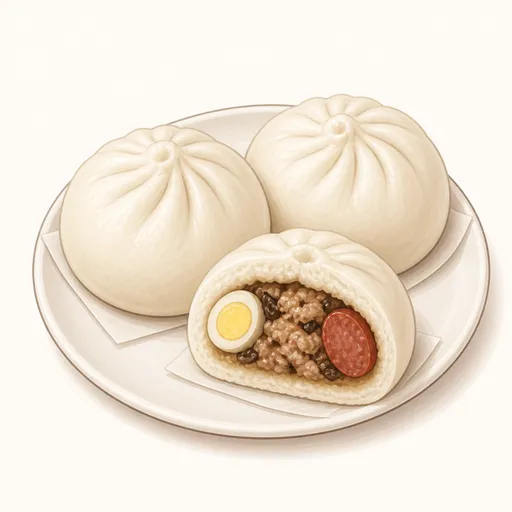
Pork-filled steamed buns are a familiar breakfast on streets all over Vietnam, with a white, fluffy, faintly sweet dough wrapped around a juicy pork filling. Each bun hides a quail egg and a slice of ruby-red Chinese sausage, and the moment you break one open, the aroma of onion and wood ear mushrooms fills the air.
- Difficulty
- Medium
- Prep
- 1 hr
- Cook
- 18 min
- Rising or chilling
- 1 hr 30 min
- Total time
- 2 hr 48 min
- Method
- Steamed
Ingredients
Bun dough
Pork filling
Instructions
Step 1
Mix together 500 g bao flour, 60 g granulated sugar, 6 g instant yeast, 8 g baking powder and 3 g salt, pour in 260 g warm whole milk and knead, then add 30 g lard and knead for about ten minutes more. Kneading long enough develops the elasticity the dough needs to trap air, which makes the buns fine and fluffy. The dough is ready when it is smooth, not sticky and stretches into a thin membrane.
Step 2
Shape the dough into a ball, place it in a lightly oiled bowl, cover tightly with plastic wrap and let it rise in a warm place for about an hour. The yeast needs time and warmth to produce gas, which makes the buns light and fragrant. The dough is ready when it has nearly doubled and a fingertip dent springs back very slowly.
Step 3
Soak 10 g dried wood ear mushrooms in warm water for about fifteen minutes and chop them finely, dice 80 g onion and mince 20 g shallots, then mix everything with 400 g ground pork, 15 g fish sauce, 8 g granulated sugar and 2 g ground black pepper; slice 80 g Chinese sausage on the diagonal and peel 100 g boiled quail eggs. The onion keeps the filling moist and juicy, while the wood ear mushrooms add a pleasant crunch. The filling is ready when the seasoning is evenly mixed and the meat is sticky and holds together.
Step 4
Punch down the dough to release the gas, knead it a few times, then weigh and divide it into ten equal pieces, roll them into balls and cover with a towel. Equal pieces help the buns cook at the same rate and look uniform on the plate. The dough is ready when each ball is taut and smooth with no creases.
Step 5
Roll each ball into a round about twelve centimeters across, with the edges thinner than the center, place a portion of pork filling, a slice of sausage and a quail egg in the middle, then pleat around the edge and twist it closed at the top. Thin edges keep the pleats from bunching into a thick knot at the top, while a thicker base holds in the meat juices. The buns are ready when the pleats are even, the tops are sealed and each bun stands steadily on a square of parchment paper.
Step 6
Set each bun on its parchment square, arrange them in the steamer about three centimeters apart and let them rest for another twenty minutes. The second rise relaxes the dough and puffs it up further, so the buns steam up round and smooth without cracking. They are ready when they have visibly puffed and feel lighter than when you first shaped them.
Step 7
Set the steamer over a pot of rapidly boiling water, wrap a towel around the lid so condensation does not drip onto the buns, and steam over high heat for about eighteen minutes. The raw pork filling needs enough time to cook through, and the towel keeps the dough smooth and white instead of pitted. The buns are done when the skin is taut and glossy, springs back when pressed lightly and a skewer pushed into the filling releases clear juices.
Step 8
Turn off the heat, open the lid just a crack and leave the buns in the steamer for about three minutes before taking them out. Letting them cool down gradually keeps the dough from shrinking suddenly and wrinkling. The buns are ready when their tops stay smooth and taut after you lift them out.
Equipment
- Steamer
- Mixing bowl
- Rolling pin
- Bench scraper
- Parchment paper
- Plastic wrap
- Kitchen scale
Tips
- If you do not have lard, you can use vegetable shortening or vegetable oil instead, but lard gives whiter, softer buns.
- The milk should be only about body temperature; milk that is too hot will kill the yeast and the dough will not rise.
- Adding a few drops of white vinegar to the steaming water helps the buns stay bright white.
Storage
Once cool, the buns can be wrapped tightly and kept in the fridge for about three days, or in the freezer for up to a month. To serve, steam them again for eight to fifteen minutes, depending on whether they come from the fridge or the freezer.
Common problems and how to fix them
- The buns wrinkle and shrink after steaming.
- The lid was opened too suddenly or the second rise went on too long. Shorten the second rise and always crack the lid for a few minutes before taking the buns out.
- The buns are tough and not fluffy.
- The dough did not rise enough the first time or the yeast is old. Check the yeast's expiration date and let the dough double in a warm place before dividing it.
- The bottoms are wet and stick to the paper.
- Water dripped from the lid or the steamer sat too close to the water. Wrap a towel around the lid and keep the water level at least three centimeters below the steamer basket.
This recipe is based on the common ratios for this bake and is written entirely in our own words.