Taro mousse cake
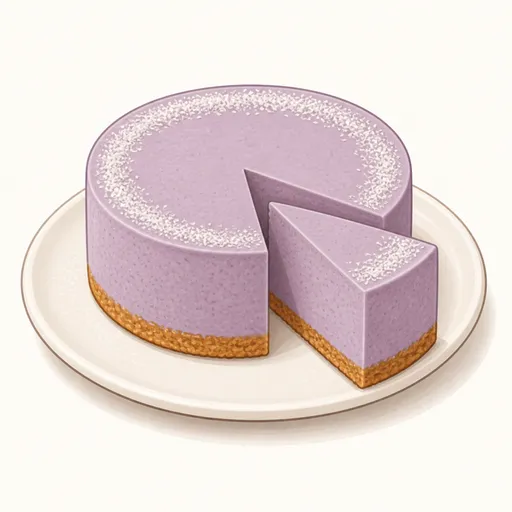
Taro mousse cake has a soft, pale purple color and the rich, nutty flavor of taro blended with coconut milk and cream, all on a buttery cookie-crumb base. The mousse is smooth but still keeps a little of taro's natural density, making this a chilled cake full of East Asian flavor.
- Difficulty
- Medium
- Prep
- 45 min
- Cook
- 25 min
- Rising or chilling
- 5 hr
- Total time
- 6 hr 10 min
- Method
- Chilled
Ingredients
For the cookie-crumb base
For the taro mousse
For decorating
Instructions
Step 1
Peel the taro, cut it into slices about two centimeters thick and steam them for about twenty minutes, then weigh out 300 g steamed taro. Even slices cook at the same time so none stay hard. The taro is ready when a chopstick passes through easily and the pieces are soft and crumbly.
Step 2
While the taro steams, mix 120 g digestive biscuit crumbs with 50 g melted unsalted butter, press it firmly into the bottom of an 18 cm springform pan and refrigerate it. A firmly packed, chilled base won't get soggy from the mousse. The base is ready when it's flat, even and firm to the touch.
Step 3
Put the hot taro in a blender with 150 g whole milk, 100 g coconut milk and 60 g granulated sugar, blend until very smooth, then strain it through a sieve. Hot taro purées more easily, and straining removes the fibers so the mousse is silky. The mixture is ready when it's smooth as cream, a pale purple-gray and free of lumps.
Step 4
Sprinkle 10 g powdered gelatin over 50 g cold water and wait about five minutes. Gelatin that has absorbed water first dissolves completely in the warm taro mixture. The gelatin is ready when it has swelled evenly with no white specks of powder left.
Step 5
Pour the taro mixture into a saucepan, warm it over low heat, then turn off the heat, stir in the gelatin until dissolved and let it cool to room temperature. Thick taro scorches easily, so it only needs to be warm enough to melt the gelatin. The mixture is ready when it has cooled, is as thick as a thin porridge and has no strands of gelatin left.
Step 6
Whip 250 g cold whipping cream for about three minutes until it reaches soft peaks. The taro mixture is fairly thick, so the cream only needs soft peaks to blend in easily. The cream is ready when it leaves ripples on the surface and the peaks droop gently.
Step 7
Fold the whipped cream into the taro mixture in three additions, pour it over the base, smooth the top with a flat spatula and tap the pan a few times to release air bubbles. Adding the cream in stages keeps the dense taro from deflating it. The mousse is ready when it's an even pale purple, smooth and level.
Step 8
Cover the pan and refrigerate the cake for about five hours or overnight. The gelatin and the taro starch need time in the cold for the mousse to set to the right firmness. The cake is ready when the top springs back when pressed lightly and doesn't leave a dent.
Step 9
Wipe the outside of the pan with a warm towel, release the cake, then sprinkle 15 g desiccated coconut over the top or around the edge. The coconut both decorates the cake and adds a rich, nutty note that goes beautifully with the taro. The cake is finished when the sides of the mousse are straight and smooth and the coconut is evenly scattered.
Equipment
- Steamer
- Blender
- Springform pan
- Small saucepan
- Hand mixer
- Spatula
- Sieve
- Kitchen scale
- Refrigerator
Tips
- Choose waxy taro with clear purple streaks for a fragrant, pretty mousse; for a deeper purple, you can add a little steamed purple sweet potato when blending.
- Wear gloves when peeling taro so your hands don't itch.
- You can roughly mash a little extra steamed taro and fold it into the mousse for chunky bits that stand out when you slice the cake.
Storage
Covered, the cake keeps for three days in the fridge. You can freeze it for up to two weeks and thaw it in the fridge for about four hours before serving.
Common problems and how to fix them
- The mousse tastes undercooked and has gritty bits.
- The taro wasn't steamed long enough or wasn't strained. Steam it until crumbly and strain the mixture through a sieve after blending.
- The mousse is too thick and hard to fold into the cream.
- The taro mixture sat cooling too long and started to set. Fold in the cream as soon as the taro has just reached room temperature, or warm it gently to loosen it again.
This recipe is based on the common ratios for this bake and is written entirely in our own words.