Basque burnt cheesecake
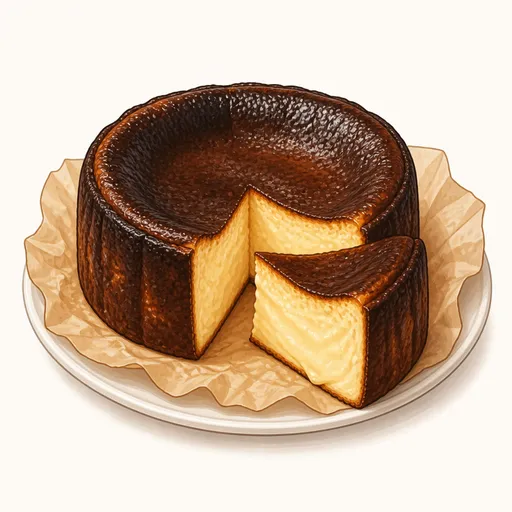
Basque burnt cheesecake comes from the city of San Sebastián in Spain's Basque Country and is known for its deeply caramelized, scorched top and creamy, custardy center. It has no crust, needs no water bath and is deliberately baked at very high heat, which makes it one of the easiest cheesecakes you can make.
- Difficulty
- Easy
- Prep
- 20 min
- Cook
- 40 min
- Rising or chilling
- 6 hr
- Total time
- 7 hr
- Method
- Oven-baked
Ingredients
Instructions
Step 1
Heat the oven to 230°C with a rack in the middle, and set the cream cheese, eggs and heavy cream out to come to room temperature. The oven must be very hot to create the signature burnt top in a short time. The oven is ready after about twenty minutes of preheating.
Step 2
Crumple two large sheets of parchment paper, flatten them out again and lay them crosswise in a 20 cm round pan so the paper rises at least five centimeters above the rim. Crumpled paper softens, hugs the pan and creates rustic folds around the sides of the cake. The pan is ready when the paper covers the bottom and sides with no gaps.
Step 3
Beat 600 g cream cheese with 180 g granulated sugar and a pinch salt on low speed for about three minutes. Low speed makes the cheese smooth without beating in too much air, which would make the cake puff up and then crack. The mixture is ready when it is silky with no lumps of cheese and the sugar has almost dissolved.
Step 4
Add 200 g eggs to the cheese one at a time, whisking until each is fully incorporated before adding the next. Adding the eggs gradually keeps the mixture thick and smooth rather than watery. The mixture is ready when it is an even creamy yellow and glossy.
Step 5
Pour in 250 g heavy cream and 4 g vanilla extract and stir well, then sift 15 g cake flour over the top and stir gently until it disappears. A small amount of flour gives the center enough structure to slice while staying soft and oozy in the middle. The batter is ready when it is as runny as drinkable yogurt with no specks of flour.
Step 6
Strain the batter through a sieve into the lined pan, then tap the pan on the counter a few times. Straining removes any remaining lumps of cheese, and tapping brings air bubbles to the surface. This step is done when the surface is perfectly flat with almost no bubbles.
Step 7
Bake at 230°C for 35 to 40 minutes, until the top is scorched a deep, dark brown. The high heat caramelizes the sugar on top while the center stays only partly set. The cake is ready when the edges are firm but the center wobbles like jelly when you gently shake the pan.
Step 8
Take the cake out and let it cool in the pan at room temperature for about two hours. It will sink and keep cooking gently in its own residual heat, which creates the creamy texture. It has cooled when the bottom of the pan no longer feels warm.
Step 9
Cover the pan with plastic wrap and refrigerate the cake for at least four hours, ideally overnight. Chilling sets the center just enough to cut neat slices. The cake is ready when the sides stand firm once you release the pan; then peel off the parchment and slice with a knife dipped in warm water.
Equipment
- Oven
- Springform pan
- Parchment paper
- Hand mixer
- Spatula
- Sieve
- Kitchen scale
- Mixing bowl
- Refrigerator
Tips
- If you like a runnier center, cut the baking time by about five minutes and serve the cake after chilling for just two hours.
- If your oven does not get hot enough to burn the top, you can switch on the top broiler for the last three to five minutes, but watch it closely.
- Cream cheese softened completely at room temperature is the most important secret to a lump-free center.
Storage
Covered tightly, the cheesecake keeps in the fridge for four to five days. Take it out about twenty minutes before serving so the center softens and the cheese flavor comes through. Do not freeze it, because the center will weep when thawed.
Common problems and how to fix them
- The top is only pale golden instead of burnt.
- Your oven runs cooler than its setting. Check it with an oven thermometer, then raise the temperature or move the pan up one rack.
- The center runs out when you slice it.
- The cake was not chilled long enough or was slightly underbaked. Chill it overnight, and next time bake it about five minutes longer.
This recipe is based on the common ratios for this bake and is written entirely in our own words.