New York cheesecake
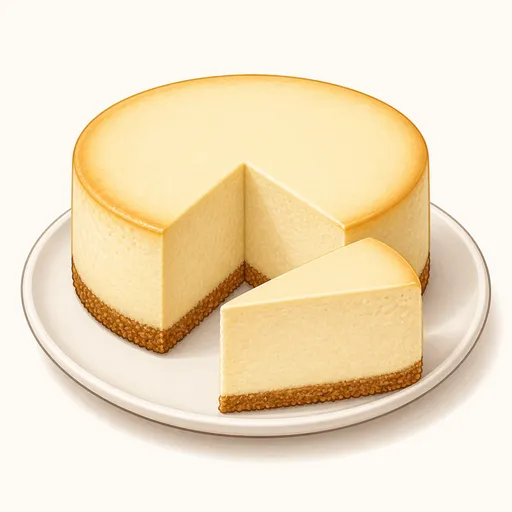
New York-style cheesecake is famous for its tall, dense filling that is as smooth as cream, deeply rich with a gentle tang from sour cream and lemon zest. A crisp, buttery cookie crust holds up the tall filling, and the cheesecake needs to rest overnight in the refrigerator to reach its signature firm, silky texture.
- Difficulty
- Medium
- Prep
- 40 min
- Cook
- 1 hr 35 min
- Rising or chilling
- 9 hr
- Total time
- 11 hr 15 min
- Method
- Oven-baked
Ingredients
Cookie crust
Cheesecake filling
Instructions
Step 1
Take 900 g cream cheese, 160 g sour cream and the eggs out of the refrigerator and leave them at room temperature for about one hour. Only fully softened cream cheese beats smooth without long mixing, so the filling has fewer air bubbles and won't crack. The cream cheese is right when a finger presses into it as easily as soft butter.
Step 2
Preheat the oven to 175 degrees C and wrap the bottom and outer sides of a springform pan tightly in two layers of foil. The foil keeps water from the hot water bath from seeping into the crust during baking. The pan is right when the foil is pressed snugly against it with no gaps around the bottom edge.
Step 3
Mix 180 g graham cracker crumbs with 25 g granulated sugar and 85 g melted unsalted butter, tip it into the pan and press it into an even layer with the bottom of a glass. Pressing firmly keeps the crust from crumbling when you slice the cheesecake. The crust is right when the surface is flat and firm and the crumbs don't shift when pressed.
Step 4
Bake the crust at 175 degrees C for about 8 to 10 minutes, take it out to cool, then lower the oven to 160 degrees C. A quick bake dries and crisps the crust so it doesn't turn soggy under the filling. The crust is right when it smells buttery and the edges have darkened slightly.
Step 5
Beat the cream cheese on low speed until smooth, add 250 g granulated sugar, 20 g all-purpose flour and a pinch salt, then add the sour cream, 10 g vanilla extract and 3 g lemon zest. Low speed keeps air out, since air bubbles are the main reason cheesecakes crack. The mixture is right when it is perfectly smooth with no specks of cheese and you have scraped down the sides of the bowl well.
Step 6
Add 200 g eggs and 36 g egg yolks one at a time, mixing on low speed only until each one just disappears into the mixture. The eggs set the filling's structure, and overmixing makes the cheesecake puff up and then sink. The filling is right when it is glossy, thick and falls from the beaters in a heavy ribbon.
Step 7
Pour the filling over the crust, tap the pan gently a few times to bring air bubbles to the surface, set the pan in a deep roasting pan and pour boiling water into it until it comes about halfway up the sides of the springform. The steam keeps the heat around the cheesecake gentle and even, so the filling cooks slowly without cracking. You are ready to bake when the water sits evenly around the pan and doesn't reach the top edge of the foil.
Step 8
Bake at 160 degrees C for about 70 to 85 minutes, without opening the oven door during the first hour. Low heat and a long bake give a filling that is dense and creamy rather than airy like sponge cake. The cheesecake is right when the outer edge is set and slightly puffed while a center circle about eight centimeters wide still jiggles gently like jelly when you shake the pan.
Step 9
Turn off the oven, prop the door open slightly with the handle of a wooden spoon and let the cheesecake cool gradually inside for about one hour. A slow change in temperature lets the filling contract evenly, which helps prevent cracks on top. It is right when the sides of the pan are only slightly warm; then take it out and run a thin knife around the edge.
Step 10
Let the cheesecake cool completely at room temperature, cover it with plastic wrap and refrigerate for at least eight hours, ideally overnight. The long chill sets the filling firmly, lets the tangy and rich flavors meld and gives you clean, sharp slices. The cheesecake is ready when the center feels evenly firm to a light press and the pan releases easily.
Equipment
- Oven
- Springform pan
- Baking sheet
- Hand mixer
- Spatula
- Kitchen scale
- Mixing bowl
- Refrigerator
Tips
- For neat slices, dip your knife in hot water, wipe it dry and make one cut, repeating after every slice.
- If you don't have graham crackers, you can use the same weight of finely crushed digestive biscuits.
- Serve with a quick strawberry, blueberry or cherry sauce to balance the richness of the filling.
Storage
Covered tightly, the cheesecake keeps for five days in the refrigerator. You can also cut it into slices, wrap each one separately and freeze for up to a month; thaw in the refrigerator for about six hours before eating.
Common problems and how to fix them
- The top cracked in a long line across the middle.
- The filling had too much air beaten into it, was overbaked or cooled too quickly. Beat on low speed, take the cheesecake out while the center still jiggles and always let it cool gradually in the oven.
- The crust is wet and soggy.
- Water from the bath seeped through a gap in the foil. Next time, add another layer of wide foil or set the springform inside a larger round pan before placing it in the water bath.
- The filling has small holes and a grainy texture.
- The cream cheese was still cold when beaten, so it couldn't get smooth. Let it soften fully at room temperature and beat it on its own until perfectly smooth before adding the other ingredients.
This recipe is based on the common ratios for this bake and is written entirely in our own words.