Taiwanese castella
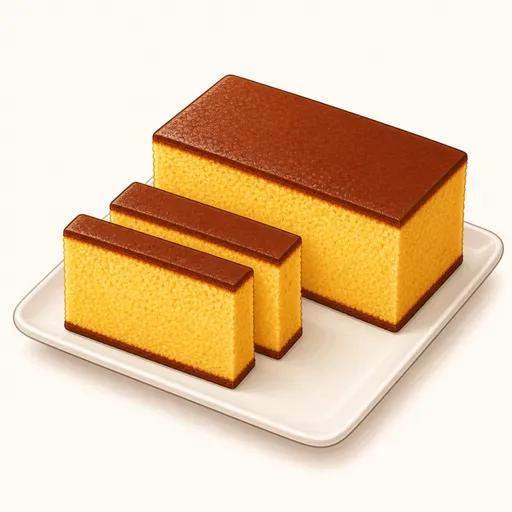
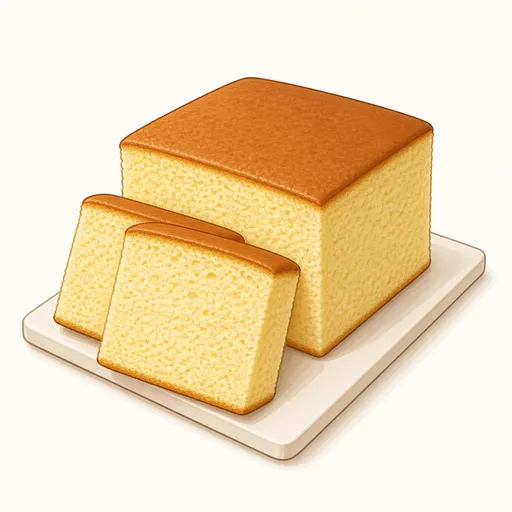
Taiwanese castella is the Tamsui-style version of castella, famous for its tall, perfectly square loaf that wobbles like cotton when sliced and is so soft and moist you can press it gently and watch it puff back up. The secret lies in scalding the flour with hot oil and baking it in a water bath at a low temperature. The cake has a light, delicate egg-and-milk flavor and isn't too sweet, so you'll never tire of it.
- Difficulty
- Hard
- Prep
- 35 min
- Cook
- 1 hr 10 min
- Rising or chilling
- 20 min
- Total time
- 2 hr 5 min
- Method
- Oven-baked
Ingredients
For the yolk batter
For the meringue
Instructions
Step 1
Line the bottom and sides of a 20 cm square pan with parchment paper so the paper stands a few centimeters above the rim, set the pan in a larger deep tray, then heat the oven to 150°C and bring a kettle of water to a boil. The tall paper lets the cake rise above the rim without overflowing, and the larger tray is for the water bath. This step is done when the paper is neatly folded at all four corners without big creases.
Step 2
Heat 80 g vegetable oil in a small saucepan over low heat to about 80 to 85°C, then turn off the heat right away. Oil that's just hot enough partly cooks the starch, creating the signature soft, wobbly texture without making the flour clump. The oil is ready when a thermometer shows that range, or when tiny bubbles form around a wooden chopstick dipped into it.
Step 3
Sift 100 g cake flour into a bowl, pour in the hot oil and whisk quickly, then add 90 g warm whole milk and a pinch salt and keep stirring. Scalding the flour with oil lets it absorb more liquid, which keeps the crumb moist and silky. The mixture is ready when it's smooth, glossy, as thick as paste and free of lumps.
Step 4
Add 110 g egg yolks, 50 g whole eggs and 3 g vanilla extract to the flour mixture, whisk until combined, then strain it through a sieve. Straining removes the egg membranes and any leftover bits of flour, giving a finer crumb. The mixture is ready when it flows smoothly like thin cream, is bright yellow and has no lumps.
Step 5
Whip 200 g cold egg whites with 5 g lemon juice on medium speed, adding 90 g superfine sugar in three additions, then lower the speed at the end so the bubbles are small and even. The meringue should be soft and supple, because whipping it too stiff makes the cake crack on top and turn dry. The meringue is ready when it's glossy and smooth and the peak on the lifted whisk droops over like a hook.
Step 6
Mix a third of the meringue into the yolk batter to lighten it, then pour this back into the meringue bowl and fold gently from the bottom up until even, pour it into the pan and tap the pan on the counter twice. Pouring the batter back into the meringue blends the two quickly with fewer bubbles lost. The batter is ready when it's an even pale yellow, smooth and thick, and falls in ribbons that fold over each other before slowly sinking in.
Step 7
Place the tray with the pan in the oven, pour hot water into the outer tray to a depth of about 2 cm, then bake at 150°C for about 65 to 75 minutes. Steam from the tray cooks the cake slowly and evenly moist and keeps the top from cracking. The cake is done when the top is an even golden brown, springs back when pressed lightly and a skewer inserted in the center comes out clean.
Step 8
Take the cake out and drop the pan onto the counter from about a hand's span high to release the hot steam, lift the cake out of the pan by the parchment and peel the paper off all four sides right away, then let it cool for about twenty minutes before slicing. Peeling the paper early lets steam escape, so the sides don't shrink and wrinkle. The cake is ready when it's just slightly warm and a knife leaves a smooth, wobbly cut face.
Equipment
- Oven
- Square pan
- Deep skillet
- Hand mixer
- Whisk
- Small saucepan
- Thermometer
- Sieve
- Spatula
- Parchment paper
- Mixing bowl
- Kitchen scale
Tips
- Slice the cake with a long serrated knife, sawing gently back and forth instead of pressing straight down, so the crumb doesn't get squashed.
- You can scatter grated cheddar cheese between layers of batter before baking for the cheese castella that's hugely popular in Taiwan.
- Every oven is different, so use an oven thermometer to be sure the actual temperature is exactly 150°C.
Storage
The cake is best warm or on the day it's baked. Wrapped tightly, it keeps for a day at room temperature or three days in the fridge; before serving, bring it back to room temperature or microwave it for about ten seconds to soften it again.
Common problems and how to fix them
- The top split wide open during baking.
- The meringue was whipped too stiff or the oven was too hot. Stop whipping while the peak still curls over, and lower the oven by about 10 degrees for the first half of the baking time.
- The cake shrank and its sides wrinkled after coming out of the oven.
- The cake wasn't fully baked, or the pan wasn't dropped and the paper peeled off in time. Bake it five minutes longer and handle it as soon as it comes out of the oven.
- There's a dense, wet layer at the bottom of the cake.
- The batter lost its air from overmixing, or water from the water bath seeped into the pan. Fold gently, and use a pan with a fixed bottom or wrap the bottom of the pan tightly in foil.
This recipe is based on the common ratios for this bake and is written entirely in our own words.