Sun cakes
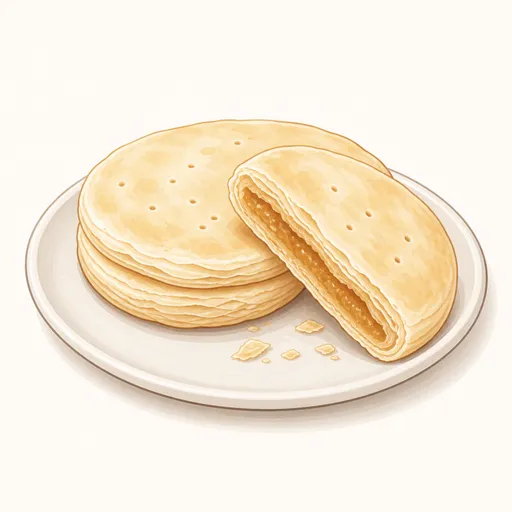
Sun cakes are a famous specialty of Taichung in Taiwan: flat, round pastries as big as the sun, with an ivory crust as thin as paper. Bite into one and the thousand-layer crust shatters into crisp flakes, revealing a chewy, sweet maltose filling that tastes like candy. In Taiwan, people often break the cakes into a bowl and pour hot water over them to eat as a warm sweet soup.
- Difficulty
- Hard
- Prep
- 1 hr
- Cook
- 28 min
- Rising or chilling
- 55 min
- Total time
- 2 hr 23 min
- Method
- Oven-baked
Ingredients
For the water dough
For the oil dough
For the maltose filling
Instructions
Step 1
Spread 75 g cake flour for the filling on a parchment-lined tray and toast it in a 150°C oven for about 10 to 12 minutes, stirring once halfway through. Toasted flour loses its raw taste and makes the filling smooth and chewy instead of pasty. The flour is ready when it's dry and loose, ivory in color and smells faintly like cookies.
Step 2
Warm 75 g maltose in the microwave for about twenty seconds to soften it, mix it with 75 g powdered sugar, 15 g softened unsalted butter and 15 g water, then add the cooled toasted flour and knead until even. Warm maltose blends with the sugar and flour much more easily than when it's cold and stiff. The filling is ready when it forms a smooth, pliable mass that stretches without tearing and is slightly sticky.
Step 3
Divide the filling into ten pieces, roll them into balls and refrigerate for about 20 minutes. Chilled maltose filling firms up, so it's easier to wrap and doesn't run while you work. The filling is ready when the balls hold their round shape and give only slightly when pressed.
Step 4
Knead 150 g all-purpose flour, 15 g powdered sugar, 50 g lard and 65 g water into a smooth dough, then wrap it in plastic and let it relax for about 20 minutes. The rest calms the gluten so the dough rolls thin without shrinking back. The water dough is ready when it's soft and smooth and stretches thin without tearing.
Step 5
Rub 110 g cake flour together with 55 g lard into a mass as soft as butter, divide it into ten portions and divide the water dough into ten portions as well. Dividing both doughs into the same number of pieces gives every cake the same balance of crust layers. You're done when you have two sets of ten evenly sized balls.
Step 6
Wrap each ball of oil dough in a ball of water dough, roll it into a long strip, roll it up, turn it lengthwise, then roll it out and roll it up once more, cover with plastic wrap and wait about 15 minutes. The second roll doubles the number of layers, creating the signature paper-thin crust. The dough is ready when the rolls have softened again and don't spring back when flattened.
Step 7
Flatten each roll of dough, roll it into a round, set a ball of filling in the center, seal it completely, then turn it seam side down and roll it very gently into a round cake about ten centimeters across, and prick a few holes in the top with a toothpick. The holes let steam escape so the tops stay flat instead of blistering. The cakes are ready when they're evenly thin and nicely round, with the filling spread almost to the edges.
Step 8
Arrange the cakes on a parchment-lined baking sheet and bake at 180°C for about 25 to 30 minutes, flipping them once after fifteen minutes so both sides bake flat and even. Sun cakes bake at a moderate heat so the crust stays ivory instead of turning deep golden. They're done when the edges show distinct layers, the tops are dry and the bottoms are only lightly golden.
Step 9
Let the cakes cool completely on a rack for about thirty minutes before eating or packing them away. The maltose filling needs to cool to set into its chewy texture; eaten right away, it will run and be very hot. They're ready when they feel light in your hand, the crust is crisp and the tops are no longer warm.
Equipment
- Oven
- Microwave
- Mixing bowl
- Kitchen scale
- Rolling pin
- Baking sheet
- Parchment paper
- Plastic wrap
- Refrigerator
- Wire cooling rack
Tips
- Dip your fingertips in water when handling the maltose so it doesn't stick to your hands.
- To eat them the Taiwanese way, break a cake into a bowl, pour boiling water over it and stir gently; the maltose filling melts into a thick, fragrant sweet soup.
- For a buttery crust, you can replace half of the lard in the oil dough with unsalted butter.
Storage
The cakes keep for about a week at room temperature in an airtight container or a bag with a desiccant packet. Avoid the fridge, since the crust will absorb moisture and lose its crispness; if the crust has softened, warm the cakes in a 150°C oven for about five minutes.
Common problems and how to fix them
- The maltose filling leaked out and burned on the bottom of the cakes.
- The crust had a hole somewhere or the filling wasn't cold enough when wrapped. Chill the filling more thoroughly, and check that the crust is fully sealed before rolling the cakes flat.
- The tops puffed up into domes and cracked.
- The steam had no way to escape. Prick more holes in the tops and flip the cakes halfway through baking to press them flat.
This recipe is based on the common ratios for this bake and is written entirely in our own words.