Sata andagi
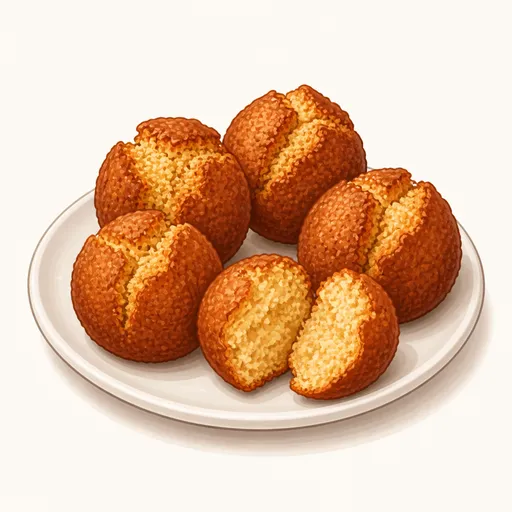
Sata andagi are round fried doughnuts from Okinawa, Japan, with a crisp brown outside that cracks open like a blooming flower and a dense, tender, cake-like inside. The dough needs no yeast; you just mix it by hand and drop balls into the oil, so a fragrant, eggy snack is ready in less than an hour.
- Difficulty
- Easy
- Prep
- 15 min
- Cook
- 25 min
- Rising or chilling
- 30 min
- Total time
- 1 hr 10 min
- Method
- Fried
Ingredients
Dough
Frying oil
Instructions
Step 1
Whisk 150 g eggs with 100 g granulated sugar until the sugar has nearly dissolved, then stir in 15 g vegetable oil. Dissolving the sugar in the eggs helps the outside brown evenly without burnt spots. The mixture is ready when it is slightly thick, pale yellow and no longer gritty with sugar.
Step 2
Sift 250 g all-purpose flour, 8 g baking powder and a pinch salt into the egg mixture and cut it in with a spatula until no dry flour remains. Mixing just enough keeps gluten from developing, so the inside stays tender instead of chewy. The dough is ready when it is soft, sticky and thicker than a sponge cake batter.
Step 3
Cover the bowl and let the dough rest in the fridge for about thirty minutes. Chilled dough firms up, is easier to roll into balls and hydrates evenly, so the doughnuts crack open beautifully as they fry. It's ready when the surface looks drier and feels firm when pressed with a finger.
Step 4
Pour to taste oil for deep-frying into a deep pot so it is at least five centimeters deep and heat it over medium heat until a thermometer reads about 160°C. A lower temperature than for ordinary doughnuts lets the thick balls cook through to the center before the outside gets too dark. The oil is ready when a small piece of dough dropped in bubbles steadily and floats up after a few seconds.
Step 5
Rub a little oil on your hands, roll the dough into balls about the size of a ping-pong ball and set them on an oiled plate. Balls of the same size cook at the same time and look evenly beautiful. They're ready when they are round and smooth and don't stick to your hands.
Step 6
Drop in five or six balls at a time, letting them roll over on their own as they cook and turning them gently now and then, and fry for about six to eight minutes. As the doughnuts expand, the outside cracks into a smiling shape, which is the signature of sata andagi. They're done when they are an even deep russet brown and one broken open is dry and fluffy inside.
Step 7
Lift the doughnuts onto a sieve or a rack lined with paper towels and let them drain for about five minutes before eating. Draining keeps the outside crisp and stops them tasting greasy. They're ready when the outside is dry with no pooled oil and the inside is still warm.
Equipment
- Deep skillet
- Thermometer
- Whisk
- Spatula
- Kitchen scale
- Mixing bowl
- Wire cooling rack
Tips
- Replace half of the sugar with brown sugar or Okinawan black sugar for a version with a deep molasses flavor.
- Add a little purple sweet potato powder or matcha powder to the dry ingredients for an unusual color.
- Don't fry too many at once, as the oil temperature will drop and the doughnuts will soak up oil.
Storage
Sata andagi are best the same day, but you can keep them in an airtight container at room temperature for up to two days. To enjoy them again, reheat them in a 160°C oven for about five minutes to crisp the outside.
Common problems and how to fix them
- The outside is dark but the inside is still raw.
- The oil was too hot or the balls were too big. Keep the oil at about 160°C and roll the balls a little smaller.
- The doughnuts didn't crack and are round, smooth and a little hard.
- The dough was too dry or the baking powder had expired. Check your baking powder and keep the dough soft and slightly sticky when mixing.
This recipe is based on the common ratios for this bake and is written entirely in our own words.