Glazed doughnuts
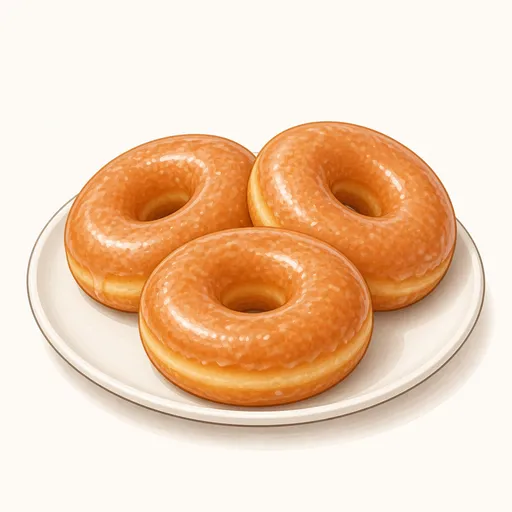
Glazed doughnuts are yeast-raised rings, fried until golden and dipped in a thin vanilla glaze. The inside is light, airy and springy like a milk bread, while the glaze dries into a delicate shell that shatters when you bite in. Once you make them at home, you'll find that a warm doughnut beats any store-bought one by a mile.
- Difficulty
- Medium
- Prep
- 40 min
- Cook
- 25 min
- Rising or chilling
- 1 hr 40 min
- Total time
- 2 hr 45 min
- Method
- Fried
Ingredients
Dough
Glaze
Frying and dusting
Instructions
Step 1
Heat 240 g whole milk with 60 g unsalted butter over low heat just until the butter melts, then turn off the heat and let it cool down. Yeast works best when it is warm, but milk that is too hot will kill it. The milk is ready when a drop on your wrist feels pleasantly warm, about 40°C.
Step 2
Put 500 g all-purpose flour, 60 g granulated sugar and 7 g instant yeast in the bowl of a stand mixer, add the warm milk, 100 g eggs and 5 g vanilla extract, knead on low speed, then add 8 g salt and keep kneading for about ten minutes. Kneading long enough builds the gluten network that makes the doughnuts airy with a gentle chew. The dough is ready when it is smooth and shiny, pulls away from the sides of the bowl and can be stretched thin without tearing right away.
Step 3
Shape the dough into a ball, place it in an oiled bowl, cover with plastic wrap and leave it in a warm spot for about an hour. Proofing gives the yeast time to produce gas and develop flavor. The dough is ready when it has doubled in size and a fingertip dent springs back very slowly.
Step 4
Dust the counter with a little to taste all-purpose flour, roll the dough about 1.3 cm thick, then cut rounds with an 8 cm cutter and punch out the centers with a 3 cm cutter. An even thickness lets the doughnuts cook at the same rate and rise evenly. This step is done when you have evenly round rings with clean edges that don't stick to the counter.
Step 5
Set the rings on small squares of parchment paper, cover them with a towel and let them rise for about thirty more minutes. The second rise makes them lighter, so they puff up round in the oil and get that pretty pale ring around the middle. They are ready when they have visibly puffed and feel as soft as a pillow when touched gently.
Step 6
Pour the to taste oil into a deep pot to a depth of at least five centimeters, heat over medium and use a thermometer to bring it to 175°C. A steady oil temperature is what lets the doughnuts cook evenly without soaking up oil. The oil is ready when the thermometer reads the right temperature and a scrap of dough dropped in bubbles steadily and floats right up.
Step 7
Lift each doughnut by its parchment square and lower it gently into the oil, frying for about a minute per side, just three or four at a time. Frying only a few at once keeps the oil temperature from dropping too much. They are done when both sides are an even golden brown with a pale band around the middle; lift them out to drain on a rack.
Step 8
Sift 300 g powdered sugar into a bowl, add 60 g whole milk and 3 g vanilla extract and whisk until very smooth. Sifted powdered sugar dissolves quickly, giving a clear, glossy glaze without lumps. The glaze is ready when it is about as thick as runny honey and coats a dipped spoon in a thin, even, opaque layer.
Step 9
While the doughnuts are still warm, dip the top of each one in the glaze, lift it so the excess drips off and set it on the rack. Warm doughnuts let the glaze flow on thinly and evenly and dry into a thin, translucent shell. They are finished when the glaze has dried and no longer feels sticky to the touch.
Equipment
- Stand mixer
- Rolling pin
- Cookie cutter
- Deep skillet
- Thermometer
- Wire cooling rack
- Whisk
- Kitchen scale
- Mixing bowl
- Plastic wrap
- Small saucepan
Tips
- You can do the first rise in the fridge overnight; the cold dough is much easier to roll and cut the next morning.
- Don't throw away the cut-out centers; fry them separately as doughnut holes, which take only about forty seconds.
- For a thicker glaze, let the first coat dry for about five minutes, then dip the doughnuts a second time.
Storage
Doughnuts are best on the day they are fried. You can keep them in a loosely covered container at room temperature for one day so the glaze doesn't melt. To soften them again, warm them in the microwave for about ten seconds.
Common problems and how to fix them
- The doughnuts are greasy and heavy.
- The oil wasn't hot enough or its temperature dropped because too many doughnuts went in at once. Keep the oil at 175°C and fry just a few per batch.
- The outside is dark but the inside is still raw.
- The oil was too hot or the dough was rolled too thick. Turn down the heat, double-check your thermometer and roll the dough to the right thickness.
- The doughnuts stay flat instead of puffing up in the oil.
- The dough was underproofed or the yeast was weak. Check the expiration date on your yeast and let the dough double in size before rolling.
This recipe is based on the common ratios for this bake and is written entirely in our own words.