Beignets
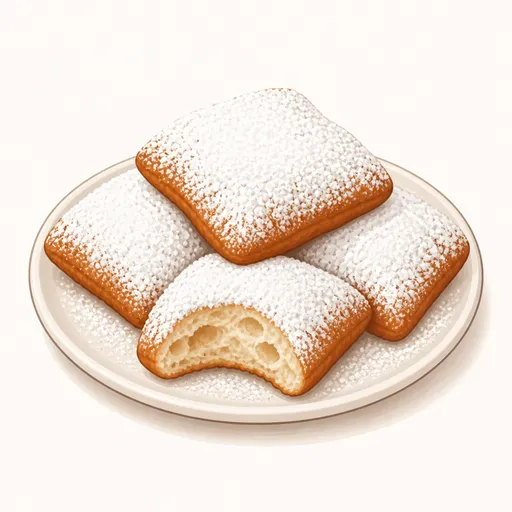
Beignets are the famous square fried pastries of New Orleans, made from a soft yeast dough that puffs up like a little pillow when it hits the hot oil. The outside is golden and lightly crisp, the inside hollow and airy, and they are eaten hot under a heavy blanket of powdered sugar with a cup of café au lait.
- Difficulty
- Medium
- Prep
- 30 min
- Cook
- 25 min
- Rising or chilling
- 2 hr 30 min
- Total time
- 3 hr 25 min
- Method
- Fried
Ingredients
Dough
Frying and dusting
Instructions
Step 1
Pour 170 g warm water at about 40°C into the bowl of a stand mixer, sprinkle 7 g instant yeast and a small spoonful of the 50 g granulated sugar over it, and stir gently. This step makes sure the yeast is alive before you put effort into the dough. After about five minutes, the surface should be covered with tiny bubbles and smell gently yeasty.
Step 2
Add the remaining sugar, 120 g evaporated milk and 50 g eggs to the bowl and whisk, then add 500 g all-purpose flour and 6 g salt, and finally 30 g vegetable shortening. Knead with the dough hook on low speed for about six minutes to develop just enough gluten for the beignets to puff without turning chewy. The dough is ready when it is soft and slightly sticky but pulls away from the sides of the bowl.
Step 3
Shape the dough into a ball, place it in a lightly oiled bowl, cover tightly with plastic wrap and leave it in a warm spot for about two hours. A long enough rise lets the yeast produce plenty of gas, which is what makes the beignets puff up hollow in the oil. The dough is ready when it has doubled in size and a fingertip dent fills back in only very slowly.
Step 4
Lightly flour the counter, roll the dough into a sheet about 6 mm thick, then use a sharp knife or pastry wheel to cut it into squares about 6 cm on each side. One decisive cut keeps the edges from sealing together, so all four sides puff evenly. The pieces are ready when they have straight edges, an even thickness and do not shrink back.
Step 5
Arrange the squares slightly apart on a tray lined with parchment paper, cover with a clean towel and let them rest for about twenty minutes while you heat the oil. This short rest relaxes the gluten so the beignets do not shrink when they go into the pan. They are ready when the pieces have puffed slightly and feel softer than when first cut.
Step 6
Heat oil for deep-frying (to taste) in a deep pot to about 175°C, add three or four pieces per batch and fry for about one minute per side, turning them with long chopsticks. Keeping the temperature steady is crucial, because cool oil makes the beignets greasy while oil that is too hot darkens the outside before the inside has cooked. They are done when they have puffed up like pillows, are golden on both sides and feel light when lifted.
Step 7
Lift the beignets onto a wire rack to drain for about a minute, then sift a thick layer of 60 g powdered sugar over them while they are still piping hot. The warmth of the beignets makes the sugar cling and melt slightly where it touches the crust. They are perfect when covered in a snow-white layer and break open to reveal a soft, airy, hollow inside.
Equipment
- Stand mixer
- Mixing bowl
- Rolling pin
- Deep skillet
- Thermometer
- Wire cooling rack
- Sieve
- Kitchen scale
- Plastic wrap
Tips
- You can let the dough rise overnight in the fridge after kneading; the next morning, just let it come to room temperature for about thirty minutes, then roll and cut as usual.
- Use a thermometer to monitor the oil; if you do not have one, drop in a small piece of dough, and when it floats up right away with even bubbles around the edges, the oil is hot enough.
- Beignets are best within fifteen minutes of frying, so fry them in small batches just before serving.
Storage
Beignets should be eaten the same day, because the crust softens quickly. Cut, unfried dough can be frozen on a tray and then packed into an airtight bag for about a month; when needed, thaw it in the fridge and let it rest at room temperature before frying.
Common problems and how to fix them
- The beignets do not puff and are flat and dense inside.
- The dough was underproofed or rolled too thin. Wait until the dough has doubled, roll it about 6 mm thick and let the pieces rest before frying.
- The beignets are oily and taste greasy.
- The oil was not hot enough, or too many pieces went in at once and the temperature dropped sharply. Fry in small batches and wait for the oil to return to 175°C before the next batch.
This recipe is based on the common ratios for this bake and is written entirely in our own words.