Sakura mochi
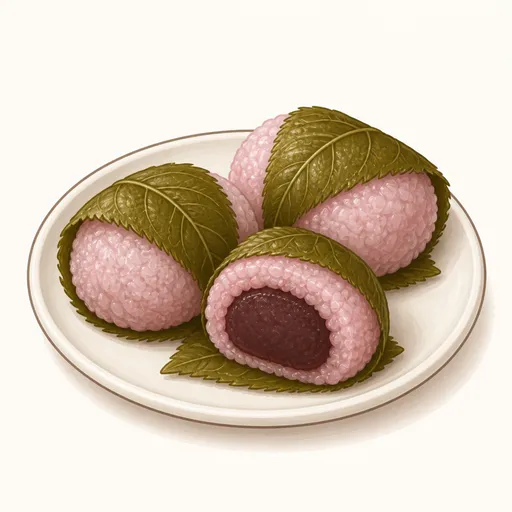
Sakura mochi is a Japanese springtime sweet made of pale pink sticky rice wrapped around sweet red bean paste and tucked into a salted cherry blossom leaf. This recipe follows the Kansai style, where the rice is only half pounded, so the mochi is chewy yet still dotted with whole grains. The gentle saltiness of the leaf against the sweet, earthy red beans tastes just like spring.
- Difficulty
- Medium
- Prep
- 40 min
- Cook
- 30 min
- Rising or chilling
- 3 hr 20 min
- Total time
- 4 hr 30 min
- Method
- Steamed
Ingredients
Sticky rice wrapper
Red bean filling
Leaves for wrapping
Instructions
Step 1
Rinse 150 g glutinous rice well, soak it in plenty of cold water for about three hours, then drain it in a colander. A full soak lets the rice absorb water evenly and steam up soft. It's ready when a grain crumbles easily when you pinch it between two fingers.
Step 2
Soak 16 g salted cherry blossom leaves in a bowl of cold water for about twenty minutes, changing the water once, then pat them dry with paper towels. Soaking draws out some of the salt so the leaves are only lightly salty. They're ready when they feel soft and pliable and taste just a little salty.
Step 3
Divide 200 g sweet red bean paste into eight equal portions, roll each into a ball and cover them with a towel. Portioning the filling ahead lets you wrap quickly while the rice is still warm and sticky. You'll end up with eight round balls of filling with smooth, uncracked surfaces.
Step 4
Line a steamer basket with damp cheesecloth, spread the rice over it in an even layer and steam over high heat for about twenty minutes. Strong steam cooks the grains from the outside in. The rice is ready when the grains look translucent and soft, with no hard core when you taste one.
Step 5
Stir 30 g granulated sugar and a pinch red food coloring into 60 g water until dissolved, tip the rice into a bowl, drizzle the syrup over it evenly and toss gently so it soaks in. The syrup sweetens the rice and gives it a soft cherry blossom pink. It's ready when all the grains are evenly pale pink and the syrup has been fully absorbed.
Step 6
Return the rice to the steamer and steam for about ten minutes more over high heat. The second steaming lets the rice absorb all the sugar and water, making it chewier. It's ready when the rice is glossy and sticky and the grains cling together.
Step 7
Tip the rice into a bowl and pound it gently with a wooden pestle or the bottom of a glass dipped in water for about a minute, until about half of the grains are crushed. Pounding just enough makes the rice sticky enough to hold together while keeping some grains whole. It's ready when it presses into a cohesive mass but you can still clearly see whole grains of rice.
Step 8
Dip your hands in lightly salted water, divide the rice into eight portions, flatten each into a disk in your palm, place a ball of filling in the center, then close the rice around it and shape it into an oval. Damp hands keep the rice from sticking. Each one is ready when the filling is completely enclosed and the surface is smooth and even.
Step 9
Place each mochi on the underside of a leaf, wrap the leaf around it with the stem pointing down and let the mochi rest for about fifteen minutes. The leaves need time to pass their fragrance into the rice. They're finished when the leaves cling snugly to the mochi and give off their gentle, distinctive aroma.
Equipment
- Steamer
- Mixing bowl
- Sieve
- Spatula
- Kitchen scale
- Plastic wrap
Tips
- If you can find domyoji flour (steamed, dried and crushed glutinous rice), simply soak it in the pink syrup and steam it for fifteen minutes, skipping the rice soaking and pounding.
- The salted cherry blossom leaves are edible along with the mochi; if you don't care for the salty taste, peel them off before eating.
- You only need a tiny amount of coloring, so dab it on with a toothpick to get a soft pink rather than a deep red.
Storage
Sakura mochi is best the day it's made; wrap each one in plastic wrap and keep them somewhere cool and airy. Avoid the fridge, since it hardens the rice; if the mochi firms up, steam it again for two to three minutes.
Common problems and how to fix them
- The rice falls apart and won't wrap around the filling.
- The rice wasn't pounded enough or had already cooled. Pound it a little more to crush more grains and wrap the mochi while the rice is still warm.
- The mochi tastes too salty.
- The leaves weren't soaked long enough to draw out the salt. Next time, soak them longer and change the water twice, tasting one before wrapping.
This recipe is based on the common ratios for this bake and is written entirely in our own words.