Sachertorte
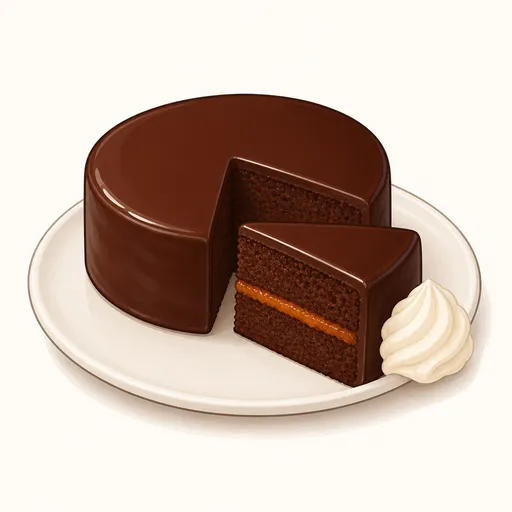
Sachertorte is Vienna's most famous chocolate cake, created in 1832 by an apprentice named Franz Sacher. A rich, slightly dense chocolate sponge is layered with gently tart apricot jam and covered in a cooked chocolate glaze as glossy as a mirror. Austrians always serve it with a spoonful of unsweetened whipped cream to balance the sweetness.
- Difficulty
- Hard
- Prep
- 1 hr
- Cook
- 1 hr
- Rising or chilling
- 4 hr
- Total time
- 6 hr
- Method
- Oven-baked
Ingredients
Chocolate sponge
Apricot jam
Chocolate glaze
Instructions
Step 1
Preheat the oven to 170°C, line the bottom of a 22 cm springform pan with parchment paper and lightly butter the sides. A moderate temperature lets the chocolate-rich cake bake through to the center without the top burning. The oven is ready after about fifteen minutes of preheating.
Step 2
Chop 130 g dark chocolate, put it in a bowl set over a pan of barely simmering water on low heat and stir until melted, then take it off and let it cool slightly. Chocolate that's too hot will melt the butter and make the batter heavy. It's ready when it is smooth and glossy and only feels slightly warm when you touch the side of the bowl.
Step 3
Beat 130 g softened unsalted butter with 110 g powdered sugar and 4 g vanilla extract for about three minutes, then add 110 g egg yolks one at a time, and finally the cooled chocolate. Adding the yolks gradually keeps the mixture from curdling. It's ready when it is smooth, creamy and an even chocolate brown.
Step 4
In a clean bowl, whisk 190 g egg whites with a pinch salt until foamy, then gradually sprinkle in 110 g granulated sugar and keep whisking for about five minutes. The whipped whites are the only thing that makes a Sacher sponge rise, since the recipe uses no baking powder. The meringue (egg whites whipped with sugar) is ready when it is glossy and smooth and the peak curls over slightly when you lift the whisk.
Step 5
Stir a third of the meringue into the chocolate mixture to loosen it, then sift 130 g all-purpose flour over the top and fold it in, alternating with the remaining meringue in two additions. Alternating keeps the flour from clumping while preserving as many air bubbles as possible. The batter is ready when it is evenly brown, with no white streaks, and still light and airy.
Step 6
Pour the batter into the pan, smooth the top and bake at 170°C for about 50 to 60 minutes. The thick, chocolate-rich cake needs a long bake to cook evenly all the way to the center. It's done when the top is dry and cracked slightly and a toothpick inserted in the center comes out with just a few moist crumbs.
Step 7
Leave the cake in the pan for ten minutes, remove the ring, then turn the cake upside down onto a rack to cool for at least two hours, ideally overnight. Turning it over flattens the top so the glaze flows evenly, and the rest firms up the crumb so it slices easily. It's ready when it is completely cool and the top is flat with no dome.
Step 8
Put 200 g fruit jam, traditionally apricot, in a small saucepan with 10 g dark rum if using, heat it over medium heat, stirring, until it bubbles gently, then press it through a sieve. Hot, strained jam turns thin, so it spreads easily in a thin layer and soaks lightly into the cake. It's ready when it is clear, smooth and runs off the spoon in a stream.
Step 9
Slice the cake horizontally into two layers, spread half of the warm jam over the bottom layer, set the top layer back on, then spread the remaining jam over the top and sides to cover the cake completely. The outer layer of jam keeps the cake moist and creates a smooth surface for the chocolate glaze to cling to. It's ready when the top and sides are glossy with jam and no crumb shows anywhere; then let the jam set for about twenty minutes.
Step 10
Cook 200 g granulated sugar with 125 g water over medium heat until the sugar dissolves and a thermometer reads about 112°C, take the pan off the heat to cool for a few minutes, then add 150 g finely chopped dark chocolate and stir until melted. Sugar cooked to exactly the right temperature crystallizes very finely, giving the glossy yet thinly crisp coating that Sacher is known for. The glaze is ready when it is as thick as a heavy sauce and a drop on a plate sets into a glossy pool that doesn't spread.
Step 11
Set the cake on a rack over a tray to catch the drips, pour all the glaze onto the center of the cake in one go, then sweep a palette knife over it quickly two or three times to coat the sides. The glaze sets very fast, so every extra stroke leaves a mark; work decisively. It's ready when the glaze covers the whole cake in an even, mirror-glossy layer.
Step 12
Leave the cake at room temperature for about an hour until the chocolate is dry to the touch before moving it to a plate. Putting it in the fridge too soon turns the glaze dull and makes it sweat. It's ready when the surface feels dry and no longer sticky when touched lightly.
Equipment
- Oven
- Springform pan
- Hand mixer
- Small saucepan
- Thermometer
- Spatula
- Sieve
- Kitchen scale
- Mixing bowl
- Parchment paper
- Wire cooling rack
Tips
- The Viennese serve Sacher with unsweetened whipped cream; its cool richness makes the intense chocolate even more enjoyable.
- If you don't have a thermometer, you can replace the cooked chocolate glaze with a ganache of equal parts chocolate and heavy cream; it's less crisp but still beautifully glossy.
- Use dark chocolate with around sixty to seventy percent cocoa so the cake tastes deep without being too bitter.
Storage
Sachertorte keeps well in an airtight container in a cool room for up to five days, since the chocolate glaze seals the cake and stops it drying out. Only refrigerate it when the weather is very hot, and take it out half an hour before serving.
Common problems and how to fix them
- The glaze is grainy and dull instead of glossy.
- The sugar was cooked too hot or you worked the knife over it too many times. Use a thermometer to stop at the right moment, and smooth the glaze with only two or three quick strokes.
- The cake sank deeply in the middle after baking.
- It wasn't baked through to the center, or the meringue was overmixed and lost its air. Bake five minutes longer, test with a toothpick and fold more gently.
This recipe is based on the common ratios for this bake and is written entirely in our own words.