Puff pastry meat pies (pate chaud)
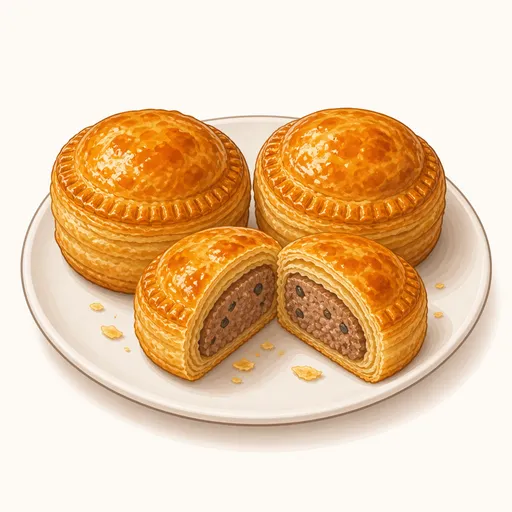
Pate chaud is a French-born puff pastry that has become thoroughly Vietnamese: a golden crust that shatters into paper-thin layers, wrapped around a rich filling of pork mixed with liver pate. They are best fresh from the oven, when every bite crackles and buttery flakes scatter everywhere, and they are often enjoyed with a glass of Vietnamese iced milk coffee in the morning.
- Difficulty
- Hard
- Prep
- 1 hr
- Cook
- 25 min
- Rising or chilling
- 2 hr 30 min
- Total time
- 3 hr 55 min
- Method
- Oven-baked
Ingredients
Base dough
Butter for laminating
Pork and pate filling
Egg wash
Instructions
Step 1
Mix 250 g all-purpose flour with 4 g salt, add 30 g softened unsalted butter and 115 g cold water, knead quickly into a ball, press it flat into a square, then wrap it well and refrigerate for about thirty minutes. Kneading just enough and chilling lets the gluten relax, so the dough rolls out easily and does not shrink in the oven. The dough is ready when it is smooth, slightly firm and evenly cold right through to the center.
Step 2
Place 170 g cold unsalted butter between two sheets of parchment, pound and roll it into a square about fifteen centimeters across, then refrigerate for fifteen minutes. A flat sheet of butter as pliable as the dough spreads evenly between the layers without breaking. The butter is ready when it bends slightly without snapping but still feels firm when pressed.
Step 3
Roll the dough into a square twice the size of the butter, set the butter on the diagonal in the middle, fold the four corners of dough over it like an envelope, then roll it out long and fold it in thirds like a letter; repeat for four letter folds in total, refrigerating for about thirty minutes after every two folds. Each fold multiplies the layers of butter and dough, and in the oven the steam from the butter pushes them apart into flaky puff pastry. The dough is ready when a cut side shows thin, parallel streaks of butter and no butter is breaking through.
Step 4
Soak 5 g dried wood ear mushrooms until soft and chop them finely, then mix them with 250 g ground pork, 60 g liver pate, 60 g chopped onions, 15 g shallots, 10 g soy sauce, 5 g granulated sugar and a pinch ground black pepper; divide into twelve flat patties and chill. The raw filling bakes together with the pastry, so it keeps its juices, and the pate makes it richer and smoother. The filling is ready when it is sticky and holds together when shaped.
Step 5
Turn the oven on to 200°C about twenty minutes ahead and line a baking sheet with parchment paper. Puff pastry needs strong heat from the start so the steam can burst up and form the layers. The oven is ready when an oven thermometer reads exactly 200°C and holds steady.
Step 6
Roll the dough about three millimeters thick, cut out twenty-four rounds with an eight-centimeter cutter, set a patty of filling on twelve of them, brush a little water around the edges, then lay the remaining rounds on top and press the edges closed with the tines of a fork. A clean cut with a sharp cutter keeps the layers at the edges from sticking together, so the pastry rises evenly all around. The pies are right when the edges are sealed, the filling sits neatly in the center and none of it shows.
Step 7
Beat 18 g egg yolks with 10 g whole milk and brush a thin layer over the tops, without letting it run down the cut edges, then cut a small, shallow cross in the center. The yolk gives a glossy golden color, and the slit lets steam from the filling escape. The tops are right when they are evenly glazed golden and the edges are still dry.
Step 8
Bake at 200°C for about 20 to 25 minutes, until the pies have puffed up tall and are deep golden all over the tops and sides. The strong heat makes the crust thoroughly crisp and cooks the filling through. They are done when you can see distinct, separate layers from the side and the bottoms are golden brown, with no wet butter, when you lift one.
Step 9
Move the pies to a rack and let them cool for about ten minutes before eating. The hot filling needs a little time for the juices to settle, and the crust firms up and turns crisper as the steam escapes. They are ready when they are comfortable to hold and the crust sounds dry and crisp when tapped.
Equipment
- Oven
- Baking sheet
- Rolling pin
- Cookie cutter
- Pastry brush
- Parchment paper
- Plastic wrap
- Refrigerator
- Nonstick skillet
- Kitchen scale
Tips
- Keeping everything very cold is the secret to puff pastry; if the butter starts to soften and ooze as you roll, put the dough in the fridge for another fifteen minutes before continuing.
- You can use store-bought puff pastry to save time; then just make the filling and start from the cutting step.
- The scraps left after cutting can be stacked on top of each other and rolled out again; do not ball them up, or you will ruin the butter layers.
Storage
Once cool and wrapped well, the baked pies keep for one day at room temperature or three days in the fridge; reheat at 180°C for about five minutes to crisp them. Shaped, unbaked pies can be frozen for up to a month; bake them straight from frozen, adding just a few minutes.
Common problems and how to fix them
- The pastry does not puff into layers and butter leaks onto the tray.
- The butter got too soft while rolling or the oven was not hot enough. Chill the dough longer between folds and check the oven temperature before putting the pies in.
- The pastry puffs up lopsided and the filling bursts out.
- Egg yolk ran down and glued the layers at the edge, or the edges were not sealed properly. Brush the egg very thinly on the tops only and press the edges firmly with the fork.
This recipe is based on the common ratios for this bake and is written entirely in our own words.