Passion fruit mousse cake
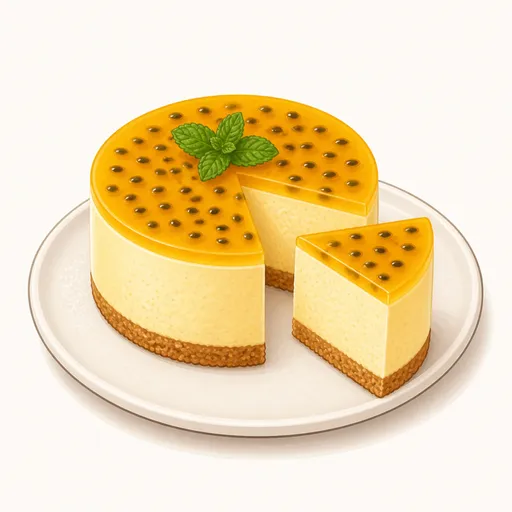
This passion fruit mousse cake is inspired by Brazil's mousse de maracujá, using sweetened condensed milk and whipping cream to create a rich, sweet-tart flavor from just a few ingredients. The buttery cookie base needs no baking, and the top is covered in a golden jelly dotted with crunchy black passion fruit seeds, perfect for hot weather.
- Difficulty
- Easy
- Prep
- 40 min
- Cook
- 5 min
- Rising or chilling
- 5 hr
- Total time
- 5 hr 45 min
- Method
- Chilled
Ingredients
Cookie base
Passion fruit mousse
Passion fruit jelly topping
Instructions
Step 1
Mix 120 g digestive biscuit crumbs with 55 g melted unsalted butter, press firmly into the bottom of a 20 cm springform pan lined with parchment paper, then refrigerate for about twenty minutes. The butter sets in the fridge and holds the base together without baking. The base is ready when it feels firm and cold and no longer crumbles when pressed.
Step 2
Halve the passion fruit, scoop out the pulp and divide it in two: press the pulp for the mousse through a sieve to get 200 g seedless passion fruit juice, and keep 100 g passion fruit pulp with the seeds for the topping. The mousse needs to be smooth, so the seeds must go, while the seeds on top add a striking look and crunch. You have it right when the juice is clear yellow with no black seeds left.
Step 3
Sprinkle 10 g powdered gelatin over 50 g cold water, wait five minutes for it to bloom, then microwave for about ten seconds to melt it. The gelatin must dissolve completely for the mousse to set evenly. The gelatin is ready when it is clear and as runny as water, with no granules.
Step 4
Stir 200 g sweetened condensed milk with the passion fruit juice, then pour in the warm gelatin and stir quickly. The acid in the passion fruit naturally thickens the condensed milk, making the mousse thick and smooth without eggs. The mixture is ready when it is as thick as yogurt and a creamy yellow.
Step 5
Whip 300 g very cold whipping cream in a chilled bowl for about three minutes. Whipped cream gives the mousse its signature light, airy texture. The cream is ready when it leaves clear ridges on the surface and the peaks stand but droop slightly at the tips.
Step 6
Divide the cream into three portions and fold them one at a time into the passion fruit and condensed milk mixture, then pour the mousse over the base and smooth the top with a spatula. Folding in portions keeps as much air as possible, so the mousse does not turn runny. The mousse is ready when it is an even pale yellow, soft and fluffy, and holds a trail when you draw the spatula through it.
Step 7
Refrigerate the cake for about three hours to set the mousse. The surface needs to firm up enough to hold the passion fruit seed jelly. The mousse is ready when a light touch on the surface does not stick to your finger or leave a deep dent.
Step 8
Soak 3 g powdered gelatin in a little cold water taken from 45 g water; heat the rest of the water over low heat with the passion fruit pulp and 30 g granulated sugar until the sugar dissolves, then turn off the heat, stir in the gelatin, let it cool and pour it over the mousse; chill for about another hour and a half. Cooling it before pouring keeps the mousse underneath from melting. The topping is right when it sets glossy, with the passion fruit seeds spread evenly rather than drifting to one side.
Step 9
Run a thin knife around the inside of the pan, unlock it and lift off the ring, then move the cake to a plate. A long enough chill lets the sides of the mousse stand firm once the pan is removed. The cake is finished when the sides are straight and smooth and the golden jelly has no cracks.
Equipment
- Springform pan
- Hand mixer
- Whisk
- Spatula
- Sieve
- Small saucepan
- Microwave
- Kitchen scale
- Mixing bowl
- Refrigerator
Tips
- Ripe passion fruit has slightly wrinkled skin, feels heavy in your hand and gives more fragrant juice than fruit with taut skin.
- The mousse is quite sweet from the condensed milk, so you can add a little more passion fruit juice if you prefer it tangier.
- Chilling the bowl and whisk in the freezer for ten minutes helps the cream whip up quickly and stay stable.
Storage
The cake keeps for three days in the fridge, covered so the jelly does not dry out on top. You can freeze the cake without its jelly topping for up to two weeks and thaw it overnight in the fridge.
Common problems and how to fix them
- The mousse is runny and does not set after several hours.
- The gelatin did not fully dissolve or the cream was not whipped enough. Heat the gelatin until it is clear, and whip the cream until the peaks stand before folding.
- The base crumbles when you slice the cake.
- The base was not pressed firmly enough or did not have enough butter. Press it down really well with the bottom of a glass and chill it for the full twenty minutes before adding the mousse.
This recipe is based on the common ratios for this bake and is written entirely in our own words.