Panna cotta
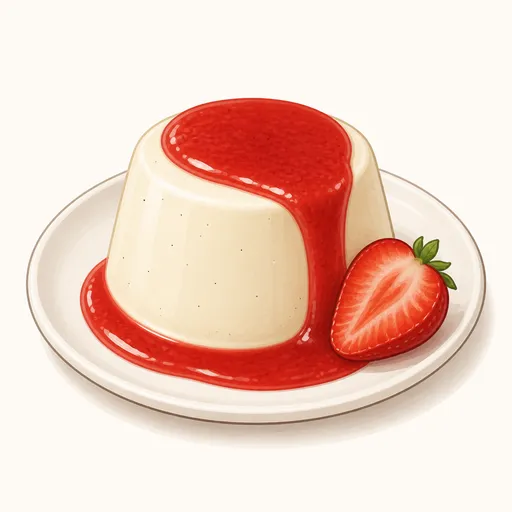
Panna cotta is an Italian dessert whose name literally means cooked cream: heavy cream and milk set softly with gelatin. It is wobbly, silky smooth and scented with real vanilla, served with a sweet-tart strawberry sauce, and it is very easy to make at home without an oven.
- Difficulty
- Very easy
- Prep
- 20 min
- Cook
- 15 min
- Rising or chilling
- 4 hr
- Total time
- 4 hr 35 min
- Method
- Chilled
Ingredients
Panna cotta cream
Strawberry sauce
Instructions
Step 1
Soak 8 g gelatin sheets in a bowl of very cold water for about ten minutes, making sure they are fully submerged. Cold water softens the gelatin sheets without dissolving them. The gelatin is ready when it is limp like wet cloth with no stiff, brittle parts left.
Step 2
Split 4 g vanilla beans in half, scrape out the seeds and put both seeds and pods in a saucepan with 500 g heavy cream, 200 g whole milk and 70 g granulated sugar, then heat over medium heat, stirring until the sugar dissolves. Bringing it just to the brink of boiling releases the vanilla aroma without making the cream split. The mixture is ready when it steams gently and tiny bubbles appear around the edge of the pan; turn off the heat right away.
Step 3
Lift out the gelatin sheets, squeeze them gently, drop them into the hot cream and stir slowly for about one minute. The hot cream dissolves the gelatin completely, and stirring slowly avoids foam on the surface. The mixture is ready when no clear strands of gelatin cling to the spoon as you lift it.
Step 4
Strain the mixture through a fine sieve into a pitcher, let it cool for about ten minutes, stirring gently a few times, then pour it evenly into six small molds or glasses. Stirring as it cools keeps the vanilla seeds suspended instead of sinking to the bottom. The molds are right when they all hold the same amount and the surface has no bubbles.
Step 5
Set the molds on a tray, cover with plastic wrap and chill for at least four hours. Gelatin needs a long enough chill to create a soft, wobbly texture that still holds its shape. The panna cotta is ready when the surface does not run when you tilt the mold and it jiggles evenly like jelly when shaken gently.
Step 6
Chop 200 g fresh strawberries and put them in a saucepan with 40 g granulated sugar and 10 g lemon juice, then cook over medium heat for about eight minutes, mashing lightly with a spoon. The lemon juice keeps the sauce brightly colored and balances the richness of the cream. The sauce is ready when the strawberries are very soft and the juices have thickened and turned glossy; let it cool before serving.
Step 7
Dip the bottom of each mold in warm water for about five seconds, run the tip of a knife around the edge, then turn it upside down onto a plate and shake gently, and spoon the strawberry sauce around it. The warm water melts a very thin layer so the panna cotta slides out whole. It is finished when it stands firmly on the plate with a smooth, glossy surface and wobbles gently when touched.
Equipment
- Small saucepan
- Whisk
- Sieve
- Ramekins
- Kitchen scale
- Refrigerator
Tips
- If you serve the panna cotta in glasses instead of turning it out onto plates, you can use a quarter less gelatin for an even silkier texture.
- If you do not have vanilla beans, use vanilla extract and add it after turning off the heat so the aroma does not cook off.
- Instead of strawberry sauce, try passion fruit, mango or raspberry sauce depending on the season.
Storage
Covered with plastic wrap, panna cotta keeps for three days in the fridge; store the strawberry sauce separately in a sealed jar for up to five days. Do not freeze it, because the gelatin weeps and loses its smoothness when thawed.
Common problems and how to fix them
- The panna cotta is firm and rubbery like jelly.
- Too much gelatin was used, or a stronger-setting type. Weigh the gelatin very precisely and use slightly less next time.
- The panna cotta separates into two layers, clear on the bottom and cloudy on top.
- The mixture was poured while too hot, so the fat rose to the top. Let the cream cool a little and stir gently a few times before pouring it into the molds.
This recipe is based on the common ratios for this bake and is written entirely in our own words.