Square sticky rice cake (banh chung)
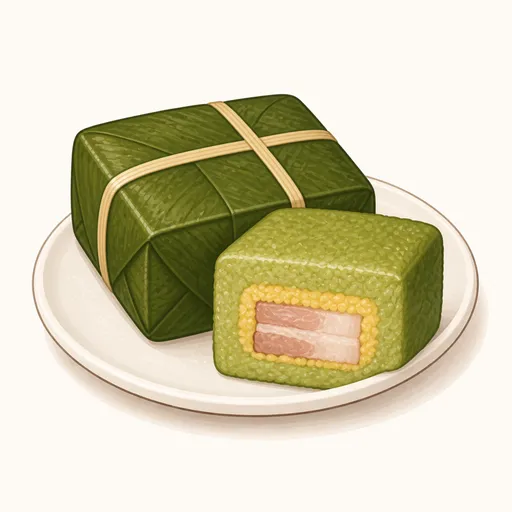
Banh chung is a square cake wrapped in dong leaves, an essential part of the Lunar New Year feast in northern Vietnam. A layer of tender glutinous rice, tinted green by the leaves, embraces a nutty mung bean filling and rich pork belly, and after many hours of gentle boiling everything melds into a firm, leaf-scented cake.
- Difficulty
- Hard
- Prep
- 1 hr 30 min
- Cook
- 10 hr
- Rising or chilling
- 12 hr
- Total time
- 23 hr 30 min
- Method
- Boiled or simmered
Ingredients
Glutinous rice
Mung bean and pork filling
Wrapping leaves
Instructions
Step 1
Rinse 1,200 g glutinous rice several times, then soak it, fully covered, in cold water for about eight hours or overnight. Rice soaked long enough absorbs water evenly, so it cooks right through to the center without staying hard. The rice is ready when a grain crumbles easily when pinched between two fingertips.
Step 2
Soak 400 g split peeled mung beans in warm water for about four hours, then rinse them again to wash away any remaining skins. Soft, soaked beans cook quickly and give a smooth filling without gritty bits. They are ready when they have swollen to about one and a half times their size and give when pressed with a fingernail.
Step 3
Cut 500 g pork belly into strips about the length of two finger joints and marinate them with 30 g minced shallots, 15 g fish sauce and 3 g of ground black pepper for about two hours. Pork with both lean and fat melts during the long boil and keeps the filling rich and moist. The pork is ready when the surface has darkened and smells of pepper.
Step 4
Drain the beans, mix them with 6 g salt and steam for about twenty-five minutes until tender, then mash them and press them into flat rounds about the size of your palm. Steaming the beans first firms up the filling so it doesn't make the surrounding rice mushy. They are ready when they mash easily under light pressure and hold together without falling apart when shaped.
Step 5
Wash 250 g dong leaves one at a time, thoroughly on both sides, wipe them dry, then use a knife to shave down the thick central rib on the back. A thinner rib makes the leaves supple, so they fold into sharp corners without tearing as you wrap. The leaves are ready when they bend in half smoothly without a crisp snapping sound.
Step 6
Drain the rice in a colander for about thirty minutes until completely dry, then sprinkle with 8 g salt and toss well by hand. The salt seasons the glutinous rice and balances the richness of the pork filling. The rice is ready when the surface is dry, the grains are separate and it tastes lightly salty.
Step 7
Line a square mold with two layers of leaves, add a layer of rice, a round of mung beans, the pork, another round of mung beans and then cover everything with rice, then fold the leaves over and tie them tightly with string in a cross. Wrapping tightly keeps the cake's sharp corners and stops the cooking water from making the rice mushy. A wrapped cake is ready when its edges are square and it feels firm when pressed, with no loose spots.
Step 8
Arrange the cakes in a large pot, add water to cover them completely and boil steadily over medium heat for about ten hours, topping up with boiling water now and then so the cakes stay submerged. The long boil is what turns the rice into a dense, sticky mass and makes the dong leaves release their green color into the cake. The cakes are done when the leaves have turned a yellowish green and a corner opened to check shows translucent, evenly tender rice.
Step 9
Lift out the cakes, rinse them quickly in cold water, then lay them on a flat surface and place a cutting board and a heavy weight on top to press them for about eight hours. Pressing squeezes out excess water and makes the cakes firm enough to slice without breaking. They are ready when they have cooled completely, the tops are flat and they feel solid when lifted.
Equipment
- Deep skillet
- Shaping molds
- Kitchen twine
- Mixing bowl
- Sieve
- Kitchen scale
- Steamer
Tips
- If you don't have a mold, you can wrap by hand by first folding the leaves into a square box; with a little practice, your cakes will still look beautiful.
- Top up with boiling water rather than cold while boiling, because cold water suddenly drops the temperature of the pot and can leave the rice undercooked and hard.
- For a deeper green color, line the mold with an extra layer of galangal leaves or blend a few dong leaves with water and mix the juice into the rice before wrapping.
Storage
In winter, banh chung keeps for about four to five days in a cool, airy place. In warm weather, wrap it tightly and keep it in the fridge, eating it within ten days; before serving, you can steam it again or pan-fry slices until crisp on the outside.
Common problems and how to fix them
- The rice is undercooked, with hard grains that don't stick together.
- The rice wasn't soaked long enough or the pot boiled low and the cakes floated above the water. Next time, soak the rice overnight and keep the cakes submerged by topping up with boiling water regularly.
- The cake is mushy and breaks apart when sliced.
- It was wrapped too loosely, so the cooking water seeped inside. Tie the string very tightly and be sure to press the cakes long enough after boiling to squeeze out the excess water.
This recipe is based on the common ratios for this bake and is written entirely in our own words.