Pandan rice cake (banh duc la dua)
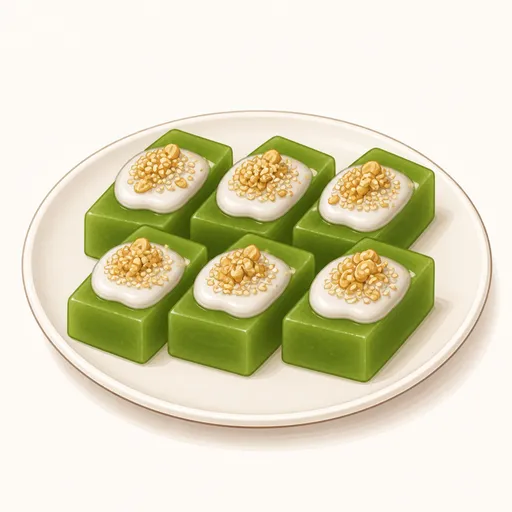
Pandan rice cake is the sweet southern Vietnamese version of banh duc, a cool jade green with the gentle fragrance of fresh pandan leaves. The rice flour is cooked with coconut milk and a little slaked lime water, giving the cake a firm, bouncy, springy bite that is very different from the savory northern style. To serve, you pour over rich coconut sauce and sprinkle on crushed roasted peanuts.
- Difficulty
- Easy
- Prep
- 30 min
- Cook
- 40 min
- Rising or chilling
- 3 hr
- Total time
- 4 hr 10 min
- Method
- Steamed
Ingredients
Pandan batter
Coconut sauce
Peanut and sesame topping
Greasing the pan
Instructions
Step 1
In a large bowl, whisk 200 g rice flour and 50 g tapioca starch with 500 g pandan juice, then add 200 g coconut milk, 120 g granulated sugar, a pinch salt and 20 g slaked lime water, stir until dissolved, let it rest for about 20 minutes and strain it through a sieve. The lime water gives the cake its signature bouncy firmness, while straining removes any pandan pulp. The mixture is ready when it is evenly green, smooth as milk and has no undissolved sugar at the bottom.
Step 2
Brush a very thin layer of to taste vegetable oil over the inside of a 20 cm square pan and bring a steamer to a boil on the stove. The oiled pan lets the cake come out whole once it has cooled. The pan is ready when the inside is evenly shiny with no drops of oil pooling.
Step 3
Pour the batter into a nonstick pot and stir constantly over medium heat for about 12 minutes, until it thickens and is about eighty percent cooked, then pour it straight into the pan and smooth the top with a spatula. Precooking on the stove keeps the cake from separating into layers and helps it cook quickly in the steamer. The batter is ready when it is thick and sticky, pulls away in sheets with the spatula and its green turns more translucent.
Step 4
Set the pan in the steamer, put a towel under the lid and steam over medium heat for about 20 minutes so the rest of the batter cooks through completely. This final steaming gives an even texture from the edges to the center. The cake is done when the top is glossy, it springs back when pressed lightly and a skewer comes out clean.
Step 5
Take out the pan and let the cake cool at room temperature for about three hours, or refrigerate it once the heat has gone. The cake has to cool completely to set firm and cut into neat pieces. It is ready when it feels cool to the touch and pulls away from the sides on its own when you tilt the pan.
Step 6
Mix 10 g tapioca starch with a splash of water and put it in a saucepan with 250 g coconut milk, 25 g granulated sugar and a pinch salt, then cook over low heat, stirring, for about 4 minutes. The tapioca starch thickens the sauce slightly so it clings to the cake. The sauce is ready when it is just bubbling gently, silky and nicely balanced between salty and sweet.
Step 7
Turn the cake out onto a cutting board, cut it into squares or diamonds, pour over the coconut sauce and sprinkle with 30 g crushed roasted peanuts and 15 g toasted white sesame seeds. The peanuts and sesame add a nutty crunch that contrasts with the cool, bouncy cake. The plate is ready when the pieces have sharp edges, an even green color and a pretty white coat of sauce on top.
Equipment
- Small saucepan
- Steamer
- Square pan
- Blender
- Sieve
- Whisk
- Spatula
- Kitchen scale
Tips
- To make pandan juice, blend fresh pandan leaves with water and squeeze through a cloth, then let it settle for a few hours and pour off the deep green liquid.
- Use only the clear water at the top of the slaked lime water and leave the sediment at the bottom behind, because it will make the cake bitter.
- For a softer cake, you can use less slaked lime water or leave it out entirely.
Storage
Covered, the cake keeps for one day at room temperature or three days in the fridge. Store the coconut sauce separately in an airtight container and warm it up again before pouring it over the cake.
Common problems and how to fix them
- The cake separates into two layers, dense at the bottom and soft on top.
- The batter was not precooked thick enough before going into the pan, so the starch settled. Stir it on the stove longer, until it is really thick, before steaming.
- The cake tastes bitter and astringent.
- The slaked lime water had sediment in it or you used too much. Let the lime water settle thoroughly and pour off only the clear water at the top.
This recipe is based on the common ratios for this bake and is written entirely in our own words.