Palm sugar honeycomb cake (banh bo thot not)
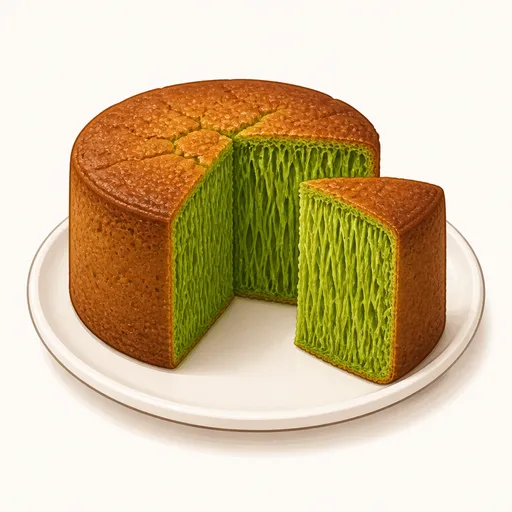
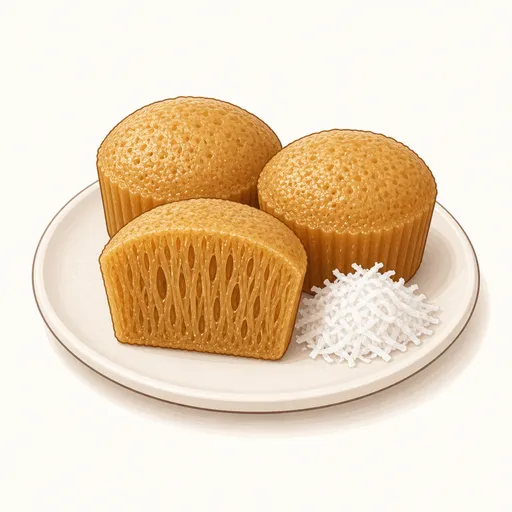
Palm sugar honeycomb cake is a specialty of the Seven Mountains region of An Giang, where rows of sugar palms yield a sugar as fragrant as honey. The cakes are a natural golden brown, with a soft, spongy crumb threaded with fine honeycomb strands and a gentle sweetness, carrying the distinctive smoky note of palm sugar and the light richness of coconut milk.
- Difficulty
- Medium
- Prep
- 30 min
- Cook
- 30 min
- Rising or chilling
- 3 hr 30 min
- Total time
- 4 hr 30 min
- Method
- Steamed
Ingredients
Batter
For greasing and serving
Instructions
Step 1
Put 180 g palm sugar, 180 g water and 200 g coconut milk in a saucepan and cook over low heat, stirring until the sugar has fully dissolved, then let it cool. Low heat preserves the aroma of the sugar without making the coconut milk split. The syrup is ready when it is a clear amber brown and has cooled to lukewarm.
Step 2
Mix 250 g rice flour, 50 g tapioca starch, a pinch salt and 5 g instant yeast together in a large bowl. Mixing the dry ingredients first spreads the yeast evenly through the flour. The mixture is ready when it is an even color with no clumps of yeast or starch.
Step 3
Pour the warm syrup into the flour in several additions, whisking constantly, then strain everything through a sieve. Gently warm liquid wakes up the yeast, and straining keeps the batter free of lumps. The batter is ready when it is as thick as pouring cream, an even golden brown and silky smooth.
Step 4
Cover the bowl tightly and let it ferment in a warm spot for about three hours. The long fermentation builds a network of air bubbles, which become the honeycomb strands in the crumb. The batter is ready when it has puffed up, the surface is covered in small bubbles and it smells gently sour and yeasty.
Step 5
Sprinkle 4 g baking powder over the fermented batter and stir gently for about one minute. The extra leavening helps the cakes spring up evenly as they steam without losing the yeast bubbles. The batter is ready when the baking powder has dissolved and the surface is still dotted with bubbles.
Step 6
Brush small cups with to taste vegetable oil, set them in a steamer over rapidly boiling water and heat them for about three minutes. Hot cups make the batter spring up the moment it is poured in. The cups are ready when they are beaded with steam and very hot to the touch.
Step 7
Fill the cups almost to the top with batter, cover with a towel-wrapped lid and steam over high heat for about 18 minutes. Strong, steady steam makes the cakes rise tall and forms the spongy strands inside. The cakes are done when the tops are puffed and taut and a toothpick inserted in the center comes out clean.
Step 8
Take out the cups, let them cool for about five minutes, then run a bamboo skewer around the sides to release the cakes; serve with 60 g freshly grated coconut if you like. The cakes shrink slightly as they cool, so they come out of the cups more easily. They are right when a cake split open shows a golden brown crumb with honeycomb strands running through it.
Equipment
- Steamer
- Small cup molds
- Small saucepan
- Whisk
- Sieve
- Mixing bowl
- Kitchen scale
- Plastic wrap
Tips
- Palm sugar varies in sweetness from place to place, so taste the syrup and use a little less or a little more before mixing the batter.
- For more honeycomb strands, replace some of the water with the liquid from fermented sweet rice, or let the batter ferment longer in cold weather.
- Instead of small cups, you can steam the batter in one large round pan and cut it into pieces; just increase the steaming time to about 35 minutes.
Storage
These cakes are best on the day they are made. Keep them in an airtight container at room temperature until evening, or refrigerate for two days and steam for about three minutes to make them soft and spongy again.
Common problems and how to fix them
- The crumb is dense, with no honeycomb strands.
- The batter did not ferment enough, or the syrup was so hot that it killed the yeast. Let the syrup cool to lukewarm and ferment until the batter is full of bubbles.
- The tops sink after steaming.
- Condensation dripped onto the cakes or the heat was too low. Wrap a towel around the steamer lid and keep the water at a rolling boil the whole time.
This recipe is based on the common ratios for this bake and is written entirely in our own words.