Orange chiffon cake
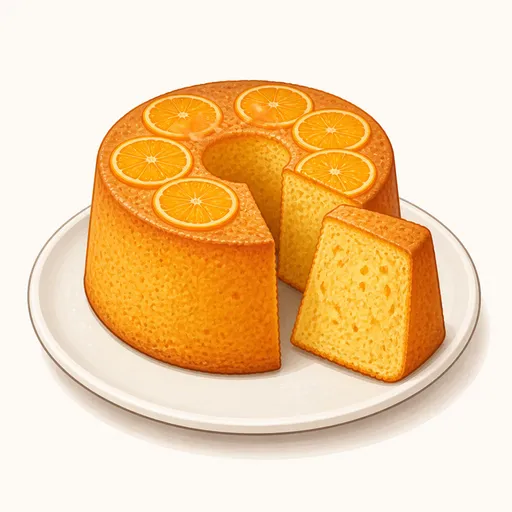
Orange chiffon cake uses freshly squeezed orange juice and grated zest in place of milk, so the crumb is sunshine yellow, gently sweet-tart and full of bright orange oil fragrance. It is as soft and light as a cloud, stays moist overnight, and makes a wonderful breakfast or gift.
- Difficulty
- Medium
- Prep
- 30 min
- Cook
- 45 min
- Rising or chilling
- 1 hr 30 min
- Total time
- 2 hr 45 min
- Method
- Oven-baked
Ingredients
Egg yolk and orange juice batter
Whipped egg whites (meringue)
Instructions
Step 1
Preheat the oven to 165°C with a rack in the middle and wait about fifteen minutes for the heat to settle. Leave the tube pan for this cake bare, with no paper and no oil, because the batter needs to cling to the sides to climb high. You will know the oven is ready when an oven thermometer shows exactly the temperature you set.
Step 2
Wash and dry the oranges, grate off 6 g orange zest, taking only the orange outer layer, then squeeze and strain 80 g orange juice. The white pith under the peel is bitter, so avoid grating too deep. The zest is right when it is fluffy, strongly fragrant and free of white bits.
Step 3
Rub the zest into 20 g granulated sugar with your fingertips, then put it in a bowl with 90 g egg yolks and a pinch salt, whisk well and add 45 g vegetable oil followed by the orange juice. Rubbing the zest with sugar releases the orange oils and works them into every grain of sugar. The mixture is ready when it is golden, slightly thick and smells clearly of orange.
Step 4
Sift 95 g cake flour and 3 g baking powder together over the orange mixture, and whisk in one direction until the flour blends into the liquid. Sifting breaks up lumps and adds air to the mix. Stop whisking when the batter is smooth with no lumps and falls from the whisk in a continuous ribbon.
Step 5
Put 160 g egg whites in a clean, dry bowl and whisk on low speed until foamy, then add 1 g cream of tartar, raise the speed to medium and add 60 g superfine sugar a spoonful at a time. The orange juice makes the batter heavier, so the meringue needs to be firm enough to hold it up. Stop the mixer when the meringue is glossy white and the peaks just curl over at the tip.
Step 6
Stir one large spoonful of meringue into the orange batter to loosen it, then pour this batter into the meringue bowl and use a silicone spatula to cut down through the middle, scrape along the bottom and turn it over. This cut-and-turn motion combines the two with as little loss of air as possible. The batter is ready when it is an even pale yellow with no white patches.
Step 7
Pour the batter into the pan in a steady stream, run a skewer around the pan so the batter fills every corner, then tap the pan gently on the counter. Bake at 165°C for 38 to 45 minutes so the cake rises fully and the top sets. The cake is done when the top is deep golden with dry cracks and a bamboo skewer inserted in the middle comes out clean.
Step 8
As soon as it comes out of the oven, drop the pan once from about a hand's span high, then turn it upside down onto a bottle and leave it for about ninety minutes. Cooling upside down keeps the cake tall, because the crumb is not yet strong enough to hold itself up. You can unmold the cake once the bottom of the pan is completely cool.
Step 9
Turn the pan upright, run a thin knife or a stiff plastic spatula around the sides and the center tube, lift out the base and release the bottom. Working slowly and close to the pan helps the cake keep its thin golden crust. The cake is ready when it is evenly round with a bright yellow, soft and springy crumb; you can arrange a few thin orange slices on top to decorate.
Equipment
- Oven
- Tube pan (chiffon pan)
- Hand mixer
- Whisk
- Spatula
- Sieve
- Kitchen scale
- Mixing bowl
Tips
- Juicy king oranges or regular oranges both work, but choose fruit with thick, plump peel so you can grate plenty of fragrant zest.
- If your orange juice is very sour, replace about a quarter of it with water for a gentler flavor.
- A glaze of powdered sugar and orange juice drizzled over the cooled cake makes it even more fragrant and very pretty.
Storage
Wrap the cake tightly in plastic wrap or keep it in a lidded container in a cool place for one day, or in the fridge for three to four days. Take a chilled cake out about twenty minutes before serving.
Common problems and how to fix them
- The cake has a bitter aftertaste.
- Some of the white pith was grated in with the zest. Grate lightly, taking only the thin orange layer of peel, and keep turning the fruit as you grate.
- The batter is runny and the meringue deflates quickly while folding.
- The meringue was not firm enough or the orange batter was still warm. Whip the whites until the peaks almost stand straight, and let the orange batter cool completely before folding.
This recipe is based on the common ratios for this bake and is written entirely in our own words.