Chinese New Year cake (nian gao)
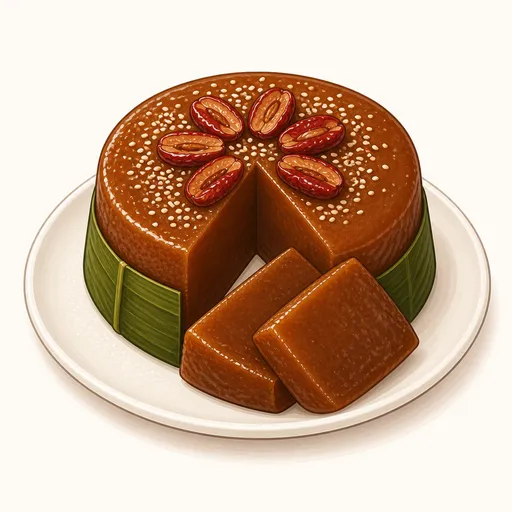
Nian gao, which Vietnamese people know as banh to, is a brown sugar glutinous rice cake that no Chinese New Year celebration is complete without, symbolizing the wish for each year to rise higher than the last. It is steamed for a long time until it turns amber brown, dense and chewy, with a light caramelized sugar aroma. Once it has cooled and firmed up, it is usually sliced, dipped in egg and pan-fried until golden, or steamed again until soft.
- Difficulty
- Easy
- Prep
- 20 min
- Cook
- 2 hr 30 min
- Rising or chilling
- 12 hr
- Total time
- 14 hr 50 min
- Method
- Steamed
Ingredients
Brown sugar syrup
Glutinous rice batter
Pan lining
Garnish
Instructions
Step 1
Put 300 g brown sugar and 380 g water in a saucepan, heat over medium and stir until the sugar has fully dissolved, then turn off the heat and let it cool completely. The syrup must be cool before mixing; if it is still hot, the glutinous rice flour will cook into lumps. The syrup is right when it is clear and deep brown with no sugar grains left at the bottom of the pan.
Step 2
Blanch 30 g banana leaves in boiling water to soften them, wipe them dry and line an 18 cm round pan so the leaves cover the bottom and come up the sides, then brush a thin layer of to taste vegetable oil over the leaves. The banana leaves keep the cake from sticking and add a gentle fragrance. The pan is right when the leaves lie flat, untorn, and cover every corner.
Step 3
Mix 450 g glutinous rice flour with 30 g wheat starch, gradually pour in the cooled syrup while whisking, and finally add 25 g vegetable oil. The wheat starch makes the cake less sticky on your teeth and gives it a glossier surface. The batter is right when it is as smooth as condensed milk, pours in an unbroken stream and has no dry flour left.
Step 4
Strain the batter through a sieve into the lined pan and skim any bubbles off the surface with a spoon. Straining removes any remaining lumps so the cake steams up smooth. The batter is right when the surface is still, glossy and free of tiny bubbles.
Step 5
Cover the top of the pan with a sheet of foil, set it in a steamer over rapidly boiling water and steam for about two and a half hours, topping up the pot with boiling water every thirty minutes. Long steaming cooks the glutinous rice all the way to the center and turns the sugar a deep amber. The cake is done when the top turns a deep, translucent brown and a chopstick inserted in the center comes out with no cloudy white batter.
Step 6
As soon as the cake comes out of the steamer, gently press 30 g pitted dates, cut in half, onto the top in a flower pattern and sprinkle with 5 g toasted white sesame seeds. The top is still hot and sticky, so the garnish stays put right away. It is right when the garnish sinks in slightly without denting the surface.
Step 7
Let the cake cool in the pan at room temperature for at least twelve hours, or overnight, before turning it out to slice. Glutinous rice cakes need a long time to set, and cutting too early makes them stick to the knife and lose their shape. The cake is ready when it feels firm and springy and comes away from the banana leaves easily.
Equipment
- Steamer
- Round cake pan
- Small saucepan
- Whisk
- Sieve
- Spatula
- Mixing bowl
- Kitchen scale
Tips
- Chinese slab brown sugar gives the deepest color and richest flavor, but regular brown sugar still works well.
- Oil your knife before slicing and wipe it after every cut for neat, tidy slices.
- To pan-fry, cut the cake into slices about 1 cm thick, dip them in beaten egg and cook over medium heat until soft again and golden on both sides.
Storage
Wrapped tightly, the cake keeps for three to four days in a cool, airy place, or two weeks in the refrigerator. Chilled cake hardens, so just steam it again for about ten minutes or dip it in egg and pan-fry it, and it will be soft and chewy as new.
Common problems and how to fix them
- The center of the cake is still cloudy white and raw.
- The cake wasn't steamed long enough, or the pot ran low on water and lost its steam. Steam it for thirty minutes more and keep the water at a rolling boil the whole time.
- Water pooled on top of the cake and left it pitted.
- Condensation dripped from the steamer lid onto the cake. Cover the pan tightly with foil and wrap a towel around the steamer lid to catch the condensation.
This recipe is based on the common ratios for this bake and is written entirely in our own words.