Mochi doughnuts
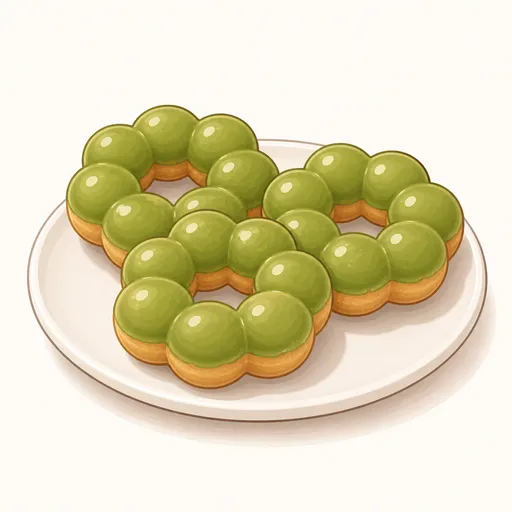
Mochi doughnuts are rings made from eight little balls of dough, inspired by Japan's famous pon de ring. Thanks to glutinous rice flour and tapioca starch, the outside is lightly crisp while the inside stays chewy and soft like mochi, and a matcha glaze adds a gently bitter fragrance that balances the sweetness beautifully.
- Difficulty
- Medium
- Prep
- 35 min
- Cook
- 20 min
- Rising or chilling
- 15 min
- Total time
- 1 hr 10 min
- Method
- Fried
Ingredients
Dough
Matcha glaze
Frying oil
Instructions
Step 1
Put 120 g glutinous rice flour, 40 g tapioca starch, 25 g granulated sugar, 4 g baking powder and a pinch salt in a large bowl and whisk well. Mixing the dry ingredients first spreads the baking powder evenly, so all the little balls puff up alike. The mixture is right when it is an even color with no small lumps.
Step 2
Melt 15 g unsalted butter, let it cool slightly, then stir it together with 90 g whole milk and 50 g egg, pour it gradually into the bowl of flour and bring it together with a spatula and then your hands. Glutinous rice flour absorbs liquid slowly, so knead for about two minutes until the dough is really smooth. The dough is right when it is soft like modeling clay, doesn't stick to your hands and doesn't crack when pressed.
Step 3
Cut parchment paper into eight squares about 10 cm on each side, divide the dough into small balls about the size of the tip of your thumb, and arrange eight touching balls in a ring on each square. The balls must touch closely so they fuse into a sturdy ring as they fry. The rings are right when they are evenly round, every ball is the same size and there are no gaps.
Step 4
Heat to taste oil for deep-frying to about 170 degrees C, lower each ring into the pot along with its parchment square, pull the paper out after about thirty seconds and keep frying for about two minutes per side. Moderate heat gives the chewy center time to cook through before the outside darkens. The doughnuts are done when they are evenly puffed and pale golden and the outside sounds crisp when tapped.
Step 5
Sift 90 g powdered sugar with 4 g matcha powder into a small bowl, then gradually stir in 20 g whole milk until fully dissolved. Sifting well keeps the matcha from clumping into dark specks on the doughnuts. The glaze is right when it is an even green, as thick as honey and runs slowly off a spoon.
Step 6
Once the doughnuts have cooled a little on a wire rack, dip the top of each one into the bowl of glaze, lift it up to let the excess drip off, and set it back on the rack for about fifteen minutes. Doughnuts that are too hot will make the glaze thin and run off. They are finished when the glaze is dry on the surface, doesn't stick to a light touch and still looks glossy.
Equipment
- Mixing bowl
- Spatula
- Parchment paper
- Deep skillet
- Thermometer
- Wire cooling rack
- Whisk
- Kitchen scale
Tips
- If the dough cracks as you roll the balls, add a few drops of milk and knead again; if it is too sticky, sprinkle in a little more tapioca starch.
- You can swap the matcha glaze for a chocolate or strawberry glaze by replacing the matcha powder with cocoa powder or freeze-dried strawberry powder.
- Mochi doughnuts are best within the first few hours, while the outside is still crisp and the inside still chewy.
Storage
The doughnuts keep at room temperature in an airtight container for about one day. Don't refrigerate them, as the glutinous rice flour will harden; if they firm up a little, warm them in a 150 degree C oven for about three minutes before glazing.
Common problems and how to fix them
- The balls came apart during frying.
- The balls weren't touching closely enough or their surfaces had dried out. Next time, press the balls gently against each other and keep the dough covered with a damp towel while you shape.
- The outside is deep golden but the inside is still raw.
- The oil was too hot, so the outside cooked faster than the inside. Lower the heat to keep the oil at about 170 degrees C and fry a little longer.
This recipe is based on the common ratios for this bake and is written entirely in our own words.