Melon pan
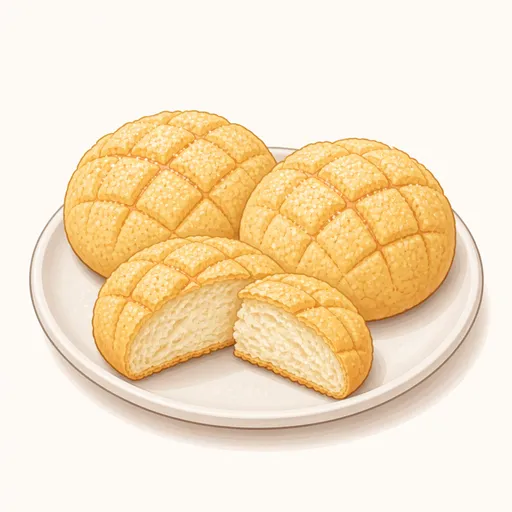
Melon pan is a sweet bread you'll find in every Japanese bakery: a soft, fluffy bread roll wrapped in a crisp butter cookie crust. The name comes from the crosshatch pattern on top, which looks like the rind of a cantaloupe; the traditional version doesn't actually taste of melon at all.
- Difficulty
- Medium
- Prep
- 50 min
- Cook
- 15 min
- Rising or chilling
- 2 hr
- Total time
- 3 hr 5 min
- Method
- Oven-baked
Ingredients
Bread dough
Cookie crust
Sugar coating
Instructions
Step 1
Put 250 g bread flour, 30 g superfine sugar, 4 g instant yeast, 25 g eggs and 145 g whole milk in the mixer bowl and knead on low speed, then add 4 g salt and 25 g softened butter and knead for about fifteen more minutes. The bread needs thorough kneading so it's strong enough to lift the heavy cookie crust on top. The dough is ready when it's smooth and shiny, very elastic and stretches into a thin windowpane.
Step 2
Shape the dough into a ball, place it in a bowl, cover with plastic wrap and let it rise somewhere warm for about an hour. The first rise develops flavor and builds enough gas for a fluffy crumb. The dough is ready when it has doubled in size and a floured finger poked into it leaves a dent that stays.
Step 3
While the dough rises, beat 50 g softened butter with 60 g granulated sugar until light, gradually add 50 g eggs and 2 g vanilla extract, then sift in 150 g cake flour and 1.5 g baking powder and fold into a dough. Mix just enough so the crust bakes up crisp and crumbly rather than hard. The crust dough is ready when it's soft like modeling clay, slightly sticky but not runny.
Step 4
Divide the crust dough into eight equal balls, wrap them in plastic wrap and refrigerate for about 30 minutes. Chilling firms up the butter in the crust so you can roll it thin without it sticking and falling apart. It's ready when it feels cool and is firm enough to pick up without losing its shape.
Step 5
Punch down the bread dough, divide it into eight equal pieces and shape each into a tight ball, then cover with a towel and let them rest for about ten minutes. Tight, round balls bake into beautifully tall domes. They're ready when the surface is smooth with no cracks and the bottom is pinched closed.
Step 6
Put a ball of crust dough between two sheets of plastic wrap and roll it into a round about 10 cm across, peel off one sheet, then lay it over a ball of bread dough and smooth it gently with your palm so the crust covers about three-quarters of the bun. Leaving the bottom uncovered lets the bun rise without the crust bursting open. The bun is ready when the crust covers it evenly, hugging the top and sides, with the white bread still showing at the bottom.
Step 7
Holding the bun by its base, dip the crust side into 20 g superfine sugar to coat it lightly, then use the back of a knife to press diagonal lines into it, making squares or diamonds. Pressing too deep will make the crust crack apart as the bun rises, so press just enough to leave a mark. The top is ready when the lines clearly form an even grid like a melon rind.
Step 8
Arrange the buns on a baking sheet lined with parchment paper, spaced well apart, and let them rise at room temperature for about 40 minutes without covering them; meanwhile, preheat the oven to 180°C. Leaving them uncovered keeps the sugar on top from getting wet and melting. They're ready when they've grown to about one and a half times their size and the grid on top has spread wider.
Step 9
Bake the buns at 180°C for about 12 to 15 minutes, watching closely in the last few minutes, since the cookie crust browns easily. Moderate heat makes the crust crisp and dry while the inside stays soft and moist. They're done when the crust is a pale golden color like a butter cookie, small cracks have opened along the lines and the bottoms are lightly golden.
Equipment
- Oven
- Stand mixer
- Kitchen scale
- Mixing bowl
- Baking sheet
- Parchment paper
- Plastic wrap
- Bench scraper
- Refrigerator
Tips
- For a version that really tastes of melon, add a few drops of melon flavoring and a little green food coloring to the cookie crust.
- If the crust is too soft and sticky to roll, put it back in the fridge for ten minutes rather than adding more flour, since extra flour makes the crust dry and hard.
- You can sandwich a scoop of whipped cream or vanilla ice cream in a cooled bun for the ice cream melon pan that's so popular in Japan.
Storage
Melon pan is crispest on the day it's baked. Keep the buns in a loosely covered container at room temperature for two days, or freeze them for up to two weeks and reheat them in a 160°C oven for about five minutes to crisp up the crust again.
Common problems and how to fix them
- The cookie crust cracks into large pieces.
- The crust was rolled too thin or it covered the bottom too, leaving no room for the bun to rise. Roll the crust about three millimeters thick and leave some bread showing at the bottom of the bun.
- The sugar on top melts into a wet, sticky layer.
- The buns rose somewhere too humid or were covered with plastic wrap. Let them rise somewhere dry and airy, and leave them uncovered during the final rise.
This recipe is based on the common ratios for this bake and is written entirely in our own words.