Marble cake
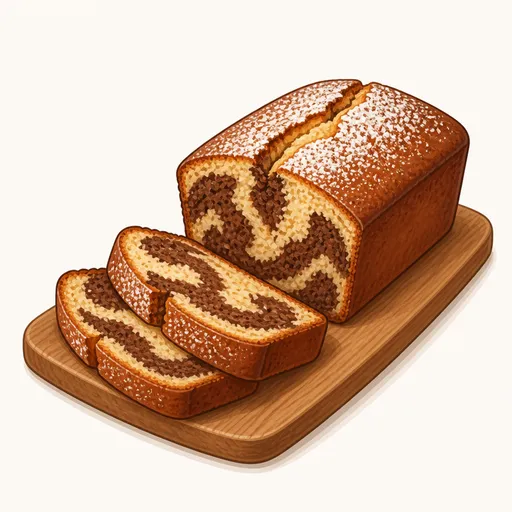
Marble cake is a butter loaf cake with swirls of vanilla and chocolate woven together like veins in marble. The crumb is fine, pleasantly firm and buttery, and every slice reveals a different pattern, which makes it a big favorite with kids.
- Difficulty
- Easy
- Prep
- 25 min
- Cook
- 1 hr
- Rising or chilling
- 1 hr
- Total time
- 2 hr 25 min
- Method
- Oven-baked
Ingredients
Vanilla batter
Chocolate mix-in
Preparing the pan
Instructions
Step 1
Preheat the oven to 170°C, grease a 25 cm loaf pan with unsalted butter (to taste), then line the bottom and the two long sides with parchment paper. A well-lined pan keeps the butter cake from sticking and gives it neat, straight sides. The pan is ready when the parchment sticks firmly thanks to the butter.
Step 2
Put 225 g softened butter and 225 g granulated sugar in a bowl and beat on medium speed for about four minutes. Beating butter and sugar for a good while traps lots of tiny air bubbles, which helps the cake rise with a fine crumb. The mixture is ready when it's fluffy, pale cream in color and the beaters leave clear trails.
Step 3
Add 200 g beaten eggs to the bowl a little at a time, beating well after each addition, then add 6 g vanilla extract. Room-temperature eggs blend into the butter more easily and won't make the mixture curdle. The mixture is ready when it's creamy and smooth and hasn't split into tiny grains.
Step 4
Sift 225 g all-purpose flour with 7 g baking powder and a pinch of salt, add it to the bowl in two additions, alternating with 60 g whole milk, and fold gently. Alternating dry and wet ingredients keeps the batter lump-free without overmixing. The batter is ready when it's thick and smooth and drops from the spatula in soft dollops.
Step 5
Spoon about half the batter into another bowl, sift in 25 g cocoa powder, add 30 g whole milk and stir well. The extra milk makes up for the liquid the cocoa absorbs, so both batters end up equally thick. The chocolate batter is ready when it's an even brown and has the same consistency as the vanilla batter.
Step 6
Drop alternating spoonfuls of vanilla and chocolate batter into the pan in a checkerboard pattern, building two layers, then plunge a skewer all the way to the bottom and drag it through the length of the pan in an S shape, twice. A few passes keep a clear line between the two colors; too many and they blend into a muddy brown. The batter is ready when you can see distinct two-tone swirls on top.
Step 7
Tap the pan gently on the counter and bake at 170°C for about 55 to 60 minutes; if the top browns too quickly, lay a sheet of foil over it. A tall loaf cake needs a long bake for the center to cook through. It's done when the top has a golden brown crack down the middle and a skewer inserted into the center comes out clean.
Step 8
Leave the cake in the pan for about fifteen minutes, then lift it onto a rack and let it cool completely, about an hour in total. A butter cake needs to cool so its crumb can set; if you slice it hot, the slices will be gummy. It's ready when the slices show crisp swirls and the crumb doesn't stick to the knife.
Equipment
- Oven
- Loaf pan
- Hand mixer
- Spatula
- Sieve
- Mixing bowl
- Kitchen scale
- Parchment paper
- Wire cooling rack
Tips
- The butter should be soft enough that a fingertip leaves a dent, but not so soft that it turns oily; that's when it creams up properly.
- For a richer chocolate swirl, you can swap the cocoa for melted dark chocolate; if you do, leave out the extra milk.
- You can bake this batter in a 20 cm round pan instead; the baking time drops to about 40 to 45 minutes.
Storage
Tightly wrapped, the cake stays soft at room temperature for about four days. You can also slice it, wrap the slices in plastic wrap and freeze them for up to two months; thaw at room temperature before eating.
Common problems and how to fix them
- There are no swirls, and the crumb is a single light brown color.
- You dragged the skewer through too many times. Next time, two S-shaped passes are all you need for a marbled look.
- The crumb is dry and crumbly.
- The cake was overbaked or you measured too much flour. Weigh the flour instead of using cups and start checking the cake five minutes earlier.
This recipe is based on the common ratios for this bake and is written entirely in our own words.