Plain steamed buns (mantou)
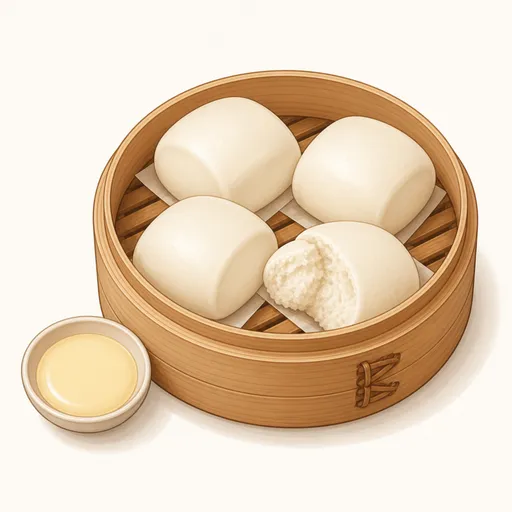
Mantou are Chinese steamed buns without a filling, made from a simple yeasted wheat dough, so the inside is snow white, soft, fluffy and gently sweet. You can eat them with condensed milk, stuff them with braised pork or serve them with savory dishes in place of rice. The secret is kneading the dough until very smooth and proofing it just enough.
- Difficulty
- Easy
- Prep
- 35 min
- Cook
- 15 min
- Rising or chilling
- 1 hr 40 min
- Total time
- 2 hr 30 min
- Method
- Steamed
Ingredients
Instructions
Step 1
Put 500 g bao flour, 40 g granulated sugar, 5 g instant yeast and 5 g salt in a bowl, pour in 265 g warm water along with 10 g vegetable oil and knead for about ten minutes. Bao flour is low in gluten, so kneading it long enough gives a fine, white crumb. The dough is ready when it's dry to the touch, as smooth as a baby's skin and no longer sticks to your hands.
Step 2
Shape the dough into a ball, place it in a bowl, cover with a damp towel and let it rise in a warm spot for about fifty minutes. Mantou only need to rise until the dough is about one and a half times its size, so the crumb stays dense and fine. The dough is ready when you tear off a corner and see small, even air pockets inside.
Step 3
Turn the dough out onto the counter, knead it again for a few minutes to push out all the air, roll it into a rectangle about half a centimeter thick, then roll it up tightly from the long side into a log. Pressing out all the air gives the buns a smooth surface with no pockmarks. The log is ready when it's evenly round, about 40 cm long and the seam is pinched shut.
Step 4
Use a sharp knife to cut the log into twelve equal pieces, set each one on a square of parchment paper and arrange them in a steamer basket, leaving room for them to expand. Cutting in one decisive stroke keeps the cut sides neat instead of squashed. You'll see the spiral of the roll clearly on the cut side of each piece.
Step 5
Cover the steamer with its lid and let the buns rise for about twenty-five more minutes at room temperature. This rise makes the buns light so they puff up round when steamed. They're ready when they've grown by about a third and feel light when you lift them.
Step 6
Set the steamer over a pot of boiling water, wrap the lid in a towel so condensation doesn't drip onto the buns, and steam over medium heat for about twelve to thirteen minutes. Medium heat helps the buns rise evenly without wrinkling. They're done when they're plump, shiny white and spring back when pressed lightly.
Step 7
Turn off the heat but leave the lid on for about five minutes before lifting it slowly. Opening the lid suddenly causes a sharp change in temperature that makes the buns collapse and wrinkle. They're ready when they stay round and plump with no dents once the lid is off.
Step 8
Peel off the parchment and serve the buns hot, with condensed milk or stuffed with braised pork or fried egg, as you like. Hot mantou have the softest, fluffiest crumb and the most pronounced sweet aroma. They're just right when you tear one open and find a fine, white, light crumb with thin layers.
Equipment
- Steamer
- Stand mixer
- Rolling pin
- Bench scraper
- Kitchen scale
- Parchment paper
- Plastic wrap
Tips
- You can replace half the water with fresh milk for more fragrant buns; if you do, cut back on the sugar slightly.
- If you don't have bao flour, use all-purpose flour mixed with a little cornstarch for a whiter, softer crumb.
- Don't let the first rise go too long, or the buns will taste sour and the surface will pit easily.
Storage
Put cooled buns in an airtight bag and keep them in the fridge for three days or in the freezer for up to two months. To serve, just steam them again for five to ten minutes and they'll be as soft as fresh.
Common problems and how to fix them
- The buns wrinkle after steaming.
- They were overproofed or you lifted the lid too soon. Shorten the second rise and always wait five minutes after turning off the heat before opening the lid.
- The crumb is dense and heavy.
- The yeast wasn't active enough or the dough rose somewhere too cold. Use water at about 35°C and let the dough rise somewhere warm, such as a turned-off oven with a bowl of hot water inside.
This recipe is based on the common ratios for this bake and is written entirely in our own words.