Mango pudding
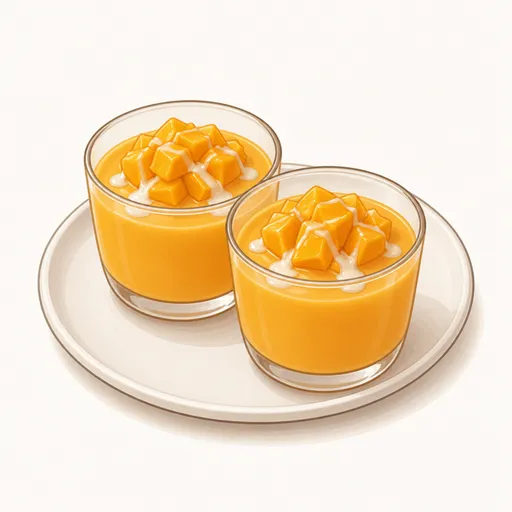
Hong Kong-style mango pudding is a cool, silky, lightly creamy dessert bursting with the natural flavor of ripe mango. It needs no oven, just a few ingredients and a fridge; served with fresh mango and a drizzle of milk, it's perfect for a hot day.
- Difficulty
- Very easy
- Prep
- 20 min
- Cook
- 5 min
- Rising or chilling
- 4 hr
- Total time
- 4 hr 25 min
- Method
- Chilled
Ingredients
Pudding
To serve
Instructions
Step 1
Put the ripe mango flesh in a blender and blend until completely smooth to get 400 g mango puree, then push it through a sieve if the mango is fibrous. Smooth puree gives the pudding a satiny surface. The puree is ready when it's thick and velvety, with no fibers left on the spoon.
Step 2
Divide 180 g water into three portions, pour one portion of cold water into a small bowl, sprinkle 10 g powdered gelatin evenly over the top and leave it for five minutes. Gelatin needs to soak in cold water first so it dissolves evenly without clumping when heated. It's ready when it has swollen into a clear, spongy mass with no dry powder left.
Step 3
Heat the remaining water with 70 g granulated sugar over low heat until the sugar dissolves, take the pan off the heat and stir in the bloomed gelatin until it melts. Don't boil the gelatin, because high heat weakens its setting power. The mixture is ready when it's completely clear with no specks of gelatin floating in it.
Step 4
Pour the warm gelatin mixture into the bowl of mango puree, stir well, then add 150 g evaporated milk and 100 g whipping cream. The warm gelatin blends into the mango easily, while the milk and cream add a soft richness. The mixture is ready when it's an even pale orange-yellow with no white streaks of cream.
Step 5
Strain the mixture through a sieve once more, then pour it into eight small bowls or glasses and skim off any foam with a spoon. Straining and skimming keep the pudding smooth, with no air holes once it sets. You've got it right when the surface in every cup is perfectly flat and bubble-free.
Step 6
Cover with plastic wrap and refrigerate the cups for at least four hours. Gelatin needs enough time in the cold to create that soft, wobbly texture. The pudding is ready when it jiggles gently but doesn't flow when you tilt the cup.
Step 7
Dice 150 g ripe mango and pile it on top of the puddings, then drizzle 40 g evaporated milk over them just before serving. The drizzle of milk adds richness and a pretty contrast of color. It's ready to serve when the milk flows in soft white ribbons around the golden mango cubes.
Equipment
- Blender
- Small saucepan
- Whisk
- Sieve
- Kitchen scale
- Ramekins
- Refrigerator
Tips
- Choose very ripe, fragrant, low-fiber mangoes, such as Vietnamese cat or keo mangoes or Ataulfo, for the most intense flavor.
- For a firmer pudding you can turn out onto a plate, add a little more gelatin and pour it into lightly oiled molds.
- If your mangoes are already very sweet, you can cut back on the sugar and add a few drops of lemon juice for a fresher taste.
Storage
The pudding keeps for three days in the fridge when each cup is tightly covered. Don't freeze it, because the gelatin will weep and the pudding will lose its silky texture when thawed.
Common problems and how to fix them
- The pudding hasn't set after several hours.
- The gelatin was boiled or didn't dissolve completely. Soak the gelatin in cold water for a full five minutes and dissolve it only in warm liquid, never letting it boil.
- The pudding separated, with a yellow layer on top and a white layer underneath.
- The mixture wasn't stirred well enough or was poured while still too hot. Let it cool a little and stir it again right before pouring.
This recipe is based on the common ratios for this bake and is written entirely in our own words.