Mango mousse cake
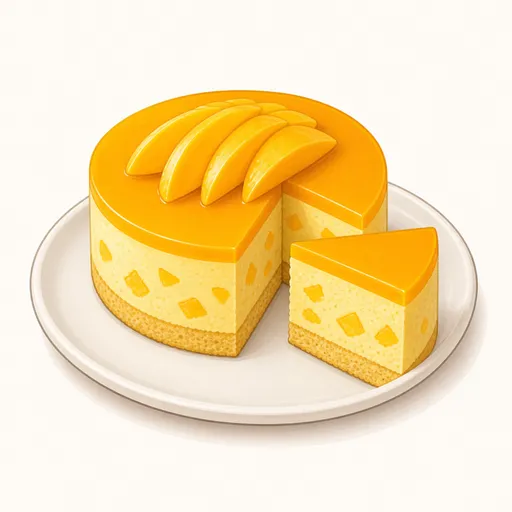
This mango mousse cake has a thin layer of sponge at the bottom, a silky, cloud-light mango mousse studded with pieces of ripe mango, and a shimmering golden mango jelly on top. Its sweet tropical fragrance and cool, refreshing texture make it a summertime favorite.
- Difficulty
- Medium
- Prep
- 1 hr
- Cook
- 20 min
- Rising or chilling
- 5 hr
- Total time
- 6 hr 20 min
- Method
- Chilled
Ingredients
Sponge base
Mango mousse
Mango jelly topping
Instructions
Step 1
Preheat the oven to 180°C and line the bottom of a round cake pan with parchment paper. A thin sponge bakes very quickly, so the oven needs to be at the right temperature before you mix the batter. The oven is ready after preheating for about fifteen minutes.
Step 2
Beat 100 g eggs with 50 g superfine sugar on high speed for about eight minutes; you can set the bowl over a pot of warm water at the start to help the eggs whip up faster. Whipped whole eggs are the only thing that makes this sponge rise, so beat them long enough. The mixture is ready when it's ivory white, has tripled in volume and, when you lift the beater, the ribbon that falls leaves a clear trail on the surface for a few seconds.
Step 3
Sift 50 g cake flour into the eggs in two additions, folding gently, then mix 15 g melted butter with 15 g warm whole milk, stir in a little of the batter and pour it all back into the bowl. Mixing the butter with some batter first keeps it from sinking to the bottom and knocking out the air. The batter is ready when it's smooth, glossy and still light and airy.
Step 4
Pour the batter into the pan, spread it level and bake at 180°C for about 12 to 15 minutes. A thin layer only needs a short bake to stay moist and soft. The sponge is done when the top is pale golden, springs back when pressed and the edges pull slightly away from the pan.
Step 5
Let the sponge cool on a rack, slice off the thin top skin and trim the edges so the diameter is about one centimeter smaller than your mousse ring, then set it in the bottom of a lined springform pan or ring. The gap around the edge lets the mousse flow down and fully encase the sponge for a neat finish. The base is ready when it lies flat in the center with an even gap all the way around.
Step 6
Sprinkle 10 g powdered gelatin for the mousse over 50 g cold water, and separately sprinkle 4 g powdered gelatin for the jelly over 20 g cold water, then let both bowls sit for about five minutes. Blooming them separately lets you use each one for its own layer without worrying about it setting too early. The gelatin is ready when it's swollen, translucent and has no dry granules left.
Step 7
Gently warm one third of the 300 g mango puree with 50 g granulated sugar over low heat, turn off the heat and stir in the bloomed gelatin for the mousse until dissolved, then mix in the rest of the mango puree and 15 g lemon juice. Warming only part of the mango keeps its fresh flavor while still dissolving the gelatin completely. The mixture is ready when it's smooth, has cooled to room temperature and is just starting to thicken.
Step 8
Whip 250 g cold whipping cream for about three minutes until it reaches soft peaks. Softly whipped cream blends easily into the mango and gives a light, silky, cloud-like mousse. The cream is ready when it forms soft peaks that droop over when you lift the beater.
Step 9
Fold the whipped cream into the mango mixture in two additions, pour half over the sponge, scatter 150 g diced ripe mango on top, then pour over the rest of the mousse and tap the pan gently. The layer of fresh mango in the middle adds a lovely surprise when you slice the cake and boosts the flavor. You're there when the mousse is level, with no white streaks of cream or large air bubbles.
Step 10
Refrigerate the cake for about four hours, until the mousse has set. The surface has to be firm so the jelly poured on top doesn't sink into it. The mousse is ready when the top feels dry, springy and not sticky to the touch.
Step 11
Melt the gelatin for the jelly by setting the bowl in hot water, then mix it with 120 g mango puree and 20 g granulated sugar. Let it cool until it's just slightly cool, then pour it gently over the mousse over the back of a spoon. Cooled jelly won't melt the mousse underneath. The jelly layer is ready when it covers the whole top in a smooth, glossy golden sheet.
Step 12
Chill for about one more hour until the jelly sets, then warm the outside of the ring gently with a hair dryer and lift it off. The warmth melts the mousse against the ring ever so slightly, so the cake releases with clean edges. The cake is finished when the sides are straight and smooth; you can decorate it with a few slices of fresh mango.
Equipment
- Oven
- Round cake pan
- Springform pan
- Hand mixer
- Whisk
- Spatula
- Sieve
- Small saucepan
- Parchment paper
- Kitchen scale
- Refrigerator
Tips
- Choose tree-ripened Vietnamese cat or keo mangoes, or another low-fiber variety such as Ataulfo, for a smooth, fragrant mousse; if your mangoes are fibrous, push the puree through a sieve after blending.
- Avoid very tart, underripe mangoes, because the acid can weaken the gelatin and make the mousse hard to set.
- If you'd rather not bake, you can swap the sponge for a cookie crumb base mixed with butter.
Storage
Covered, the cake keeps for three days in the fridge. You can also freeze the cake before adding the jelly for up to two weeks, then thaw it in the fridge for about four hours before topping it with jelly and serving.
Common problems and how to fix them
- The mousse separated into a dense mango layer at the bottom and a cream layer on top.
- The mango mixture was still too warm or too runny when you added the cream. Wait until the mango has cooled and thickened slightly before folding in the cream.
- The jelly ran and blended into the mousse.
- The jelly was poured while still warm, or the mousse hadn't set enough. Let the jelly cool completely and only pour it once the mousse no longer feels sticky to the touch.
This recipe is based on the common ratios for this bake and is written entirely in our own words.