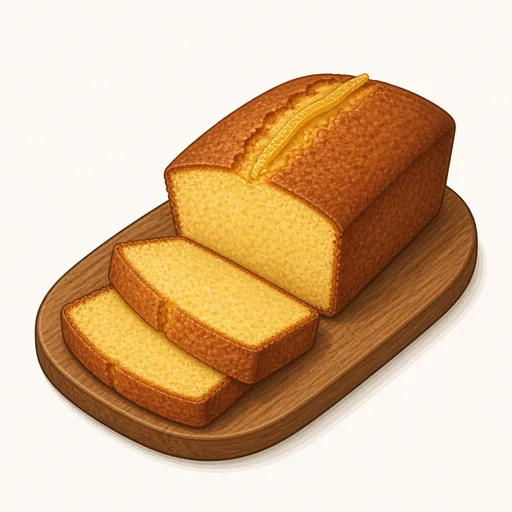
Madeira cake
Madeira cake is a classic British butter cake, named after the glass of Madeira wine it was once served with. It has a firm yet fine, tender crumb fragrant with butter and lemon zest, and a signature crack across the top. It's sturdy enough to slice for afternoon tea or to use as the base for a fondant-covered cake.
- Difficulty
- Easy
- Prep
- 25 min
- Cook
- 1 hr
- Rising or chilling
- 30 min
- Total time
- 1 hr 55 min
- Method
- Oven-baked
Ingredients
Instructions
Step 1
Preheat the oven to 170°C, grease a 21 cm loaf pan with butter and line it with parchment paper, letting the paper stand a little higher than the sides of the pan. The tall paper shields the sides of the cake from some of the heat, so the crust doesn't darken during the long bake. The oven is ready when an oven thermometer reads exactly 170°C.
Step 2
Beat 175 g softened butter with 175 g superfine sugar and 4 g lemon zest on medium speed for about five minutes. Beating for a long time works plenty of air into the butter, and that's what makes the crumb fine and tender. The mixture is ready when it's pale, light and fluffy and noticeably increased in volume.
Step 3
Beat 150 g eggs and add them to the butter a little at a time, beating well after each addition; if the mixture starts to look split, add a spoonful of flour. Adding the eggs gradually keeps the mixture emulsified so the cake rises evenly and isn't heavy. It's ready when it's silky and glossy and holds its shape when scooped.
Step 4
Sift 175 g self-rising flour, 50 g all-purpose flour and a pinch of salt into the bowl, fold gently with a spatula, then add 30 g whole milk to loosen the batter. The all-purpose flour gives Madeira cake its characteristically firm, fine crumb. The batter is ready when it drops off the spoon in dollops after a few seconds of gentle shaking.
Step 5
Spoon the batter into the pan, smooth it out and use the back of a spoon to make a shallow groove down the center. The groove helps the cake crack neatly in the middle instead of at random. The pan is ready when the batter is level on both sides and just slightly dipped in the center.
Step 6
Bake at 170°C for about 50 to 60 minutes; if the top browns early, lay a loose sheet of foil over it. A moderate temperature lets the thick crumb bake evenly without the crust drying out and hardening. It's done when the top is golden brown, the crack in the middle looks dry and a skewer comes out clean.
Step 7
Leave the cake in the pan for about 15 minutes, then lift it onto a rack and let it cool completely before slicing. A butter cake needs to cool fully so the butter firms up, giving neat slices that don't crumble. It's ready when the center no longer feels warm and the crust is dry.
Equipment
- Oven
- Loaf pan
- Hand mixer
- Spatula
- Sieve
- Mixing bowl
- Kitchen scale
- Parchment paper
- Wire cooling rack
Tips
- Leave the butter, eggs and milk at room temperature for at least an hour before you start so the mixture doesn't split.
- For a traditional touch, lay a thin strip of lemon peel on top of the cake after about thirty minutes of baking.
- If you don't have self-rising flour, use all all-purpose flour and add about one and a half teaspoons of baking powder.
Storage
Wrapped tightly, Madeira cake keeps for five days at room temperature and is even better on the second day. You can also double-wrap it and freeze it for up to two months, thawing it overnight at room temperature.
Common problems and how to fix them
- The butter and egg mixture looks curdled.
- The eggs were too cold or added too quickly. Add a spoonful of flour and keep beating, and next time bring the eggs to room temperature first.
- The cake has a wet, dense streak just under the top.
- It wasn't fully baked or the oven wasn't hot enough. Check your oven temperature with a thermometer and bake ten minutes longer with foil over the top.
This recipe is based on the common ratios for this bake and is written entirely in our own words.