Steamed Malay sponge cake (ma lai go)
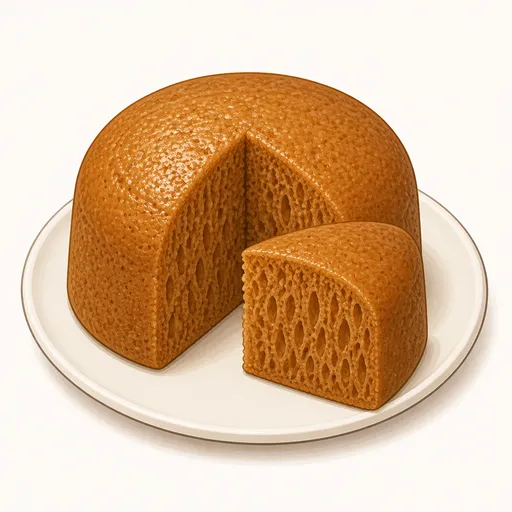
Ma lai go is a steamed cake familiar from Cantonese dim sum houses, with a name that hints at its Malay origins. Brown sugar gives it a honey-brown color, and its tall, airy crumb is full of vertical air pockets, soft, moist and fragrant with milk and egg custard. Because it's steamed rather than baked, it has no hard crust and is silky smooth from the outside in.
- Difficulty
- Easy
- Prep
- 25 min
- Cook
- 35 min
- Rising or chilling
- 1 hr
- Total time
- 2 hr
- Method
- Steamed
Ingredients
Batter
Oil for the pan
Instructions
Step 1
Put 250 g room-temperature eggs and 150 g brown sugar in a large bowl and beat with a mixer on high speed for about eight minutes. Whipped whole eggs are the main source of air that makes the cake rise tall in the steamer. The mixture is ready when it has tripled in volume, turned pale beige and, when you lift the beaters, the trail that falls sits on the surface for a few seconds before disappearing.
Step 2
Sift 150 g all-purpose flour, 15 g custard powder, 8 g baking powder and 2 g baking soda into the eggs in two additions, folding very gently from the bottom with a spatula each time. Sifting them together spreads the leaveners evenly so the air pockets in the cake are uniform. The batter is ready when the dry streaks have just disappeared and the mixture is still slightly puffy.
Step 3
Melt 60 g butter and stir it with 80 g evaporated milk and 3 g vanilla extract, mix in a little of the batter first, then pour it all back into the main bowl and fold until even. Loosening the butter-milk mixture first keeps the fat from sinking to the bottom and making the cake dense. The batter is ready when it's evenly colored and smooth with no glossy streaks of butter.
Step 4
Cover the bowl with plastic wrap and let the batter rest at room temperature for about an hour. The rest lets the flour hydrate and the leaveners start to form bubbles, which gives the steamed cake its signature vertical air pockets. It's ready when the surface is dotted with small bubbles and the batter has thickened slightly.
Step 5
Bring the steamer to a rolling boil over high heat and wrap a towel around the lid; meanwhile, grease a 20 cm round pan with vegetable oil (to taste) and line the bottom with parchment paper. The steam must be very strong from the start for the cake to rise quickly. The steamer is ready when steam rises strongly and evenly through the holes of the steamer basket.
Step 6
Stir the batter gently a few times, pour it into the pan to about seven-tenths of its height and steam over high heat for about thirty to thirty-five minutes, without lifting the lid for the first twenty minutes. Opening the lid early makes the heat drop suddenly and the cake will collapse. It's done when it has risen into a tall dome, the top is dry and a bamboo skewer inserted in the center comes out clean.
Step 7
Lift out the pan, let the cake cool for about ten minutes, then turn it out onto a plate, peel off the parchment and cut it into wedges like a pizza. If it's still too hot, the cake will stick to the knife and the crumb will get squashed. It's ready when the cut surface clearly shows the vertical air pockets and the crumb springs back when pressed.
Equipment
- Steamer
- Round cake pan
- Hand mixer
- Whisk
- Sieve
- Spatula
- Mixing bowl
- Kitchen scale
- Parchment paper
Tips
- Some cooks replace half of the butter with vegetable oil so the cake stays softer once cool; you can try it using the same weight.
- If your steamer is small, divide the batter between two 15 cm pans and shorten the steaming time to about twenty-five minutes.
- The darker the brown sugar, the deeper the cake's color and the stronger its molasses aroma.
Storage
The cake is best while still warm. Once cool and wrapped tightly, it keeps for one day at room temperature or three days in the fridge; just steam it again for five minutes before eating and it will be soft and fluffy again.
Common problems and how to fix them
- The cake collapses and has a dense, rubbery layer at the bottom.
- The eggs weren't whipped enough, or the butter sank to the bottom because it wasn't mixed in well. Beat the eggs until the trail holds for a few seconds, and loosen the butter with a little batter before folding it in.
- The top cracks deeply and the cake tastes slightly bitter.
- There was too much baking soda or it wasn't sifted evenly. Weigh it precisely and sift the leaveners together with the flour.
This recipe is based on the common ratios for this bake and is written entirely in our own words.