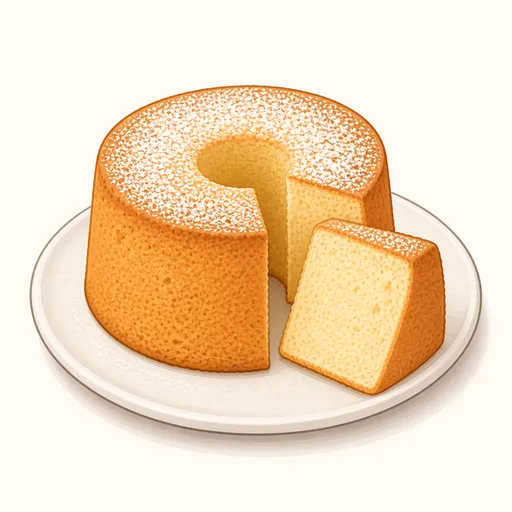
Lemon chiffon cake
This lemon chiffon cake has a light, airy, moist crumb with a hint of fragrant oil from grated lemon zest. The gentle tang of lemon juice makes it far more refreshing than the vanilla version, and a lemon glaze drizzled over the top adds a little sweet crunch with every bite.
- Difficulty
- Medium
- Prep
- 35 min
- Cook
- 45 min
- Rising or chilling
- 1 hr 40 min
- Total time
- 3 hr
- Method
- Oven-baked

Ingredients
Lemon yolk batter
Whipped egg whites
Lemon glaze
Instructions
Step 1
Preheat the oven to 165°C and move the rack one notch below the middle so the tall tube pan doesn't sit close to the top heating element. Keep the tube pan completely dry and ungreased, because the batter needs to cling to the sides to climb high. The oven is ready when the indicator light goes off and the heat inside feels even.
Step 2
Wash and dry the lemons, then grate 6 g lemon zest, taking only the thin yellow outer layer, and squeeze 45 g lemon juice for the batter, setting aside 14 g lemon juice for the glaze. The white pith underneath is very bitter, so avoid grating too deep. The zest is right when it's fluffy, fragrant and free of white bits.
Step 3
Put 90 g egg yolks, 25 g sugar, a pinch of salt and the lemon zest in a bowl, stir until the sugar dissolves, then add 45 g vegetable oil, the lemon juice and 25 g water one at a time. Rubbing the zest with the sugar releases its oils for a stronger aroma. The mixture is ready when it's an even pale yellow with no droplets of oil floating on top.
Step 4
Sift 95 g cake flour and 2 g baking powder over the yolk mixture, and whisk gently from the center outward just until the flour disappears. Overmixing develops gluten and makes the crumb chewy. The batter is ready when it's as smooth as thin cream and falls in a ribbon when you lift the whisk.
Step 5
Whip 165 g egg whites with 1 g cream of tartar on medium speed until full of fine bubbles, then sprinkle in 70 g superfine sugar in three additions and increase to high speed for about seven minutes. The acidity of the cream of tartar keeps the bubbles from collapsing when they meet the lemon juice. The meringue is ready when it's glossy and smooth and the peaks stand straight with just a slight droop at the tip.
Step 6
Add a third of the meringue to the yolk batter and mix it in thoroughly to lighten it, then fold in the rest in two additions, lifting from the bottom of the bowl with a spatula. When the two mixtures have a similar consistency, they combine quickly without losing air. The batter is ready when no white streaks remain and it's fluffy and pale lemon yellow.
Step 7
Pour the batter into the tube pan, draw a skewer through it in a few circles to release large air bubbles, then bake at 165°C for about 40 to 45 minutes. Moderate heat lets the cake rise slowly without cracking too deeply on top. It's done when the top is straw-colored, the cracks on the surface look dry and the cake springs back when pressed lightly.
Step 8
As soon as it comes out of the oven, turn the pan upside down onto the neck of a glass bottle and leave it for about an hour and a half. A hot chiffon crumb is very soft, and hanging it upside down helps it keep its full height instead of collapsing. It has cooled completely when the bottom of the pan no longer feels warm against your hand.
Step 9
Run a thin knife around the sides and the center tube to release the cake, then stir 70 g powdered sugar with the reserved lemon juice into a thick glaze and drizzle it over the top. A glaze of the right thickness runs down in pretty streams instead of soaking into the cake. The cake is finished when the glaze has set on top after about fifteen minutes.
Equipment
- Oven
- Tube pan (chiffon pan)
- Hand mixer
- Whisk
- Spatula
- Sieve
- Kitchen scale
- Mixing bowl
Tips
- Room-temperature lemons give more juice than cold ones; you can roll each lemon on the counter a few times before squeezing.
- If the glaze is too thin, add powdered sugar a little at a time; if it's too thick, add a few drops of lemon juice until it flows slowly off a spoon.
- Don't replace the lemon juice with more water, because the tang is exactly what makes this cake special.
Storage
Keep the glazed cake in an airtight container at room temperature for one day, or in the fridge for about three days. The glaze may turn a little damp in the cold, so let the cake sit out for about twenty minutes before serving.
Common problems and how to fix them
- The cake has a slightly bitter aftertaste.
- Some of the white pith was grated in with the zest. Next time, grate lightly, taking only the thin yellow peel and turning the lemon constantly.
- The meringue deflates quickly when folded into the yolk batter.
- The meringue wasn't whipped stiff enough or you folded too vigorously. Whip until the peaks stand firm, and fold in one direction, turning the bowl after each fold.
- The cake slides out of the pan while it's upside down.
- The pan had oil on it or was nonstick, so the batter couldn't cling. Use a plain aluminum pan, washed clean and dried thoroughly before pouring in the batter.
This recipe is based on the common ratios for this bake and is written entirely in our own words.