Kuih lapis
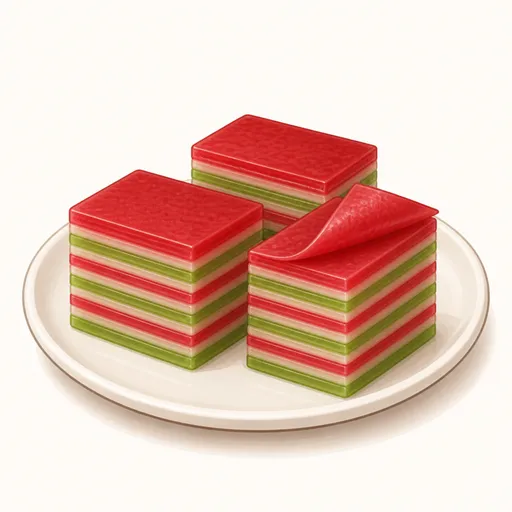
Kuih lapis is a steamed multi-layered cake from Malaysia and Singapore, with alternating layers of red, white and green. It's soft and chewy, rich with coconut milk, and you can peel it apart one thin layer at a time, which is exactly how local kids love to eat it.
- Difficulty
- Medium
- Prep
- 25 min
- Cook
- 1 hr 10 min
- Rising or chilling
- 4 hr
- Total time
- 5 hr 35 min
- Method
- Steamed
Ingredients
Batter
Coloring
Greasing the pan
Instructions
Step 1
Put 200 g sugar in a saucepan with 350 g water, heat gently and stir until the sugar has completely dissolved, then turn off the heat and let it cool a little. Sugar that's already dissolved blends evenly into the batter instead of settling as grains at the bottom of the pan. The syrup is ready when it's clear and you can't see any sugar crystals when you tilt the pan.
Step 2
Mix 120 g rice flour, 200 g tapioca starch and a pinch of salt in a large bowl, slowly pour in 400 g coconut milk and stir until smooth, then add the still-warm syrup and strain through a sieve. Tapioca starch gives the cake its chewiness, while rice flour helps the layers hold their shape and peel apart easily. The batter is ready when it's as thin as milk and perfectly smooth.
Step 3
Divide the batter into three equal portions, stir 1 g red food coloring into one and 2 g pandan extract into the second, and leave the third white. Dividing evenly from the start keeps the layers the same thickness so you don't run short of batter at the end. The three bowls are ready when the colors are even with no dark streaks on the surface.
Step 4
Brush a 20 cm square pan with a very thin coat of vegetable oil (to taste), set it in the steamer once the water is at a rolling boil, and steam the empty pan for about five minutes. A preheated pan cooks the first layer on contact at the bottom so it doesn't stick. The pan is ready when it feels clearly hot and has a light film of condensation.
Step 5
Stir one bowl of batter, pour a thin ladleful into the pan, cover and steam for about five minutes, then pour a different color on top and repeat in the order red, white, green. Always stir the batter before ladling, because the starch settles very quickly and would make each later layer denser than the one before. Each layer is cooked when it turns from opaque to translucent and doesn't stick to your finger when touched lightly.
Step 6
Pour in the last layer, usually red for a pretty top, and steam it longer, about fifteen minutes, so the whole cake cooks through to the center. This longer steaming helps the layers underneath bond tightly together. The cake is done when the top is glossy and translucent and a toothpick inserted comes out with no cloudy white batter.
Step 7
Lift out the pan and let the cake cool completely at room temperature for at least four hours, then cut it into squares or diamonds with an oiled knife or a plastic knife. While still warm the cake is very soft and sticky, and cutting it would squash the layers. It's ready when it feels chewy and springy in your hand and each cut shows every colored layer clearly.
Equipment
- Steamer
- Square pan
- Small saucepan
- Whisk
- Sieve
- Kitchen scale
- Mixing bowl
Tips
- Keep the steamer over medium heat and wrap a towel around the lid so condensation doesn't drip down and pit the surface of each layer.
- For perfectly even layers, weigh each ladleful of batter instead of judging by eye; each layer only needs to be about half a centimeter thick.
- Natural pandan gives a better fragrance: you can replace the extract with freshly blended and strained pandan juice, reducing the water for the syrup by the same amount.
Storage
Kept in an airtight container at room temperature, the cake stays soft and chewy for one day. Avoid the fridge, as the starch will harden; if you must keep it longer, steam it for about five minutes to soften it again.
Common problems and how to fix them
- The layers separate when you cut the cake.
- The lower layer was steamed too long, so its surface dried out and couldn't bond with the next one. Pour on each new layer as soon as the previous one has just turned translucent.
- The cake turns hard and cloudy after cooling.
- You may have refrigerated it, or the proportion of rice flour was too high. Keep the cake at room temperature and weigh the flours exactly as the recipe says.
This recipe is based on the common ratios for this bake and is written entirely in our own words.