Coconut-filled pandan crepes (kuih dadar)
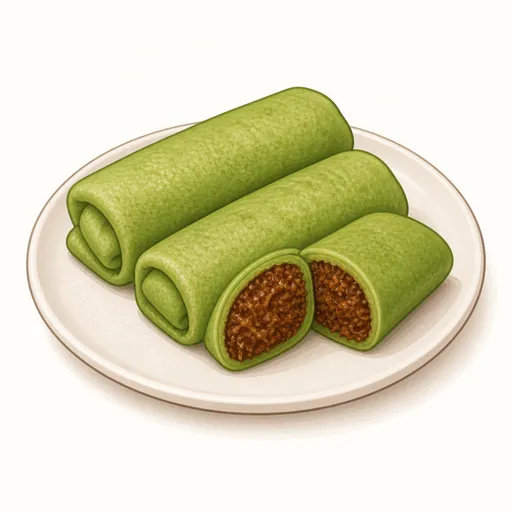
Kuih dadar is a beloved rolled treat in Malaysia and Indonesia: a thin, pandan-green crepe wrapped around freshly grated coconut cooked down with palm sugar. The crepe is soft and rich with coconut milk, while the filling is deeply sweet with caramel notes, perfect with a hot cup of tea in the afternoon.
- Difficulty
- Easy
- Prep
- 30 min
- Cook
- 40 min
- Rising or chilling
- 30 min
- Total time
- 1 hr 40 min
- Method
- Pan-cooked or waffle iron
Ingredients
Pandan crepes
Coconut and palm sugar filling
Instructions
Step 1
Heat 120 g palm sugar with 60 g water and 10 g pandan leaves tied in a knot until the sugar dissolves, then add 200 g freshly grated coconut and a pinch of salt and stir over low heat for about twelve minutes. Cooking it slowly lets the coconut soak up the sugar evenly without scorching. The filling is ready when it's almost dry, the coconut shreds are glossy brown and clump together.
Step 2
Put 150 g all-purpose flour, a pinch of salt and 50 g eggs in a bowl, whisk in 200 g coconut milk, 100 g water and 80 g pandan juice, then strain through a sieve. Straining keeps the crepes smooth, lump-free and without holes. The batter is ready when it's as thin as heavy cream and lightly coats the back of a spoon.
Step 3
Cover the bowl and let the batter rest for about thirty minutes at room temperature. Resting relaxes the gluten and lets the air bubbles rise out, so the crepes are tender and less likely to tear when rolled. The batter is ready when the surface is still and has few tiny bubbles left.
Step 4
Wipe a nonstick pan with a paper towel dipped in vegetable oil (to taste), set it over low heat, pour in a ladle of batter and swirl the pan to spread it into a thin layer, then cook until the top is dry. Low heat keeps the crepes a fresh green without brown spots. The crepe is done when the edges lift away from the pan on their own and the top no longer looks wet.
Step 5
Lay a crepe on a cutting board, spoon a strip of filling along the edge closest to you, fold in both sides and roll it up snugly, like a spring roll. Folding in the ends before rolling keeps the filling from falling out as you eat. They're finished when they're evenly rolled, hold together firmly and the seam sits underneath.
Equipment
- Nonstick skillet
- Small saucepan
- Whisk
- Sieve
- Mixing bowl
- Kitchen scale
- Blender
- Spatula
Tips
- Use freshly blended pandan juice for a natural green color and a stronger fragrance than bottled extract.
- If the crepes keep tearing, add a little more flour to the batter or let it rest longer before cooking.
- Stack the cooked crepes on a plate and cover them with a clean towel so they stay moist and their edges don't dry out before rolling.
Storage
Kept in an airtight container at room temperature, the crepes last for one day. You can refrigerate them for up to three days, then steam them for about three minutes so the crepes soften and the coconut filling becomes fragrant again.
Common problems and how to fix them
- The crepes are thick and tough.
- The batter is too thick, or you poured in too much at once. Thin the batter with a little water and use just enough to coat the bottom of the pan.
- The coconut filling is watery and makes the crepes soggy.
- The filling wasn't cooked down enough. Stir it for a few more minutes until the liquid has completely evaporated, and let it cool before rolling.
This recipe is based on the common ratios for this bake and is written entirely in our own words.