Korean twisted doughnuts (kkwabaegi)
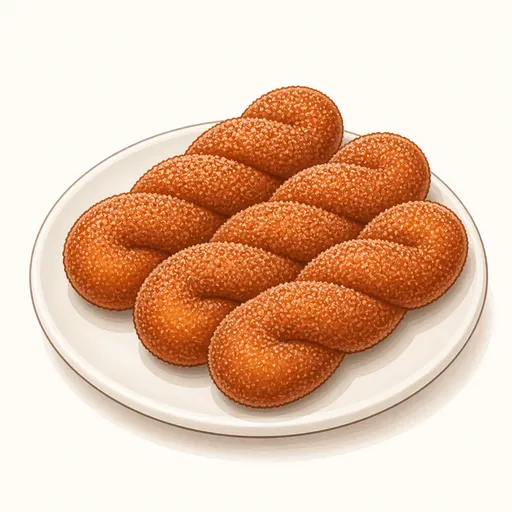
Kkwabaegi are twisted doughnuts you'll find at traditional markets all over Korea, twisted like a rope, fried golden and rolled in cinnamon sugar. They have a lightly crisp outside and a soft, chewy inside thanks to the yeasted dough, and they're perfect with a glass of milk or a cup of coffee.
- Difficulty
- Medium
- Prep
- 30 min
- Cook
- 20 min
- Rising or chilling
- 1 hr 20 min
- Total time
- 2 hr 10 min
- Method
- Fried
Ingredients
Dough
Cinnamon sugar coating
Oil for frying
Instructions
Step 1
Warm 150 g whole milk and stir in 5 g instant yeast and 25 g granulated sugar, then pour it into a bowl with 300 g all-purpose flour, 4 g salt and 50 g eggs, and knead for about five minutes before adding 15 g softened unsalted butter. Knead for about five minutes more so the gluten is strong enough for the ropes to stretch long and twist without breaking. The dough is ready when it is smooth, elastic and no longer sticks to your hands.
Step 2
Shape the dough into a ball, place it in a bowl, cover it tightly, and leave it in a warm spot for about an hour. The first rise gives the dough a yeasty aroma and a light texture. It's ready when it has doubled in size and a floured finger poked into it leaves a hole that holds its shape.
Step 3
Press the dough gently to release some of the gas, cut it into twelve equal pieces with a knife, and roll each into a ball, then cover with plastic wrap and let the dough rest for a few minutes. Dividing evenly means all the doughnuts cook at the same rate in the pan. The balls are ready when they weigh about the same and their surfaces are smooth and taut.
Step 4
Roll each ball into a rope about thirty centimeters long, hold both ends and roll them in opposite directions so the rope twists on itself, then fold it in half so it winds around itself and pinch the ends firmly together. Pinching the ends well keeps them from unraveling as the doughnuts puff up in the oil. Each one is ready when it forms an evenly twisted braid about fifteen centimeters long.
Step 5
Arrange the twists on a parchment-lined baking sheet a few centimeters apart, cover with plastic wrap, and let them rise for about twenty minutes more. This short rise makes them puff up while keeping the twists clearly defined. They're ready when they've grown by about a third and feel light and soft to the touch.
Step 6
Heat the oil for frying (to taste) to about 170°C, add the twists one at a time, and fry for about three minutes, turning them often with chopsticks. Turning them constantly browns every groove of the twist evenly. They're done when they are an even golden brown and feel light when lifted.
Step 7
Mix 80 g granulated sugar with 3 g ground cinnamon in a wide tray, lift the doughnuts out and let them drain for about a minute, then roll them in the mixture. While still warm, the doughnuts hold the cinnamon sugar firmly in every groove. They're finished when they're evenly coated in light brown sugar that smells of cinnamon.
Equipment
- Mixing bowl
- Deep skillet
- Thermometer
- Wire cooling rack
- Bench scraper
- Plastic wrap
- Kitchen scale
Tips
- You can replace some of the all-purpose flour with glutinous rice flour for an extra-chewy doughnut, the way some shops in Korea do.
- If the ropes shrink back as you roll them, let the dough rest for five more minutes so the gluten can relax, then keep rolling.
- Don't roll the doughnuts in sugar while they're still very hot, or the sugar will melt and turn clumpy.
Storage
These doughnuts are best on the day they're made. You can keep uncoated doughnuts in an airtight bag at room temperature for one day, then reheat them in an air fryer at 160°C for about three minutes before rolling them in cinnamon sugar.
Common problems and how to fix them
- The twists unravel while frying.
- The ends weren't pinched firmly enough or the rope wasn't twisted enough. Twist the ropes more tightly and press the ends well together before the second rise.
- The doughnuts are too hard and overly chewy.
- The dough didn't rise long enough or picked up too much flour while you rolled it. Let the dough rise until doubled and dust the counter with only a very little flour.
This recipe is based on the common ratios for this bake and is written entirely in our own words.