Khanom krok
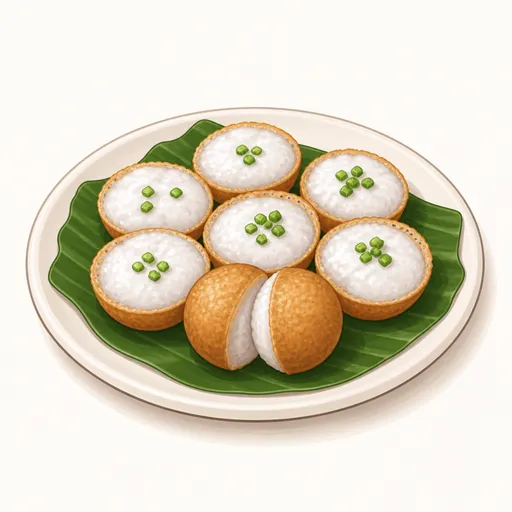
Khanom krok is a beloved Thai street snack cooked in a pan with small round cups, much like Vietnamese banh khot. Each one has a crisp bottom topped with a layer of rich, sweet-salty coconut cream as soft as custard, and two halves are usually pressed together and eaten hot.
- Difficulty
- Easy
- Prep
- 20 min
- Cook
- 30 min
- Rising or chilling
- 30 min
- Total time
- 1 hr 20 min
- Method
- Pan-cooked or waffle iron
Ingredients
For the base layer
For the coconut cream top
For the garnish
For preparing the pan
Instructions
Step 1
Put 150 g rice flour, 20 g tapioca starch, 20 g granulated sugar and 3 g salt in a bowl, slowly pour in 300 g coconut milk and 60 g water while stirring, then let the batter rest for thirty minutes. Resting lets the rice flour absorb the liquid, so the bottoms turn crisp without being gritty. The batter is ready when it is as thin as milk with no lumps.
Step 2
In another bowl, stir 250 g thick coconut cream with 50 g granulated sugar, 15 g rice flour and 2 g of salt until the sugar dissolves. A little rice flour in the cream helps the top layer set soft and smooth instead of turning watery. The mixture is ready when it is thick and glossy with no gritty sugar left at the bottom of the bowl.
Step 3
Set the small round-cup pan over medium heat, heat it for about five minutes, then brush vegetable oil (to taste) into each cup. The pan must be very hot so the bottoms form a crisp crust and don't stick. The pan is ready when a drop of water sizzles and evaporates immediately.
Step 4
Stir the base batter again, since rice flour settles quickly, then pour it into each cup until about two-thirds full. Batter poured into a hot pan cooks on the outside right away, forming a thin shell that hugs the sides of each cup. You'll hear a sizzle and see the edges start to set after about a minute.
Step 5
Once the edges of the base have set but the center is still liquid, pour the coconut cream on top to fill each cup and sprinkle with 15 g thinly sliced scallions, if you like. Adding the cream at this point lets the two layers blend just enough so they don't separate. The tops are ready when the cream covers them completely and puffs up slightly in the center.
Step 6
Cover the pan and cook for about five to seven minutes more over medium heat, turning the pan now and then if your burner heats unevenly. The heat trapped under the lid cooks the coconut cream on top until soft while the bottoms keep crisping. They're done when the cream no longer looks wet and shiny and the edges of the bottoms have turned golden brown.
Step 7
Use a small spoon to loosen each one around the edge of its cup and lift it onto a plate, then press two halves together to form a little round ball. Pairing them while hot makes the cream stick together and keeps them moist. They're at their best when the bottoms sound crisp when tapped and the cream inside is still soft and creamy.
Equipment
- Small cup molds
- Whisk
- Mixing bowl
- Kitchen scale
- Pastry brush
- Spatula
Tips
- If you don't have a khanom krok pan, use a banh khot pan or a takoyaki pan; just pour a little less batter into each cup.
- You can swap the scallions for sweet corn kernels or diced steamed taro for a different flavor.
- Brush on a fresh thin layer of oil before each batch so later batches release as easily as the first.
Storage
Khanom krok are best eaten within an hour of cooking, while the bottoms are still crisp. If you have leftovers, keep them in an airtight container in the fridge for up to a day and reheat them in the cup pan for about two minutes to crisp the bottoms again.
Common problems and how to fix them
- The cakes stick to the pan and break when you take them out.
- The pan wasn't hot enough or there was too little oil. Heat the pan longer, oil each cup thoroughly, and wait until the bottoms are fully golden before lifting them.
- The coconut cream on top is watery and doesn't set.
- The cakes weren't covered long enough or the cream didn't have enough rice flour. Stir the cream well before pouring and keep the lid on for an extra minute or two.
This recipe is based on the common ratios for this bake and is written entirely in our own words.