Japanese soufflé pancakes
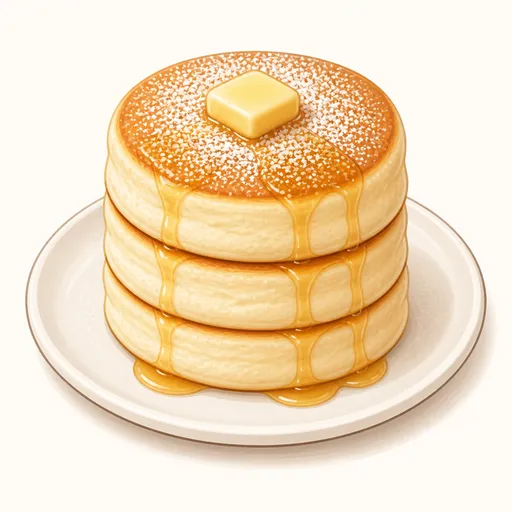
Soufflé pancakes are tall, jiggly pancakes that are hugely popular in Japanese cafés. They contain very little flour and are mostly meringue (egg whites whipped with sugar), cooked in a covered pan over very low heat so the inside is as soft as a cloud.
- Difficulty
- Medium
- Prep
- 20 min
- Cook
- 20 min
- Total time
- 40 min
- Method
- Pan-cooked or waffle iron
Ingredients
For the yolk batter
For the whipped egg whites (meringue)
For cooking
For serving
Instructions
Step 1
Separate the eggs carefully, putting 36 g egg yolks in a small bowl and 96 g egg whites in a clean stainless steel bowl, then place the bowl of whites in the freezer for about ten minutes. Cold egg whites give a meringue with small, firm bubbles that deflates more slowly. The whites are ready when a few thin ice crystals start to form around the edge of the bowl.
Step 2
Add 30 g whole milk and 2 g vanilla extract to the yolks and whisk until well combined. This yolk mixture brings flavor and richness to the pancakes. It's ready when it is evenly yellow, a little frothy, and there are no streaks of yolk left.
Step 3
Sift 40 g cake flour and 2 g baking powder into the yolk mixture and stir gently until smooth. Sifted flour won't form lumps when it meets the meringue. The mixture is ready when it is thick like pastry cream, smooth, and free of white specks of flour.
Step 4
Beat the cold egg whites with 0.5 g cream of tartar on medium speed; once they turn into fine white foam, add 30 g superfine sugar in three additions, then raise the speed to high and beat to stiff peaks. A stiff meringue is the framework that keeps the pancakes standing tall in the pan. The meringue is ready when it is glossy and smooth, the peak on the lifted beaters stands straight up, and it doesn't slide when you turn the bowl upside down.
Step 5
Add one-third of the meringue to the yolk mixture and stir to lighten it, then pour this mixture back into the bowl of meringue and fold gently with a flat spatula in two rounds. Folding in two stages breaks the fewest air bubbles. The batter is ready when it is even in color with no white patches and still holds a mound when scooped.
Step 6
Set a nonstick skillet with a lid over very low heat, wipe it with a thin film of vegetable oil (to taste) using a paper towel, and let it warm gently for about two minutes. Low heat matters most here, because the pancakes need to cook slowly from the bottom all the way to the center. The pan is ready when you hold your hand a few centimeters above it and feel a comfortable warmth rather than a sting.
Step 7
Scoop one large spoonful of batter into the pan, then stack two more spoonfuls on top to build a tall mound; make three mounds spaced well apart. Piling the batter high gives these pancakes their signature thickness. The mounds are ready when they are about four centimeters tall and don't spread out.
Step 8
Pour about half of the 30 g water into the empty spaces between the mounds, cover the pan, and cook over low heat for about five minutes; while you wait, you can add a little more of the remaining batter on top of each mound. The steam cooks the tops of the pancakes without needing high heat. They're ready to flip when the bottoms are pale golden and the pancakes slide slightly when you shake the pan.
Step 9
Flip the pancakes very gently using two thin spatulas, pour the rest of the water into the pan, cover, and cook for about five more minutes. Flipping with two spatulas keeps the pancakes from breaking or collapsing. They're done when both sides are golden brown, the sides are dry, and the tops spring back when pressed lightly.
Step 10
Arrange the hot pancakes on a plate, top them with 10 g unsalted butter, drizzle with 40 g maple syrup, dust with a little powdered sugar (to taste), and serve right away. Soufflé pancakes slowly deflate after a few minutes, so they need to be eaten hot. They look their best while still tall and jiggling as you set the plate on the table.
Equipment
- Nonstick skillet
- Hand mixer
- Whisk
- Spatula
- Sieve
- Kitchen scale
- Mixing bowl
Tips
- Set a parchment-lined ring mold in the pan and spoon the batter inside for taller, perfectly round pancakes.
- If your stove is hard to turn down low enough, use a heat diffuser or lift the pan off the burner for a few seconds every minute.
- The batter can't wait long, so get your pan and tools ready before you start whipping the meringue.
Storage
Soufflé pancakes should be eaten right after cooking, since they deflate and lose their fluffiness within fifteen minutes. If you have leftovers, keep them in an airtight container in the fridge for a day and warm them in the microwave for a few seconds; they'll be soft but not as tall as at first.
Common problems and how to fix them
- The pancakes collapse as soon as they come out of the pan.
- The insides weren't fully cooked or the meringue wasn't stiff enough. Cook them longer, covered, over low heat, and whip the meringue until the peaks stand straight up.
- The bottoms burn black while the centers are still raw.
- The heat is too high for the thickness of the pancakes. Turn the heat down to the lowest setting, cover the pan tightly, and add water so the steam cooks the pancakes gently.
This recipe is based on the common ratios for this bake and is written entirely in our own words.