Hotteok
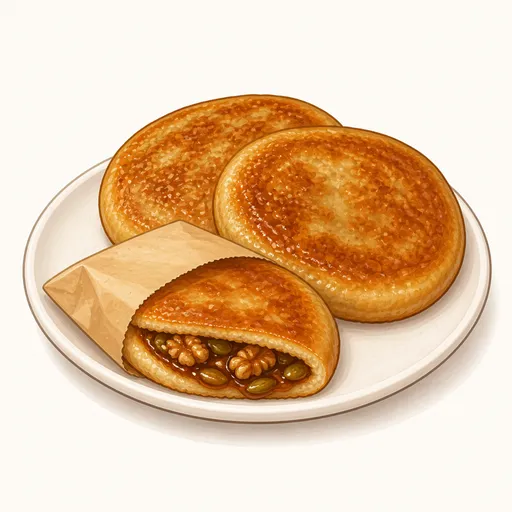
Hotteok are sweet, pan-fried Korean street pancakes, especially loved in winter. The dough combines all-purpose flour with glutinous rice flour, so it's crisp on the outside and delightfully chewy inside, while the brown sugar and cinnamon filling melts into a warm, syrupy stream mixed with rich, nutty seeds.
- Difficulty
- Easy
- Prep
- 25 min
- Cook
- 25 min
- Rising or chilling
- 1 hr
- Total time
- 1 hr 50 min
- Method
- Pan-cooked or waffle iron
Ingredients
For the dough
For the cinnamon sugar filling
Oil for pan-frying
Instructions
Step 1
Put 250 g all-purpose flour, 50 g glutinous rice flour, 15 g granulated sugar, 3 g salt and 4 g instant yeast in a bowl, pour in 230 g warm water and 12 g vegetable oil, and stir vigorously with a spoon for a few minutes. Hotteok dough is very soft and sticky, and that's what makes the pancakes chewy rather than hard. The dough is ready when it comes together into a thick, stretchy mass with no streaks of dry flour.
Step 2
Cover the bowl with plastic wrap and leave the dough in a warm spot for about an hour. The yeast creates air bubbles that make the pancakes puff slightly and turn light as they cook. The dough is ready when it has doubled in size, the surface is dotted with bubbles, and it smells faintly tangy and yeasty.
Step 3
Finely chop 30 g walnuts and mix them with 80 g brown sugar, 3 g ground cinnamon and 15 g pumpkin seeds, if using. Chopping the nuts finely spreads the filling evenly and keeps them from poking through the dough. The filling is ready when the nuts are evenly coated in cinnamon sugar and the mixture is a uniform brown.
Step 4
Rub a little vegetable oil on your hands, punch down the dough, and divide it into eight pieces. Flatten one piece in your palm, place about one heaping tablespoon of filling in the center, and pull the edges up and pinch them closed like a little pouch. Oiled hands keep the dough from sticking and make it easy to stretch thin. Each ball is ready when it is round, the seam is completely sealed, and no sugar is peeking out.
Step 5
Heat vegetable oil (to taste) in a nonstick skillet over medium heat, place a ball seam side down, and fry for about a minute, then flip it and press it flat with a flat spatula into a disk about one centimeter thick. Pressing after the bottom has set keeps the dough from tearing and spreads the filling evenly. It's ready when it has become a flat round disk with a golden, crisp underside.
Step 6
Turn the heat down to low and keep frying for about one to two minutes per side, covering the pan for a little while if you like. Low heat gives the sugar inside time to melt into syrup without burning the outside. The hotteok are done when both sides are evenly golden brown and the center feels slightly puffed and soft when pressed gently.
Step 7
Transfer the hotteok to paper towels for about a minute, then enjoy them hot, folded in half in a sheet of paper the way street vendors serve them. A short rest takes the edge off the scorching filling while keeping it runny. They're at their best when the outside is crisp and a warm stream of cinnamon syrup flows out as you bite in.
Equipment
- Nonstick skillet
- Mixing bowl
- Spatula
- Kitchen scale
- Plastic wrap
Tips
- The sugar filling is very hot straight from the pan, so take a small bite from the edge first to avoid burning yourself.
- Add a few roasted peanuts or sunflower seeds to the filling for a seed-packed version in the style of Busan.
- If the dough is too sticky to wrap, oil your hands more instead of adding dry flour to the dough.
Storage
Hotteok are best eaten hot, right after frying. Cooled pancakes keep in an airtight container in the fridge for up to two days or in the freezer for up to two weeks; reheat them in a skillet over low heat so the outside crisps up and the filling melts again.
Common problems and how to fix them
- The sugar filling leaks into the pan when you press the pancake.
- The seam wasn't pinched closed or the dough was stretched too thin. Leave a thicker edge of dough where you wrap it and pinch it firmly before placing it in the pan.
- The outside is burnt but the sugar inside is still grainy.
- The heat was too high during the final stage. Turn the heat down to low, cover the pan, and fry a little longer so the heat has time to melt the filling.
This recipe is based on the common ratios for this bake and is written entirely in our own words.