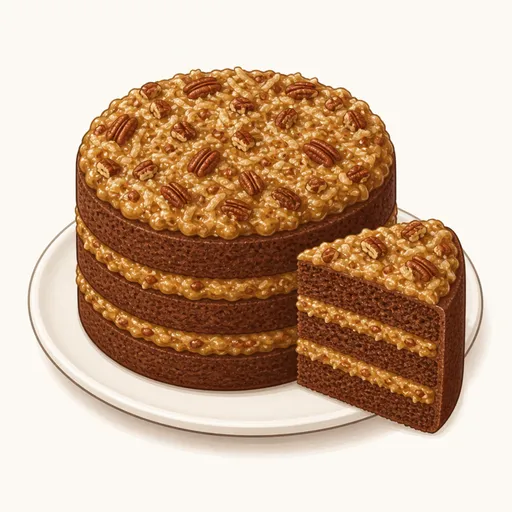
German chocolate cake
Despite its name, this three-layer cake is American, named after Sam German, who created the sweet baking chocolate originally used in it. Light, tender chocolate layers are stacked with a cooked custard filling full of coconut and toasty pecans, and the sides are traditionally left bare.
- Difficulty
- Hard
- Prep
- 1 hr
- Cook
- 50 min
- Rising or chilling
- 1 hr 40 min
- Total time
- 3 hr 30 min
- Method
- Oven-baked
Ingredients
Chocolate cake layers
Coconut pecan filling
Pan prep
Instructions
Step 1
Preheat the oven to 175°C, grease three 23 cm round pans with to taste unsalted butter and line the bottoms with parchment paper. Baking three thin layers at once means they bake quickly and stay tender. The pans are ready when the parchment lies flat and the sides are evenly coated with butter.
Step 2
Put 115 g chopped dark chocolate in a bowl, pour 120 g just-boiled water over it and stir until fully melted, then let it cool. Chocolate melted in hot water turns silky smooth without direct heat. The mixture is ready when it is smooth and fluid like chocolate milk and has cooled down a bit.
Step 3
Beat 225 g softened unsalted butter with 400 g granulated sugar on medium speed for about four minutes. Beating a large amount of sugar into the butter creates lots of air pockets, which keeps the crumb soft and light. The mixture is ready when it is fluffy, pale and feels smooth when rubbed between your fingers.
Step 4
Add 80 g egg yolks one at a time, beating well after each, then add the cooled chocolate and 5 g vanilla extract. The yolks emulsify the batter and give the crumb a rich, fine texture. The mixture is ready when it is an even light brown, silky and not curdled.
Step 5
Sift 250 g all-purpose flour with 5 g baking soda and 3 g salt, then add it to the bowl in three additions, alternating with 240 g buttermilk, mixing on low speed. The acid in buttermilk activates the baking soda and makes the crumb soft and tender. The batter is ready when the dry flour has just disappeared and it is smooth and creamy.
Step 6
Whip 130 g egg whites in a very clean bowl to stiff peaks, about four minutes. Whipped egg whites are what make German chocolate cake lighter than other butter cakes. The whites are ready when the peaks stand straight up as you lift the whisk and they don't slide when you tip the bowl.
Step 7
Stir a third of the whites into the batter to loosen it, then fold in the rest very gently. That first addition softens the batter so the remaining whites don't lose their air. The batter is ready when no white streaks remain and it is still light and airy.
Step 8
Divide the batter evenly among the three pans and bake at 175°C for about 30 to 35 minutes. Keep an eye on the thin layers toward the end so the edges don't dry out. They are done when the tops spring back, the edges pull away from the pans and a skewer comes out clean.
Step 9
Leave the layers in the pans for about fifteen minutes, run a knife around the sides, turn them out onto a rack and let them cool for about an hour. Cake made with whipped whites is quite delicate, so it needs to rest before coming out of the pan. The layers are ready when they are completely cool and the tops are no longer tacky.
Step 10
Spread 120 g pecans on a baking sheet and toast them at 170°C for about 8 to 10 minutes, then let them cool and chop them. Toasting makes the nuts crisp and buttery so they stay crunchy in the moist filling. They are ready when they smell clearly toasty and have turned a shade darker.
Step 11
Put 340 g evaporated milk, 200 g granulated sugar, 70 g egg yolks and 115 g unsalted butter in a saucepan and cook over medium heat, stirring constantly, for about twelve minutes. Constant stirring keeps the yolks from setting into lumps. The filling is ready when it is thick, has turned a caramel gold and coats the back of a spoon.
Step 12
Take the pan off the heat, stir in 5 g vanilla extract, 150 g desiccated coconut and the pecans, then let it cool for about 40 minutes, stirring now and then. As it cools, the filling thickens just enough to spread without running off the cake. It is ready when it is thick and falls from a spoon in clumps.
Step 13
Set one cake layer on a plate, spread about a third of the coconut filling over it, repeat with the other two layers and finish with the last of the filling on top, leaving the sides bare. Bare sides are the hallmark of German chocolate cake and show off the layers. The cake is ready when the three layers stand straight and each has an even, thick layer of filling.
Equipment
- Oven
- Round cake pan
- Small saucepan
- Hand mixer
- Whisk
- Spatula
- Sieve
- Mixing bowl
- Kitchen scale
- Parchment paper
- Wire cooling rack
- Baking sheet
Tips
- The original recipe uses sweet baking chocolate; with dark chocolate, the cake will be a little richer and less sweet.
- If you want to cover the cake layers, you can spread a thin layer of ganache around the sides.
- If you have only two pans, bake two layers first and leave the remaining batter at room temperature, then bake the third layer right after.
Storage
Covered, the cake keeps for one day at cool room temperature. After that, refrigerate it for up to four days and let it sit out for about thirty minutes before slicing.
Common problems and how to fix them
- The coconut filling is runny and slides off the cake.
- The filling wasn't cooked thick enough or was spread while still hot. Cook it until it coats the back of a spoon and wait until it has cooled completely before spreading.
- The filling has little lumps of cooked egg.
- The heat was too high or the stirring was uneven. Cook over medium heat, stir constantly and, if needed, strain it through a sieve before adding the coconut and nuts.
This recipe is based on the common ratios for this bake and is written entirely in our own words.