French meringues
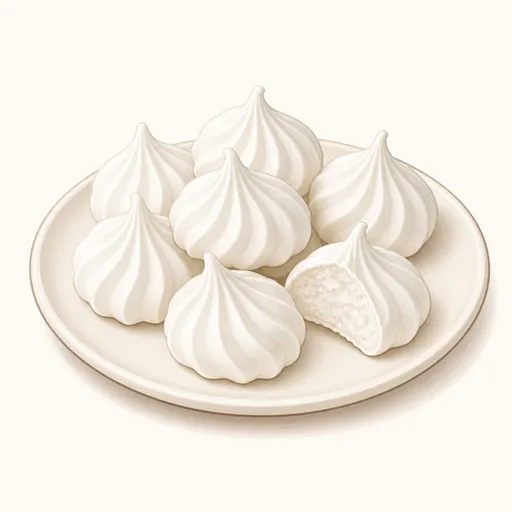
French meringue is the simplest kind of meringue: egg whites whipped with sugar and then dried very slowly in the oven. These snow-white cookies have a shatteringly crisp shell and a center as light as a cloud. They need only two main ingredients, but they do ask for a little patience with a low oven.
- Difficulty
- Easy
- Prep
- 20 min
- Cook
- 1 hr 40 min
- Rising or chilling
- 1 hr
- Total time
- 3 hr
- Method
- Oven-baked
Ingredients
Instructions
Step 1
Preheat the oven to 100°C with top and bottom heat, and line two baking sheets with parchment paper. The low heat dries the meringues without letting them take on color. The oven is ready when an oven thermometer shows a steady reading, since many ovens actually run hotter than the dial says.
Step 2
Wipe the bowl and whisk with a paper towel dampened with a few drops of lemon juice or vinegar, then add 120 g egg whites at room temperature. Even a trace of grease or yolk will stop the whites from whipping up. The bowl is ready when it is completely dry and doesn't feel greasy at all.
Step 3
Add a pinch lemon juice to the whites and whip on medium speed for about four minutes. A little acid stabilizes the bubbles and makes the whites harder to overwhip. They are ready when they turn opaque white with fine bubbles and form soft peaks that droop when you lift the whisk.
Step 4
Turn the mixer up and sprinkle in 120 g superfine sugar one spoonful at a time, a few seconds apart, then keep whipping for about six minutes, adding 3 g vanilla extract if you like. The sugar needs to dissolve fully so the meringues don't weep syrup in the oven. The meringue is ready when it is satiny and glossy, holds stiff upright peaks and feels smooth, not gritty, when you rub a little between your fingers.
Step 5
Sift 120 g powdered sugar over the meringue in two additions and fold it in gently from the bottom up with a spatula, just a few strokes until combined. Powdered sugar makes the meringues crisper and drier, but overmixing will knock out the air. The mixture is ready when no white streaks of sugar remain and it still holds stiff peaks.
Step 6
Spoon the meringue into a piping bag fitted with a star tip and pipe rosettes about 4 cm across, spaced 2 cm apart, on the lined baking sheets. Keeping them the same size means they all dry at the same rate. The trays are ready when the rosettes are crisp and sharp, each with a little twisted peak on top.
Step 7
Bake both trays at 100°C for 90 to 110 minutes without opening the oven door during the first hour. This is really a drying process: the moisture slowly evaporates and leaves a crisp structure behind. The meringues are done when they lift easily off the paper, the bottoms are dry and they sound hollow when tapped.
Step 8
Turn off the oven, prop the door open slightly with a wooden spoon and let the meringues cool slowly inside for about 60 minutes. Cooling gradually keeps the shells from cracking from a sudden change in temperature. They are ready when they are completely cool and crunchy when you bite into them.
Equipment
- Oven
- Stand mixer
- Spatula
- Sieve
- Piping bag
- Baking sheet
- Parchment paper
- Kitchen scale
Tips
- Avoid making meringues on a rainy, humid day; the sugar pulls moisture from the air and makes them soft and sticky.
- For a pale tint, dip a toothpick in food coloring and paint a few stripes inside the piping bag before filling it with meringue.
- Broken meringues can be folded with whipped cream and strawberries to make an Eton mess.
Storage
Store the meringues in an airtight container lined with paper in a cool, dry place, where they stay crisp for up to two weeks. Don't refrigerate them, because the humidity will make them soft and weepy.
Common problems and how to fix them
- The meringues weep beads of amber syrup.
- The sugar didn't fully dissolve or the oven was too hot. Add the sugar more slowly, whip until the meringue is no longer gritty and check the real oven temperature with a thermometer.
- The meringues turn golden brown.
- The oven is hotter than it needs to be. Lower it to about 90°C and extend the drying time by twenty minutes.
- The centers are still chewy and sticky after cooling.
- They weren't dried long enough or were piped too large. Bake them for another twenty to thirty minutes and let them cool completely in the switched-off oven.
This recipe is based on the common ratios for this bake and is written entirely in our own words.