French crullers
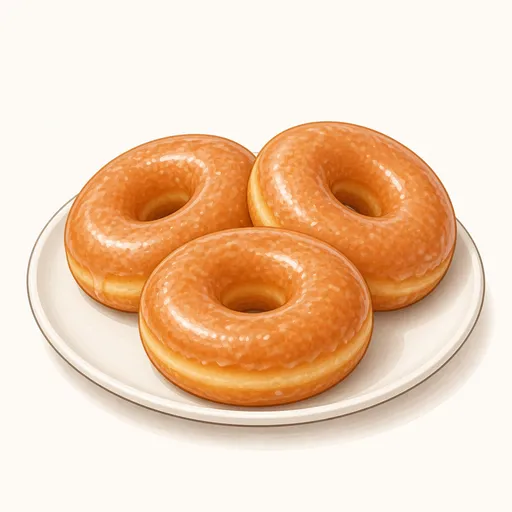
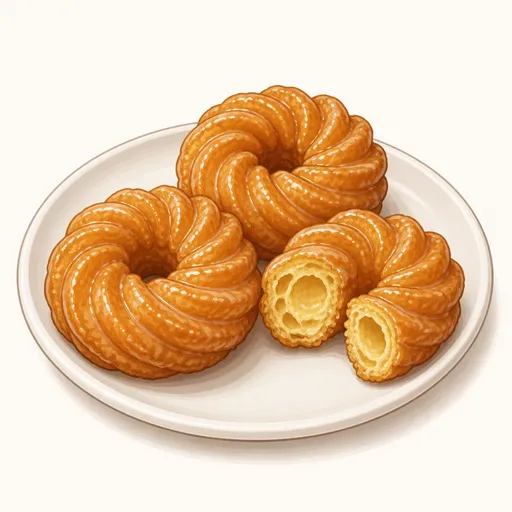
A French cruller is a doughnut made from choux pastry (a dough that is cooked on the stove and then beaten with eggs, just like the dough for cream puffs), piped into a ridged, twisted ring and fried. The result is feather-light, with a thin crisp shell and a hollow, moist center that is almost custardy, finished with a thin honey glaze that melts the moment it hits your tongue.
- Difficulty
- Hard
- Prep
- 35 min
- Cook
- 30 min
- Rising or chilling
- 20 min
- Total time
- 1 hr 25 min
- Method
- Fried
Ingredients
Choux pastry
Honey glaze
Frying oil
Instructions
Step 1
Put 120 g water, 120 g whole milk, 115 g unsalted butter cut into small pieces, 10 g granulated sugar and a pinch salt in a saucepan and heat over medium until the butter has fully melted and the mixture comes to a boil. The butter needs to melt completely before the liquid boils so the fat is spread evenly through the dough. It is ready when the whole surface is bubbling vigorously, not just the edges.
Step 2
Add all of the 140 g all-purpose flour at once and stir hard with a spatula until it comes together into a ball, then keep stirring it over the heat for about three minutes. Cooking the dough on the stove dries it out a little, so it can absorb more egg and puff up higher. The dough is ready when it pulls cleanly away from the sides and a thin film forms on the bottom of the pan.
Step 3
Transfer the dough to a bowl and beat it with a mixer on low speed for about a minute to let it cool slightly, then add 200 g beaten eggs a little at a time, waiting until each addition is fully absorbed before adding more. Adding the eggs gradually keeps the dough from separating and keeps it smooth and glossy. The dough is ready when it is shiny and smooth and falls slowly from a lifted spatula in a V shape.
Step 4
Spoon the dough into a piping bag fitted with a large star tip and pipe rings about 8 cm across onto individual 10 cm squares of parchment paper, then put the tray in the freezer for about twenty minutes. Chilling firms up the rings so they are easy to lower into the oil and keep their twisted ridges. The rings are ready when the surface feels set and they hold their shape when you lift the paper.
Step 5
Heat the to taste oil to about 185°C, lower the rings into the oil upside down along with their parchment, lift out the paper once it releases on its own, and fry for about three minutes per side. Frying hotter than for regular doughnuts makes the steam from the eggs expand quickly and creates the hollow center. The crullers are done when they have puffed up fully, the ridges are well defined and the shell is a deep golden brown.
Step 6
Whisk 180 g powdered sugar, 15 g honey, 35 g whole milk and 3 g vanilla extract into a thin glaze, then dip the tops of the crullers while they are still warm and set them on a wire rack. The thin glaze seeps lightly into the ridges and dries into a delicate, glass-like sugar shell. They are finished when the glaze is translucent, dry to the touch and slightly crisp.
Equipment
- Small saucepan
- Spatula
- Hand mixer
- Piping bag
- Parchment paper
- Deep skillet
- Thermometer
- Wire cooling rack
- Whisk
- Kitchen scale
Tips
- If the choux pastry still seems stiff after you have added nearly all the eggs, beat in a little extra beaten egg from a fifth egg until the dough falls in a V shape.
- A large open star tip is the key to the signature twisted ridges.
- Don't peel the parchment off by hand before frying; let it release on its own in the oil so the rings don't lose their shape.
Storage
Crullers are best within a few hours of frying, because the thin shell picks up moisture easily. You can keep them in a loosely covered container at room temperature until the end of the day; avoid the fridge, which will make them soggy.
Common problems and how to fix them
- The crullers collapse and are dense inside after frying.
- The choux pastry was too runny or the oil wasn't hot enough. Stop adding egg as soon as the dough forms a V shape, and keep the oil at about 185°C.
- The rings crack and split apart while frying.
- The dough was cooked too dry or didn't get enough egg, so it lacked stretch. Next time, cook the dough only until a thin film forms on the bottom of the pan and beat in enough egg to make it glossy and supple.
This recipe is based on the common ratios for this bake and is written entirely in our own words.