Ensaymada
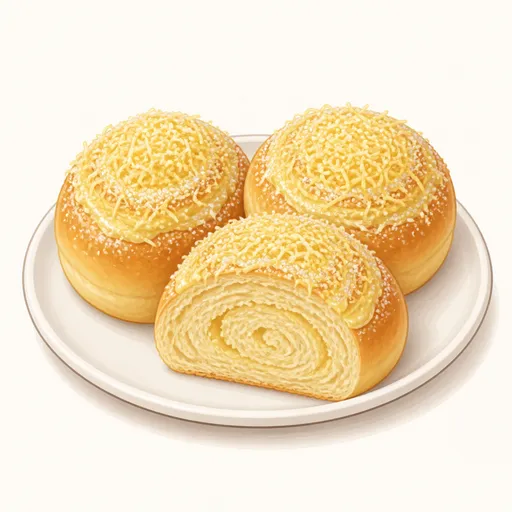
Ensaymada is a cloud-soft spiral bun from the Philippines, descended from the ensaïmada of the Spanish island of Mallorca. The dough is rolled up with butter, baked in small molds and then topped with a layer of whipped butter, a sprinkle of sugar and grated cheese, creating a wonderful blend of sweet and salty.
- Difficulty
- Medium
- Prep
- 50 min
- Cook
- 18 min
- Rising or chilling
- 2 hr 30 min
- Total time
- 3 hr 38 min
- Method
- Oven-baked
Ingredients
For the dough
For the butter spread
For the topping
Instructions
Step 1
Put 300 g bread flour, 60 g granulated sugar and 6 g instant yeast in the bowl of a stand mixer, add 80 g egg yolks, 130 g warm whole milk and 20 g water, mix on low speed, then add 4 g salt. Using plenty of yolks gives the crumb its signature golden color and soft, fine texture. The dough is ready when it comes together into a sticky mass with no liquid left.
Step 2
Knead on medium speed for about five minutes, then add 80 g softened unsalted butter in small pieces and keep kneading for about ten minutes. That much butter needs to be absorbed gradually so the dough doesn't turn greasy. The dough is ready when it's very soft, glossy and smooth and stretches into a thin windowpane.
Step 3
Place the dough in a buttered bowl, cover tightly and let it rise somewhere warm for about an hour and a half. Dough rich in butter and eggs rises slowly, but it rewards you with a crumb as soft as cotton. It's ready when it has doubled in size and feels very soft to the touch.
Step 4
Divide the dough into eight pieces, roll each one into a thin rectangle about 10 by 35 cm and spread 30 g softened unsalted butter evenly over the top. The butter in the middle creates soft, fragrant swirls as the buns rise. The strips are right when they're evenly thin and the butter reaches all the way to the edges.
Step 5
Roll each strip up tightly from the long side into a rope, then coil the rope into a spiral like a snail shell and set it in a small buttered mold, tucking the end underneath. The spiral shape helps the buns rise tall with layers that pull apart gently when torn. They're right when the coil sits neatly in the mold and the end doesn't unravel.
Step 6
Set the molds on a baking sheet, cover loosely with plastic wrap and let them rise for about 50 minutes more, until the dough reaches the rim of the molds. This rise determines how light and airy the buns will be. They're ready when they're puffy and soft and slowly spring back when gently pressed.
Step 7
Preheat the oven to 175°C, then bake the buns on the middle rack for about 15 to 18 minutes. A moderate temperature keeps them soft and only lightly golden, just like traditional ensaymada. They're done when the tops are pale golden and the bottoms are evenly golden in the molds.
Step 8
Let the buns cool completely, beat 40 g softened unsalted butter until fluffy and spread a layer over each top, then sprinkle with 40 g granulated sugar and cover with 60 g grated cheddar. The buns must be cool so the butter stays fluffy instead of melting. They're finished when the tops are fully covered in butter, sparkling with sugar and blanketed with pale golden cheese.
Equipment
- Oven
- Shaping molds
- Stand mixer
- Kitchen scale
- Rolling pin
- Spatula
- Plastic wrap
- Baking sheet
Tips
- Edam cheese is popular in the Philippines around the holidays, and you can use it instead of cheddar for a richer, saltier flavor.
- If you don't have small molds, you can use a muffin tin or sturdy paper molds, as long as you butter them well.
- The dough is very soft, so if it's hard to handle, chill it for about twenty minutes before rolling.
Storage
Since the buns are topped with butter, store them in an airtight container, where they keep for two days at cool room temperature or four days in the fridge. Before eating, let them sit out for about twenty minutes or warm them briefly in the microwave for a few seconds.
Common problems and how to fix them
- The buns are dry and not as soft as expected.
- The dough wasn't kneaded enough or the buns baked too long. Knead until the dough stretches into a windowpane and take the buns out as soon as the tops turn pale golden.
- The butter topping melted, spread and lost its fluffiness.
- The butter was spread while the buns were still warm. Wait until they've cooled completely and whip the butter at cool room temperature.
This recipe is based on the common ratios for this bake and is written entirely in our own words.