Coffee walnut cake
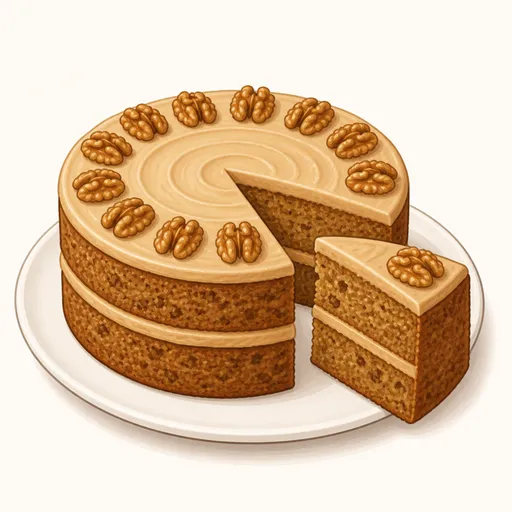
Coffee walnut cake is a British afternoon tea classic: two coffee-scented butter sponges sandwiched with coffee buttercream and decorated with walnuts. The gentle bitterness of the coffee balances the sweetness of the frosting, while the crunchy, nutty walnuts add a lovely accent to every bite.
- Difficulty
- Easy
- Prep
- 35 min
- Cook
- 25 min
- Rising or chilling
- 45 min
- Total time
- 1 hr 45 min
- Method
- Oven-baked
Ingredients
Coffee sponge
Coffee buttercream
Instructions
Step 1
Preheat the oven to 180 degrees Celsius, line the bottoms of two 20 cm round pans with parchment paper and brush a thin layer of butter around the sides. Dividing the batter between two shallow pans helps each layer bake quickly and evenly. The pans are ready when the paper lies flat and the sides are evenly buttered.
Step 2
Mix 10 g instant coffee with 20 g hot water for the sponge, and separately mix 6 g instant coffee with 10 g hot water for the frosting, then let both cool. Concentrated coffee gives a clear flavor without thinning the batter or frosting. Both cups of coffee are ready when fully dissolved and cooled to room temperature.
Step 3
Pick out the prettiest halves from 40 g walnuts for decorating, then chop 80 g walnuts into small pieces about the size of a pea. Small pieces spread evenly through the cake without weighing down the batter, while whole halves keep the top looking beautiful. The walnuts are ready when the chopped pieces are fairly even and haven't been crushed into powder.
Step 4
Beat 225 g softened unsalted butter with 225 g superfine sugar at medium-high speed for about four minutes, stopping halfway to scrape down the bowl. With this much butter and sugar, you need to beat long enough to build up air bubbles for the cake to rise. The mixture is ready when it is much paler, light and fluffy like whipped cream.
Step 5
Beat 200 g eggs in a cup, then add them to the butter a little at a time, beating well after each addition; if the mixture starts to curdle, sprinkle in a spoonful of the flour. Adding the eggs gradually lets them emulsify with the butter instead of turning lumpy. The mixture is ready when it is glossy, smooth, even and still fluffy.
Step 6
Sift 225 g self-rising flour and 3 g baking powder into the bowl, add the sponge coffee and the chopped walnuts, then fold with a spatula. Folding instead of mixing with the machine keeps the batter from getting tough so the cake stays tender. The batter is ready when it is an even light brown and drops from the spatula in soft dollops.
Step 7
Divide the batter evenly between the two pans, using a scale so both weigh the same, smooth the tops and bake at 180 degrees Celsius for about 22 to 26 minutes. Even layers give you a well-balanced cake when stacked. The cakes are done when the tops are golden brown, the edges have pulled slightly away from the pans and the centers spring back when pressed lightly.
Step 8
Leave the cakes in their pans for five minutes, then turn them out onto a rack, peel off the parchment and let them cool for about 45 minutes. Frosting a warm cake will make the buttercream melt and slide off. The layers are ready when they are completely cool all the way through.
Step 9
Beat 125 g softened unsalted butter for about a minute, sift in 250 g powdered sugar in two additions, then add the frosting coffee and beat for about three more minutes. Beating long enough makes the frosting light, smooth and easier to spread. The frosting is ready when it is a milky brown, fluffy and holds its shape when swiped with a spoon.
Step 10
Place the first layer on a plate, spread over half the frosting, set the second layer on top and spread the remaining frosting over it, then arrange the walnut halves around the edge. Splitting the frosting this way makes the filling and the top equally rich and delicious. The cake is finished when the layers stand straight and the frosting is smooth with gentle swirls.
Equipment
- Oven
- Round cake pan
- Hand mixer
- Mixing bowl
- Spatula
- Sieve
- Kitchen scale
- Parchment paper
- Wire cooling rack
Tips
- Toasting the walnuts at 170 degrees Celsius for about seven minutes before chopping makes them much crunchier and more fragrant.
- If you don't have self-rising flour, use all-purpose flour and add about one teaspoon of baking powder for every hundred grams of flour.
- You can replace the instant coffee with a little very strong espresso, but reduce the water to match.
Storage
The frosted cake keeps in an airtight container in a cool, airy spot for two days. In hot weather, store it in the fridge for up to four days and take it out about thirty minutes before serving so the buttercream softens again.
Common problems and how to fix them
- The butter and egg mixture curdled and separated.
- The eggs were too cold or added too quickly. Use room-temperature eggs, add them a little at a time and mix in a spoonful of flour to bring the mixture back together.
- The buttercream is runny and slides off when spread.
- The butter was too soft or the cake was still warm. Chill the frosting for about fifteen minutes and beat it again, and only frost once the cake has cooled completely.
This recipe is based on the common ratios for this bake and is written entirely in our own words.