Coffee mousse cake
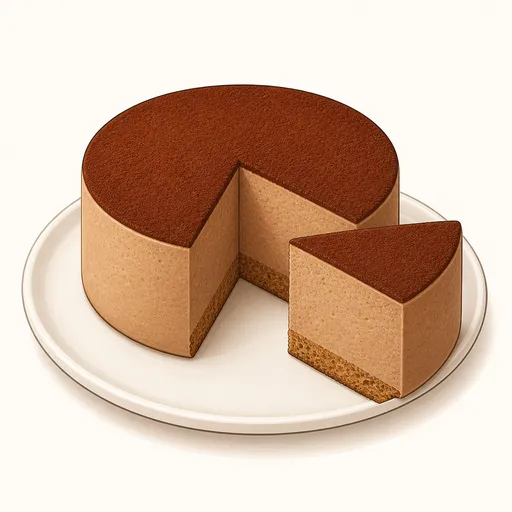
This coffee mousse cake has a thin sponge soaked in espresso under a silky café au lait mousse that melts the moment it touches your tongue. The gentle bitterness of coffee meets the richness of cream, finished with a dusting of cocoa powder, like a glass of Vietnamese iced milk coffee turned into a cake.
- Difficulty
- Medium
- Prep
- 50 min
- Cook
- 20 min
- Rising or chilling
- 5 hr
- Total time
- 6 hr 10 min
- Method
- Chilled
Ingredients
Sponge base
Coffee soaking syrup
Coffee mousse
Finishing
Instructions
Step 1
Line a 20 cm round pan with parchment paper and preheat the oven to 180 degrees Celsius. The sponge base only needs to be thin, and a pan slightly wider than the mousse ring lets you cut it to fit snugly. The oven is ready once it has heated evenly for about fifteen minutes.
Step 2
Beat 100 g eggs with 50 g superfine sugar on high speed for about eight minutes. The whipped eggs are the only leavening for this sponge. The mixture is ready when it is pale ivory, thick and leaves a clear ribbon trail on the surface when you lift the beaters.
Step 3
Sift 50 g cake flour over the eggs and fold gently, stir 15 g melted unsalted butter with a spoonful of the batter and fold it back in, then pour into the pan and bake at 180 degrees Celsius for 12 to 15 minutes. The thin sponge bakes quickly, so watch the time closely to keep it from drying out. The sponge is done when the top is pale golden, springs back when pressed lightly and the edges pull away from the pan.
Step 4
Once the sponge has cooled, use an 18 cm ring to cut out a round, set the ring on a serving plate, line its sides with an acetate strip and place the sponge round in the bottom. The acetate strip gives the mousse smooth, straight sides when you unmold it. The sponge is ready when it lies flat, fits the ring snugly and leaves no gaps around the edge.
Step 5
Stir 15 g granulated sugar into 60 g warm espresso until dissolved, add 15 g coffee liqueur if using, then brush it evenly over the sponge. A coffee-soaked sponge is moister and more flavorful alongside the mousse. The sponge is ready when it is evenly moist but not soggy.
Step 6
Sprinkle 8 g powdered gelatin over 40 g cold water and leave it for about five minutes. Gelatin needs to absorb water first so it dissolves evenly instead of forming specks in the hot custard. The gelatin is ready when it has swelled into a thick, translucent mass with no dry powder left.
Step 7
Heat 150 g whole milk with 10 g instant coffee until steaming, whisk 54 g egg yolks with 70 g granulated sugar, then slowly pour in the milk, return everything to the pan and stir constantly over low heat until it reaches about 82 degrees Celsius. Turn off the heat and stir in the gelatin until fully dissolved. The custard is ready when it is lightly thickened, coats the back of a spoon and holds a clear line when you draw a finger through it.
Step 8
Strain the coffee custard through a sieve into a clean bowl and let it cool for about 20 minutes, stirring now and then. The custard must cool enough not to melt the cream, but not so much that it sets. The custard is ready when it is about 25 degrees Celsius and slightly thick, like thinned condensed milk.
Step 9
Whip 300 g cold whipping cream at medium speed for about three minutes. Softly whipped cream blends into the coffee custard more easily and gives the mousse a silky texture. The cream is ready when it holds soft peaks that droop gently when you lift the beaters.
Step 10
Fold the whipped cream into the coffee custard in two additions with a spatula, then pour the mixture over the sponge in the ring and shake gently to level the top. Folding gently keeps the air bubbles that make the mousse light. The mousse is ready when it is an even milky brown with no white streaks and a smooth, level top.
Step 11
Refrigerate the cake for at least four hours or overnight. The gelatin needs time in the cold to set the whole mousse. The cake is ready when the top of the mousse feels firm to a light touch, doesn't stick to your finger and doesn't wobble when you shake the plate.
Step 12
Sift to taste cocoa powder over the whole top of the cake, then lift off the ring and peel away the acetate strip. The cocoa adds a balancing hint of bitterness and hides any small flaws on the surface. The cake is finished when its sides are smooth and the top is evenly covered in fine cocoa.
Equipment
- Oven
- Round cake pan
- Springform pan
- Hand mixer
- Whisk
- Spatula
- Sieve
- Small saucepan
- Thermometer
- Pastry brush
- Parchment paper
- Kitchen scale
- Refrigerator
Tips
- Use a strong instant coffee or add a little more if you like a bolder coffee flavor.
- For a quicker version, replace the sponge with ladyfingers dipped in coffee.
- If you don't have an acetate strip, warm the ring for a few seconds with a hair dryer to help it slip off easily.
Storage
Kept in an airtight container in the fridge, the cake stays delicious for three days. You can also freeze it for up to two weeks; thaw it in the fridge for about four hours before serving and only dust with cocoa just before eating.
Common problems and how to fix them
- The mousse hasn't set after several hours.
- The gelatin didn't fully dissolve, or there wasn't enough of it. Make sure you stir the gelatin into the custard while it's still hot until it has completely dissolved.
- The mousse is lumpy with small specks.
- The coffee custard had started to set before you mixed in the cream, or the eggs overcooked. Fold in the cream while the custard is still thick but fluid, and cook the egg custard over low heat.
This recipe is based on the common ratios for this bake and is written entirely in our own words.