Coconut agar jelly cake
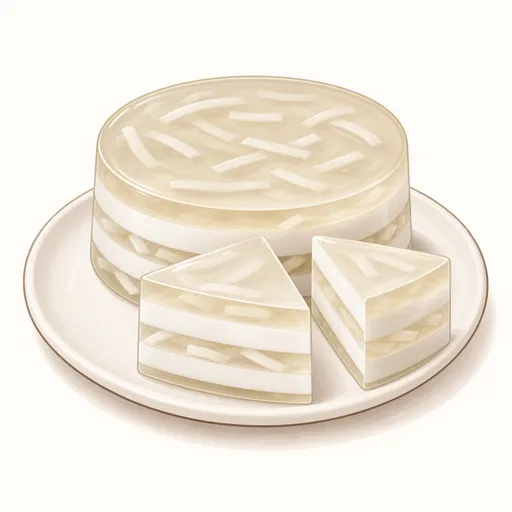
Coconut agar jelly cake is a cool, refreshing dessert much loved in Vietnam, with crystal-clear layers made from fresh coconut water alternating with milky white layers rich with coconut milk and pandan. Crunchy agar jelly lets the cake hold its shape, cut into sharp-edged pieces and give a pleasant crunch with every bite, making it perfect for hot days or holiday feasts.
- Difficulty
- Easy
- Prep
- 20 min
- Cook
- 30 min
- Rising or chilling
- 2 hr
- Total time
- 2 hr 50 min
- Method
- Chilled
Ingredients
Clear coconut water layer
Coconut milk layer
Instructions
Step 1
Wash a 20 cm round mold, rinse it with cold water and leave it slightly wet rather than drying it. The thin film of water helps the set cake slip out of the mold easily. The mold is ready when small drops of water still cling to the sides and bottom.
Step 2
Mix 7 g crunchy jelly powder thoroughly with 90 g granulated sugar, then sprinkle it slowly into a pot of 700 g fresh coconut water while stirring and let it sit for ten minutes. Mixing the powder with sugar first keeps it from clumping when it hits the liquid. The mixture is ready when no powder floats on the surface and there is no sediment on the bottom of the pot.
Step 3
Set the pot of coconut water over medium heat, stirring steadily until it boils, then keep it at a gentle boil for about three minutes more, adding 120 g young coconut flesh cut into thin strips if using. Agar needs to boil long enough to dissolve completely and set firmly. The jelly mixture is ready when it is perfectly clear and a drop on a cold plate sets within a few seconds.
Step 4
In another pot, mix 6 g crunchy jelly powder with 80 g granulated sugar and a pinch salt, then stir into 200 g water and let it soak for about ten minutes. Soaking the jelly powder in water first helps it swell evenly and dissolve faster when heated with the coconut milk. The mixture is ready when the powder has all sunk to the bottom and the water looks slightly cloudy.
Step 5
Add 10 g pandan leaves tied in a knot to the pot and bring to a boil over medium heat, then lower the heat, pour in 400 g coconut milk, stir for about three minutes more and remove the pandan leaves. Coconut milk boiled over high heat can easily split and turn oily, so it only needs to heat through. The mixture is ready when it is smooth and white, fragrant with pandan and gently steaming.
Step 6
Ladle a layer of the clear coconut water mixture about one centimeter deep into the mold and leave it at room temperature until the surface sets. This first layer becomes the top of the cake when you turn it out, so it should be level and free of bubbles. The layer is ready when a light touch of a fingertip shows the surface has firmed but is still slightly tacky.
Step 7
Lightly scratch the surface of the set layer with a fork, then ladle in a layer of the coconut milk mixture, wait for it to firm on top and keep alternating the two colors until both mixtures are used up. Scratching the surface and pouring while the layer below is still warm helps the layers stick together so they do not separate when cut. If a pot of jelly starts to set, put it back over low heat to melt it again; this step is done when the mold is full and the layers are clearly defined.
Step 8
Let the cake cool completely at room temperature, then refrigerate for about two hours. Chilling makes the agar set crunchy and the layers bond into one solid block. The cake is ready when the whole block does not shift when you tilt the mold and the top feels cold.
Step 9
Run a thin knife around the sides of the mold, place a plate on top, then flip the mold over and tap it gently to release the cake, and cut it into triangles or squares. Loosening the edges first keeps the cake from chipping when you turn it out. The cake is finished when the pieces have sharp edges and show clearly alternating clear and white layers.
Equipment
- Round cake pan
- Small saucepan
- Whisk
- Sieve
- Kitchen scale
- Refrigerator
Tips
- Each brand of crunchy jelly powder has a different setting strength, so read the package directions and adjust the amount of powder as needed.
- For a pretty blue or green clear layer, you can replace some of the coconut water with butterfly pea flower water or pandan juice.
- Pour each new layer just as the layer below has firmed on top; if you wait until it has set completely hard, the layers will separate easily when cut.
Storage
The jelly cake keeps in an airtight container in the fridge for three to four days. Cover it tightly so it does not pick up other food smells, and do not freeze it, because agar weeps water when it thaws.
Common problems and how to fix them
- The layers come apart when cut.
- The layer below had set hard or cooled completely before the next one was poured. Lightly scratch the surface of the lower layer and pour the new layer when the one below has only just firmed on top.
- The cake is soft and mushy instead of crunchy.
- The jelly powder was not boiled long enough or there was too little for the amount of liquid. Keep it boiling for at least three minutes and test a drop on a cold plate before pouring it into the mold.
- A yellow film of oil floats on the coconut milk layer.
- The coconut milk was boiled too hard for too long. Lower the heat as soon as you add the coconut milk and stir only until it is evenly hot.
This recipe is based on the common ratios for this bake and is written entirely in our own words.