Coconut cocktail buns
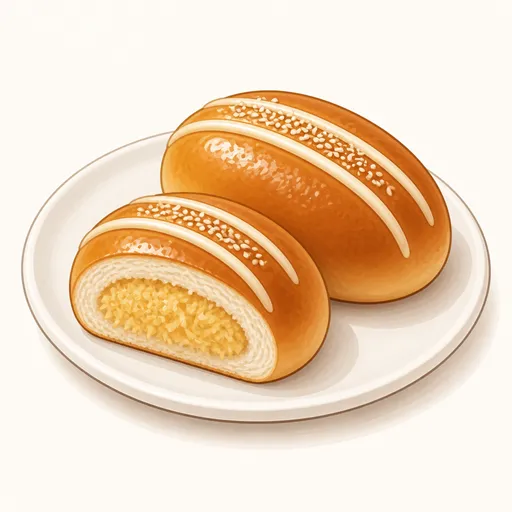
Coconut cocktail buns, a Hong Kong bakery classic, are oblong milk bread rolls wrapped around a sweet, buttery coconut filling. The tops are decorated with two parallel white stripes and a sprinkling of toasted sesame seeds. While the buns are still warm, the coconut filling turns slightly gooey and melds with the soft, fluffy crumb for an unforgettable flavor.
- Difficulty
- Medium
- Prep
- 50 min
- Cook
- 18 min
- Rising or chilling
- 1 hr 50 min
- Total time
- 2 hr 58 min
- Method
- Oven-baked
Ingredients
Bread dough
Coconut filling
Decorative piping paste
Egg wash and sesame seeds
Instructions
Step 1
Mix 300 g bread flour, 45 g granulated sugar, 10 g milk powder, 5 g instant yeast and 3 g salt, pour in 40 g eggs and 150 g whole milk and knead for about eight minutes, then add 35 g softened unsalted butter and knead for seven minutes more. Adding the butter later lets the gluten develop fully so the crumb pulls apart in soft strands. The dough is ready when it is silky smooth, not sticky and stretches into a thin, translucent windowpane.
Step 2
Shape the dough into a ball, place it in an oiled bowl, cover tightly and let it rise somewhere warm for about an hour. This time lets the yeast produce gas and the dough develop flavor. The dough is ready when it has doubled and a floured fingertip pressed into it leaves a hole that does not close.
Step 3
Beat 60 g softened unsalted butter with 50 g granulated sugar until fluffy and pale, add 25 g eggs, then mix in 70 g desiccated coconut, 15 g milk powder and 15 g all-purpose flour. A little flour and egg bind the filling so it does not ooze out of the buns during baking. The filling is ready when it forms a moist mass you can squeeze together in your hand, divided into eight equal portions.
Step 4
Divide the dough into eight pieces, roll each into an oval about fifteen centimeters long, spread a portion of filling down the middle, then roll it up from the long side, pinch the seam tight and place it seam side down on the baking sheet. Rolling tightly keeps the filling inside the bun so it does not squeeze out the ends. You are done when you have eight evenly tapered rolls with both ends sealed.
Step 5
Cover loosely with plastic wrap and let the buns rise for about 45 minutes more, turning the oven on to 180 degrees Celsius when fifteen minutes remain. The buns need to rise enough to keep their oblong shape after you pipe the stripes. The buns are ready when they have grown to almost one and a half times their size and feel as soft as a pillow.
Step 6
Mix 15 g softened unsalted butter with 10 g powdered sugar, then stir in 25 g all-purpose flour and 8 g whole milk until smooth, and spoon it into a piping bag with a small opening. The paste has to be thick enough to keep crisp lines during baking. The paste is ready when it is smooth, as pliable as toothpaste and does not run off a lifted spoon.
Step 7
Lightly brush 25 g beaten eggs over the buns, pipe two parallel decorative stripes along the length of each bun, then sprinkle 5 g white sesame seeds between the two stripes. The egg wash gives the buns a shiny golden top and holds the sesame seeds in place. You are done when each bun has two straight white stripes with an even band of sesame seeds in between.
Step 8
Bake on the middle rack at 180 degrees Celsius for about 15 to 18 minutes, rotating the baking sheet halfway through if your oven heats unevenly. This temperature bakes the buns soft without scorching the coconut filling. The buns are done when the tops are a shiny golden brown, the stripes are ivory and the bottoms are evenly golden.
Step 9
Leave the buns on the baking sheet for about five minutes, then move them to a rack to cool a little. The coconut filling is very hot straight out of the oven, and a short rest lets it thicken and makes the buns easier to hold. The buns are best while still warm, with a soft crust and a filling fragrant with butter and coconut.
Equipment
- Oven
- Stand mixer
- Kitchen scale
- Mixing bowl
- Rolling pin
- Piping bag
- Baking sheet
- Parchment paper
- Pastry brush
- Plastic wrap
- Wire cooling rack
Tips
- You can use freshly grated coconut toasted dry instead of desiccated coconut, but toast it until the shreds are completely dry so the filling is not wet.
- If you do not have a piping bag with a small tip, just snip a hole about three millimeters wide in the corner of a plastic bag.
- A few drops of vanilla extract in the coconut filling will round out the flavor of the buns.
Storage
The buns stay soft in an airtight container at room temperature for about two days. You can freeze them for up to three weeks, then reheat in a 160 degree Celsius oven for about seven minutes to bring back the aroma of the coconut filling.
Common problems and how to fix them
- The coconut filling oozes out during baking.
- The seams were not pinched tightly enough or the filling had too much butter. Pinch the seams closed, place them face down on the baking sheet and chill the filling briefly before rolling.
- The decorative stripes spread and lose their shape.
- The piping paste was too thin. Add a little more all-purpose flour to thicken it until it holds a round line when piped.
This recipe is based on the common ratios for this bake and is written entirely in our own words.