Charlotte russe
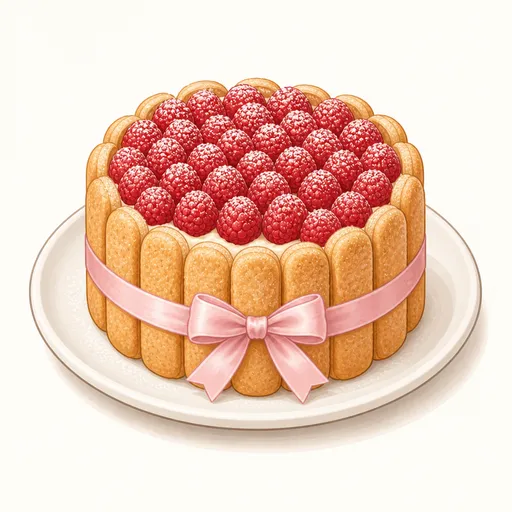
Charlotte russe is a classic French dessert: a ring of upright ladyfingers wrapped around a silky, vanilla-scented Bavarian cream (an egg custard lightened with whipped cream and set with gelatin). Once unmolded, it looks like a gift box tied with a ribbon, topped with a crown of bright red fresh raspberries.
- Difficulty
- Hard
- Prep
- 1 hr
- Cook
- 15 min
- Rising or chilling
- 6 hr
- Total time
- 7 hr 15 min
- Method
- Chilled
Ingredients
For the ladyfinger shell
For the soaking syrup
For the Bavarian cream
For decorating
Instructions
Step 1
Heat 80 g water with 40 g granulated sugar over medium heat until it boils and the sugar dissolves completely, then turn off the heat and add 15 g brandy, if using. The syrup keeps the ladyfingers soft and moist and helps them bond with the cream. The syrup is ready when it's completely clear; let it cool fully before using.
Step 2
Line the bottom of an 18 cm springform pan with parchment paper, trim one end of 200 g ladyfingers flat and stand them snugly side by side around the sides of the pan, sugared side facing out, then use the rest to cover the bottom and brush the inner sides with syrup. Packing them tightly keeps the cream from leaking out and lets the ring stand firm when unmolded. You've done it right when the ring is seamless, with no gaps, and the ladyfingers are moist but not soggy.
Step 3
Sprinkle 10 g powdered gelatin over 50 g cold water and let it bloom for five minutes. Hydrating it first helps the gelatin melt smoothly into the hot custard. The gelatin is ready when it has swelled into a clear, jelly-like mass with no dry powder left.
Step 4
Warm 300 g whole milk with 6 g vanilla extract until steaming; meanwhile, whisk 72 g egg yolks with 90 g granulated sugar, then slowly pour the hot milk into the eggs, return everything to the pot and stir constantly over low heat until it reaches about 82°C. Cooking it slowly over low heat thickens the yolks without letting them scramble. The custard is ready when it coats the back of a spoon in a thin layer and a finger drawn through it leaves a clean line.
Step 5
Turn off the heat, stir in the gelatin until dissolved, strain the custard through a sieve into a bowl and set the bowl in an ice bath, stirring now and then for about twenty minutes. The custard must be cool and starting to thicken before you fold in the whipped cream, or it will melt the cream. It's ready when it feels cool to the touch, is as thick as drinkable yogurt and starts clinging thickly to the sides of the bowl.
Step 6
Whip 300 g cold whipping cream on medium speed for about three minutes. The cream only needs soft peaks, since it will firm up further once it meets the gelatin. It's ready when it forms soft, drooping peaks and looks smooth, not grainy.
Step 7
Stir a little of the whipped cream into the custard to loosen it, then add the rest and gently fold it in with a spatula. Bavarian cream should be smooth and airy, and folding preserves the air bubbles from the whipped cream. The mixture is ready when it's an even ivory color, silky and free of white streaks.
Step 8
Pour the Bavarian cream into the lined pan, shake it gently so the cream flows into every corner and smooth the top level with the top of the ladyfinger ring. Cream that fills every gap makes the ladyfingers stick firmly to the filling. You've done it right when the surface is flat and the ladyfinger ring isn't pushed outward.
Step 9
Cover with plastic wrap and refrigerate the pan for at least six hours or overnight. The gelatin needs time to set the cream firmly while the ladyfingers soften evenly. It's ready when the cream springs back when pressed lightly and doesn't stick to your finger.
Step 10
Unlock the springform and lift off the ring, cover the top with 150 g fresh raspberries, dust with to taste powdered sugar and tie a ribbon around the cake. The ribbon isn't just for looks; it also helps the ladyfinger ring hold its shape when you slice it. It's finished when it stands straight, the ring is neat and even and the top is a vivid raspberry red.
Equipment
- Springform pan
- Small saucepan
- Whisk
- Hand mixer
- Spatula
- Sieve
- Thermometer
- Pastry brush
- Kitchen twine
- Kitchen scale
- Mixing bowl
- Refrigerator
Tips
- Dry, crisp ladyfingers hold their shape better than soft ones; brush syrup only on the inside so the outside stays dry and neat.
- You can swap the raspberries for strawberries, or blend some fruit puree into the Bavarian cream for a different flavor.
- Use a thermometer to watch the custard temperature and don't let it go above 85°C, or the yolks will curdle.
Storage
Covered tightly, the cake keeps for two days in the fridge, after which the ladyfingers turn mushy. Don't freeze it, as the Bavarian cream will weep when thawed.
Common problems and how to fix them
- The custard is lumpy like scrambled eggs.
- The heat was too high or it wasn't stirred constantly. Strain it through a sieve right away, and next time cook it over low heat and take the pot off the stove as soon as the custard thickens.
- The ladyfinger ring falls outward when unmolded.
- The ladyfingers were soaked with too much syrup or the cream hadn't set enough. Brush on just a thin layer of syrup and chill the cake overnight before unmolding.
This recipe is based on the common ratios for this bake and is written entirely in our own words.