Bika ambon
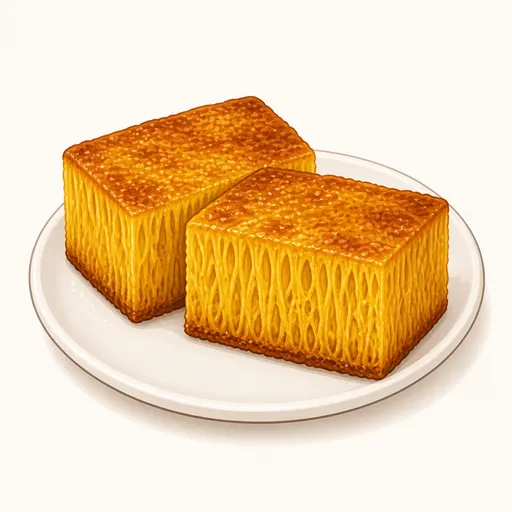
Bika ambon is a specialty of Medan, Indonesia, famous for its glowing golden crumb packed with long vertical air channels like a honeycomb. Made from tapioca starch, egg yolks and yeasted coconut milk, it's chewy, soft and rich, with the gentle tang that comes from fermentation.
- Difficulty
- Hard
- Prep
- 30 min
- Cook
- 50 min
- Rising or chilling
- 3 hr
- Total time
- 4 hr 20 min
- Method
- Oven-baked
Ingredients
Yeast starter
Pandan-infused coconut milk
Batter
Greasing the pan
Instructions
Step 1
Heat 400 g coconut milk with 15 g knotted pandan leaves over low heat, stirring, until it starts to steam, then turn off the heat and let it cool to about 40°C. The pandan perfumes the coconut milk, and letting it cool keeps it from killing the yeast. The coconut milk is ready when it feels warm to the touch, has turned a pale greenish ivory and smells of pandan.
Step 2
Stir 7 g instant yeast, 10 g granulated sugar and 20 g all-purpose flour into 60 g warm water, cover and leave for about fifteen minutes. This step tells you the yeast is alive before it goes into the whole batch. The starter is good when it's thick with bubbles, has doubled in size and smells pleasantly sour.
Step 3
Whisk 160 g egg yolks, 100 g eggs, 220 g granulated sugar and a pinch salt together until the sugar has nearly dissolved. You only need to blend them, not whip them, because the yeast will provide the air in the cake. The mixture is ready when it turns pale yellow and no longer feels gritty under the whisk.
Step 4
Add 200 g tapioca starch to the egg mixture and stir until dissolved, pour in the starter, then gradually add the coconut milk, strained of its leaves, stirring steadily. Adding the liquid slowly keeps the tapioca starch from forming stubborn lumps. The batter is ready when it's thin and smooth, with no white streaks of starch at the bottom of the bowl.
Step 5
Cover the bowl tightly with plastic wrap and leave it somewhere warm for about two and a half hours. A long rise lets the yeast produce plenty of gas, and those very bubbles become the honeycomb strands as the cake bakes. The batter is ready when the surface is covered in a thick layer of foam and smells lightly of rice wine.
Step 6
Brush to taste vegetable oil over a 22 cm square pan, put the pan in the oven and preheat both to 170°C, using only the bottom element if your oven allows. A hot pan sets the base of the cake right away, and the heat pushes the bubbles straight up to form the vertical strands. The pan is ready when a drop of water sizzles gently on it.
Step 7
Stir the batter gently to pop the largest bubbles, pour it into the hot pan and bake for about 45 to 55 minutes, switching on the top element for the last ten minutes if you want a golden top. Long heat from below helps the hollow channels form evenly from the base to the top. The cake is done when the top is mottled golden brown, a toothpick comes out free of batter and the edges pull slightly away from the pan.
Step 8
Let the cake cool in the pan for about an hour, then turn it out and slice it lengthwise into rectangles with a sharp knife. The cake only firms up once it's completely cool, and cutting it hot will crush the honeycomb strands. It's just right when the cut face shows clear hollow strands running from bottom to top.
Equipment
- Oven
- Square pan
- Small saucepan
- Whisk
- Sieve
- Mixing bowl
- Kitchen scale
- Plastic wrap
- Thermometer
Tips
- Use a thermometer to check the coconut milk; above 45°C the yeast weakens and the cake won't develop its honeycomb.
- A heavy metal or cast-iron pan conducts heat from the bottom better, giving longer, more defined honeycomb strands.
- If your kitchen is cold, let the batter rise in a switched-off oven with a bowl of boiling water beside it to keep it warm.
Storage
The cake keeps at room temperature in an airtight container for two days and stays soft and chewy. You can also refrigerate it for up to five days and steam it for a few minutes or warm it in the microwave before eating.
Common problems and how to fix them
- The crumb is dense with no honeycomb strands.
- The yeast wasn't active enough or the batter didn't rise long enough. Check that the starter bubbles up, and let the batter rise until the surface is covered in thick foam.
- The top burned while the inside was still wet.
- The top heat was too strong from the start. Use only bottom heat for most of the bake and switch on the top element just for the last ten minutes.
This recipe is based on the common ratios for this bake and is written entirely in our own words.