Bibingka
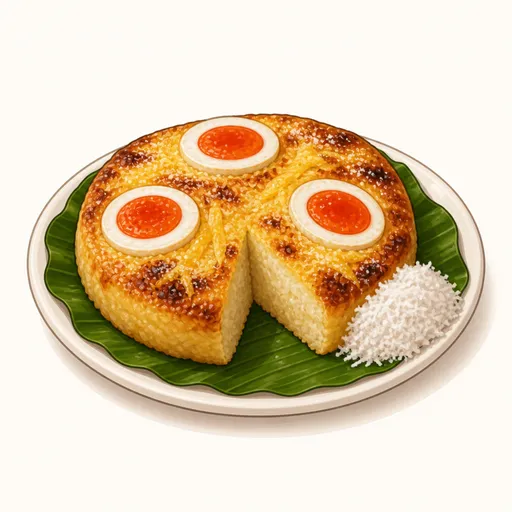
Bibingka is a traditional Filipino baked rice cake, enjoyed most of all at Christmastime after the early-morning church services. It bakes in pans lined with banana leaves, so it picks up a gentle smoky aroma, with a soft, fluffy crumb rich with coconut milk and a topping of salted egg, cheese, butter and sugar for a wonderfully unexpected sweet-and-salty bite.
- Difficulty
- Easy
- Prep
- 25 min
- Cook
- 28 min
- Total time
- 53 min
- Method
- Oven-baked
Ingredients
Batter
Topping
Banana leaf lining
Instructions
Step 1
Wash 100 g banana leaves, pass them quickly over a low flame to soften, then cut them into circles a little larger than your 13 cm tart pans and line six pans with them, brushing the leaves with a thin layer of butter. Warmed leaves turn pliable, won't tear and release their fragrance into the cakes. The leaves are ready when they turn a glossy bright green, feel soft and sit snugly against the bottom of the pans.
Step 2
Preheat the oven to 190°C and set a rack in the middle. A steady temperature from the very start helps the cakes rise evenly and keeps the crumb from turning tough. The oven is ready when the heating light first switches off.
Step 3
Whisk 150 g eggs with 150 g granulated sugar until slightly foamy, then add 300 g coconut milk, 120 g whole milk and 60 g melted unsalted butter. Beating the eggs with the sugar first makes the cakes lighter and fluffier. The mixture is ready when it's an even pale yellow and the sugar has dissolved.
Step 4
Sift 200 g rice flour together with 10 g baking powder and a pinch salt into the bowl of wet ingredients, then stir gently with a whisk. Sifting spreads the baking powder evenly and prevents lumps. The batter is ready when it's smooth, like thinned-out condensed milk, with no dry specks of flour left.
Step 5
Divide the batter evenly among the six lined pans, filling each about three-quarters full, then set the pans on a baking sheet. Leaving some room lets the cakes rise without spilling over the leaves. You're done when every pan holds the same amount of batter and the surfaces are level.
Step 6
Bake at 190°C for about 15 to 18 minutes, until the tops have just set. The tops need to firm up first so the topping doesn't sink to the bottom. The cakes are ready when the tops are slightly puffed, lightly golden and spring back when pressed gently.
Step 7
Take the baking sheet out, lay thin slices of 45 g salted egg yolks on each cake and scatter 60 g grated cheddar over the top, adding 60 g freshly grated coconut if you like. The salty topping balances the rich, sweet crumb. The tops are ready when they're evenly covered but some of the golden cake still peeks through.
Step 8
Raise the oven to 220°C or switch on the broiler, then return the cakes to the oven for about 5 to 8 more minutes. Heat from above melts the cheese and gives the tops fragrant charred spots, just like the traditional charcoal-baked version. The cakes are done when the cheese is bubbling, the tops are deep golden and a skewer inserted in the center comes out dry.
Step 9
As soon as the cakes come out of the oven, brush the tops with 20 g soft unsalted butter and sprinkle with 20 g granulated sugar, then let them rest for five minutes before lifting them out of the pans. The hot butter melts into the sugar for the glossy, sweet top that bibingka is known for. The cakes are ready when the tops shine with butter, the sugar is half melted and the banana leaves peel away easily.
Equipment
- Oven
- Tart pan
- Whisk
- Kitchen scale
- Mixing bowl
- Pastry brush
- Sieve
Tips
- In the Philippines, bibingka is served with freshly grated coconut sprinkled over it while still hot, and you can do the same.
- If you don't have banana leaves, line the pans with parchment paper instead; the cakes will still be delicious, just without that signature aroma.
- You can bake the whole batch in a single 23 cm round pan; just extend the first bake to about 25 minutes.
Storage
Bibingka is best eaten warm. Cover any leftovers and keep them in the fridge for up to three days, then reheat in a 170°C oven for about eight minutes so the cheese melts again.
Common problems and how to fix them
- The topping sank right into the cake.
- The topping went on while the surface was still runny. Bake the first round a few minutes longer, until the tops have set, before adding the topping.
- The crumb is tough and dry.
- The cakes baked too long or the batter was short on liquid. Weigh the coconut milk carefully and take the cakes out as soon as a skewer comes out just dry.
This recipe is based on the common ratios for this bake and is written entirely in our own words.