Battenberg cake
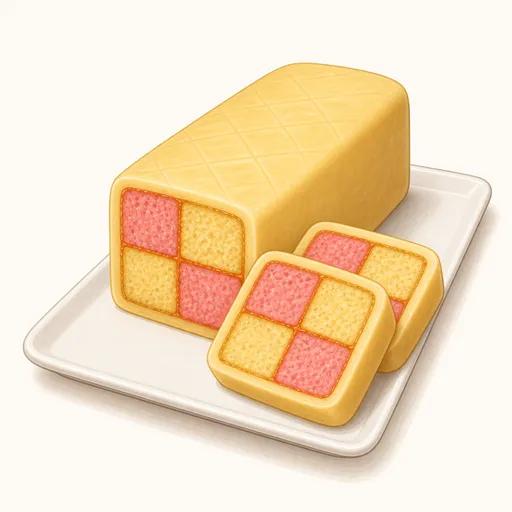
Battenberg is a British teatime cake with a four-square checkerboard of alternating pink and yellow, its sponge strips glued together with apricot jam and wrapped in a soft, pliable layer of marzipan (almond paste kneaded with sugar). The butter sponge includes almond flour, so it is moist and fragrant. It looks elaborate, but all you need is a square pan divided in two and a little patience.
- Difficulty
- Hard
- Prep
- 1 hr
- Cook
- 30 min
- Rising or chilling
- 1 hr
- Total time
- 2 hr 30 min
- Method
- Oven-baked
Ingredients
Almond butter sponge
Homemade marzipan
Assembly
Instructions
Step 1
Heat the oven to 175°C, line a 20 cm square pan with parchment paper, then fold a strip of foil into an upright divider down the middle to split the pan into two equal halves. The divider lets you bake both colors at once without them bleeding into each other. The pan is ready when the divider stands straight and both halves are the same width.
Step 2
Mix 180 g almond flour with 150 g powdered sugar, add 40 g corn syrup and 2 g almond extract, then squeeze and knead it by hand into a ball and wrap it tightly. Corn syrup keeps the marzipan pliable and is safer than raw egg white, since this part is never baked. The marzipan is ready when it is smooth, as pliable as modeling clay and not sticky.
Step 3
Beat 175 g softened unsalted butter with 175 g superfine sugar on medium speed for about four minutes. Beating the butter and sugar for a long time traps plenty of air, giving a fine, evenly risen sponge. The mixture is ready when it is pale, almost ivory, and fluffy.
Step 4
Beat 150 g eggs with 2 g almond extract, then add them to the butter in four additions, beating well after each. Adding the eggs gradually lets the butter absorb all the liquid without curdling. The mixture is ready when it is smooth and glossy with no liquid seeping around the sides of the bowl.
Step 5
Mix 125 g all-purpose flour, 50 g almond flour, 5 g baking powder and a pinch salt, sift it into the bowl and fold it in along with 30 g whole milk. The milk loosens the batter slightly so it spreads flat into each half of the pan. The batter is ready when it drops from the spoon in soft dollops with no dry flour left.
Step 6
Weigh the batter and divide it into two equal portions, then add to taste red food coloring to one portion drop by drop, stirring until you get the pink you like. The two portions must weigh the same so the four strips are even and the checkerboard is balanced. You have it right when one bowl is an even pink and the other keeps its natural pale yellow.
Step 7
Pour each color into one half of the pan, smooth the tops and bake at 175°C for about 25 to 30 minutes. The thin layer of batter in a wide pan cooks quickly and rises flat. The cake is done when the top springs back when lightly pressed, the edges just pull away from the paper and a toothpick inserted comes out clean.
Step 8
Let the cake rest in the pan for five minutes, then lift it out with the parchment onto a rack and let it cool completely for about an hour. A warm cake will crumble when you cut it into small strips. It is ready when completely cool and it feels firm in your hands.
Step 9
Trim off the domed top and the dry edges of each cake, then cut each color into two long strips with an equal square cross-section. The strips must be square, as tall as they are wide, to form a neat checkerboard when assembled. You have cut them right when you have four strips of equal length, two pink and two yellow.
Step 10
Warm 120 g fruit jam (apricot is traditional) until runny, brush it on the faces that touch, then stack the four strips into a two-layer block with the colors placed diagonally. Warm jam soaks into the sponge and acts as glue to keep the strips from sliding. The block is ready when it stands firm, the joins are snug and a clear four-square checkerboard shows at the ends.
Step 11
Dust the counter with a little powdered sugar (to taste) and roll the marzipan into a rectangle about three millimeters thick, wide enough to wrap around all four sides of the cake and as long as the block. Powdered sugar keeps the marzipan from sticking while keeping its color light. The marzipan is ready when it is evenly thick, has no tears and can be lifted without breaking.
Step 12
Brush jam over the four outer sides of the block, set the cake on one edge of the marzipan and roll it so the marzipan wraps it completely, press the seam closed underneath and trim the excess from both ends. A snug wrap keeps the cake square and stops it from drying out. The cake is finished when the marzipan lies smooth, the seam sits neatly underneath and both cut ends show a crisp checkerboard.
Equipment
- Oven
- Square pan
- Hand mixer
- Spatula
- Kitchen scale
- Mixing bowl
- Parchment paper
- Wire cooling rack
- Small saucepan
- Rolling pin
- Pastry brush
Tips
- You can use the back of a knife to score a crosshatch pattern on the marzipan and gently pinch the two top edges for the traditional look.
- To save time, you can use store-bought marzipan in the same weight as the total of the homemade marzipan group.
- Gel food coloring gives a bright pink without thinning the batter.
Storage
Wrapped snugly in marzipan, the cake stays moist very well; wrap it again in plastic wrap and keep it at room temperature for up to five days. Do not refrigerate it, because the marzipan will sweat and the sponge will dry out and harden.
Common problems and how to fix them
- The strips are uneven and the checkerboard is lopsided.
- The two portions of batter were not equal or the strips were not cut square. Weigh the batter carefully when dividing it and use a ruler when cutting each strip.
- The marzipan cracks when wrapped around the cake.
- The marzipan is too dry or has gone cold and stiff. Knead in a few drops of corn syrup and warm it in your hands before rolling it out again.
This recipe is based on the common ratios for this bake and is written entirely in our own words.