Soft steamed rice sheets (banh uot)
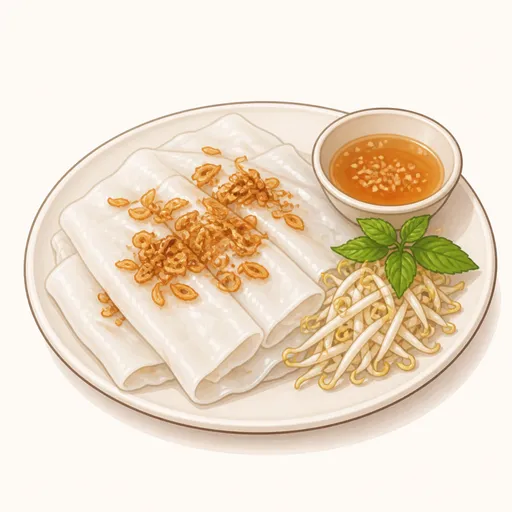
Banh uot are thin, silky, gently chewy rice sheets, traditionally steamed on a cloth stretched over the mouth of a pot of boiling water. Unlike steamed rice rolls, they usually have no filling and are simply topped with golden fried shallots, then served with blanched bean sprouts, fresh herbs, Vietnamese pork roll and a bowl of sweet and sour fish sauce.
- Difficulty
- Medium
- Prep
- 30 min
- Cook
- 45 min
- Rising or chilling
- 1 hr
- Total time
- 2 hr 15 min
- Method
- Steamed
Ingredients
Rice batter
Fried shallots
Fish sauce dip
Vegetables on the side
Instructions
Step 1
Mix 250 g rice flour and 30 g tapioca starch with a pinch salt, slowly stir in 650 g water until smooth, add 10 g vegetable oil, strain through a sieve and let the batter rest for about an hour. A long enough rest lets the flour swell evenly, so the sheets come out smooth and do not tear. The batter is ready when it is slightly thinner than milk and feels perfectly smooth between two fingers.
Step 2
Thinly and evenly slice 80 g shallots, put them in a pan with vegetable oil (to taste) while the oil is still cold and fry over medium heat for about eight minutes, stirring until golden, then lift them out and keep the shallot oil. Starting in cold oil cooks the shallots gently so they crisp evenly without turning burnt and bitter. The shallots are ready when they are straw-gold and turn shatteringly crisp as they cool.
Step 3
Dissolve 40 g granulated sugar in 130 g warm water, then add 45 g fish sauce, 15 g lime juice and 8 g minced garlic. Dissolving the sugar in water first makes it melt completely, giving a clear, balanced sauce. The sauce is ready when the salty, sweet and sour flavors are in harmony and the garlic floats on top.
Step 4
Stretch a clean, thin cloth over the mouth of a pot and tie it very tightly around the rim with string, cut a small hole near the edge for topping up water, bring the water underneath to a rolling boil and have a tall domed lid ready. A flat, taut cloth is what gives sheets of even thickness. The pot is ready when steam rises evenly across the whole cloth and it feels hot to the touch.
Step 5
Lightly brush oil over the cloth, stir the batter and pour on a small ladleful, using the bottom of the ladle to swirl it into a thin layer, then cover with the domed lid for about a minute. The thin layer cooks quickly in the strong steam and keeps its signature silky softness. The sheet is done when it turns from opaque white to translucent and puffs up with a few small bubbles.
Step 6
Slide a flat bamboo stick under the edge of the sheet, lift it gently onto a tray brushed with shallot oil, brush a little more shallot oil on top, then fold it into quarters or roll it up. The shallot oil both prevents sticking and gives each sheet its aroma. The sheets are ready when they stay intact after folding, with no tears and a smooth, glossy surface.
Step 7
Arrange the sheets on a plate, scatter the fried shallots over them, add 150 g lightly blanched bean sprouts and 60 g mixed fresh herbs on the side, and drizzle with the fish sauce dip as you eat. The vegetables and sprouts keep the dish fresh and balance the richness of the shallot oil. The plate is ready when the sheets are still warm, the fried shallots are crisp and the vegetables are fresh and green.
Equipment
- Small saucepan
- Kitchen twine
- Mixing bowl
- Whisk
- Pastry brush
- Nonstick skillet
- Sieve
- Kitchen scale
Tips
- If you do not have a cloth-covered pot, you can make the sheets in a nonstick pan with a lid over medium heat; each sheet takes only about a minute.
- Banh uot is best with sliced Vietnamese pork roll or fermented pork, so add whichever you like.
- A little tapioca starch makes the sheets chewier, but do not add too much or they will turn gummy and stick to your teeth.
Storage
Banh uot is best on the day it is made and keeps covered at room temperature for a few hours. If refrigerated, the sheets will harden, so steam them for about two minutes to soften; the fried shallots stay crisp in an airtight jar for about a week.
Common problems and how to fix them
- The sheets tear when you lift them.
- They were not cooked long enough or the batter is too thin. Steam a few seconds longer until the sheets turn fully translucent, and add a little rice flour to the remaining batter.
- The sheets are thick and stiff.
- Too much batter was poured each time or the cloth was slack. Retie the cloth so it is very taut and ladle only enough batter to cover it in a thin layer.
This recipe is based on the common ratios for this bake and is written entirely in our own words.