Alkaline sticky rice dumplings (banh u tro)
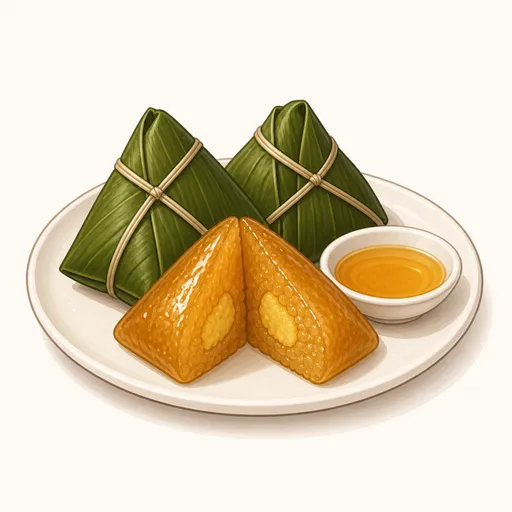
Banh u tro is the must-have treat for the Duanwu Festival on the fifth day of the fifth lunar month. The glutinous rice is soaked in alkaline water, so once boiled the grains turn as clear as amber, dense, chewy and refreshing. The dumplings are wrapped into small pyramids in bamboo leaves, often dipped in molasses or sugar, with a little sweet, nutty mung bean filling in the middle.
- Difficulty
- Hard
- Prep
- 1 hr
- Cook
- 3 hr
- Rising or chilling
- 12 hr
- Total time
- 16 hr
- Method
- Boiled or simmered
Ingredients
Glutinous rice soaked in alkaline water
Mung bean filling
Wrapping leaves
Instructions
Step 1
Rinse 500 g glutinous rice, drain it, then soak it in 600 g diluted alkaline water for about twelve hours or overnight. The alkali in the water changes the color of the rice and creates its signature clear, chewy texture. The rice is ready when the grains have turned an even pale yellow and feel softer when lightly squeezed.
Step 2
Soak 150 g split peeled mung beans in clean water for about three hours. Well-soaked beans cook into a smooth filling with no gritty bits in the dumplings. The beans are ready when they have swelled and softened and crumble into powder with a light squeeze.
Step 3
Steam the beans for about 25 minutes, mash them smooth while hot, then mix in 50 g granulated sugar and a pinch salt and roll into small balls about the size of your thumb tip. Small balls of filling add nuttiness without overpowering the alkaline rice. The filling is ready when the balls are evenly round, firm and not sticky.
Step 4
Wash 150 g bamboo leaves, blanch them in a pot of rapidly boiling water for about five minutes, then wipe each leaf dry. Blanching softens the leaves, makes them easier to fold and cleans them. The leaves are ready when they turn deep green and fold in half without cracking along the veins.
Step 5
Tip the rice into a colander, rinse it once with clean water and let it drain for about thirty minutes. Well-drained rice does not slip around when you wrap it, so the dumplings are firmer. The rice is ready when a handful feels loose and no water drips from it.
Step 6
Roll a leaf into a cone, add a layer of rice, set a ball of filling in the center, cover with more rice, then fold the leaf closed into a four-sided pyramid and tie it tightly with string. Wrap just firmly enough to leave room for the rice to swell while keeping water out. The dumplings are ready when the corners are sharp, they feel firm when gently squeezed and no rice grains escape.
Step 7
Arrange the dumplings in a pot, add water to cover them completely and boil over medium heat for about three hours, topping up with boiling water now and then so they stay submerged. A long boil cooks the alkaline rice until very soft and fuses it into a translucent block. They are done when an unwrapped test dumpling shows clear, amber rice with no cloudy white grains left.
Step 8
Lift out the dumplings, rinse them in cold water, then hang them up to drain and cool completely. Cold water firms the outside and helps the dumplings keep longer. They are ready when the leaves are dry and the unwrapped dumplings are smooth, chewy and do not stick to the leaves.
Equipment
- Small saucepan
- Steamer
- Mixing bowl
- Kitchen scale
- Kitchen twine
- Sieve
Tips
- Store-bought alkaline water is usually very strong, so dilute it according to the directions on the bottle; water that is too concentrated gives a harsh taste and dark color.
- If you do not have bamboo leaves, you can wrap the dumplings in dong leaves cut to size, and they will still smell lovely and leafy.
- Banh u tro is best dipped in sugarcane molasses or sprinkled with a little granulated sugar.
Storage
Thanks to the alkaline water, the dumplings keep for three to four days in a cool, airy place if hung so the leaves stay dry. You can also refrigerate them for about a week; they will firm up slightly but still taste refreshing and chewy.
Common problems and how to fix them
- The dumplings still have cloudy white grains inside.
- The rice did not soak in the alkaline water long enough or was not boiled long enough. Soak it overnight, boil for about thirty more minutes and check again.
- The dumplings are mushy and waterlogged.
- The leaves were not sealed or the string was too loose, so water got in. Overlap the leaf edges more and tie the string more firmly.
This recipe is based on the common ratios for this bake and is written entirely in our own words.